
REVIEW: (Everyone I Love Has) A Terrible Fate (Befall Them) is an acidic trip through love and loss
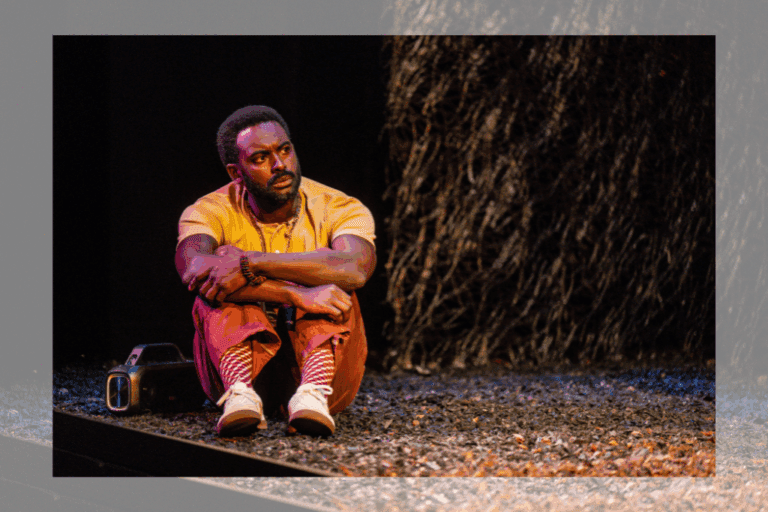
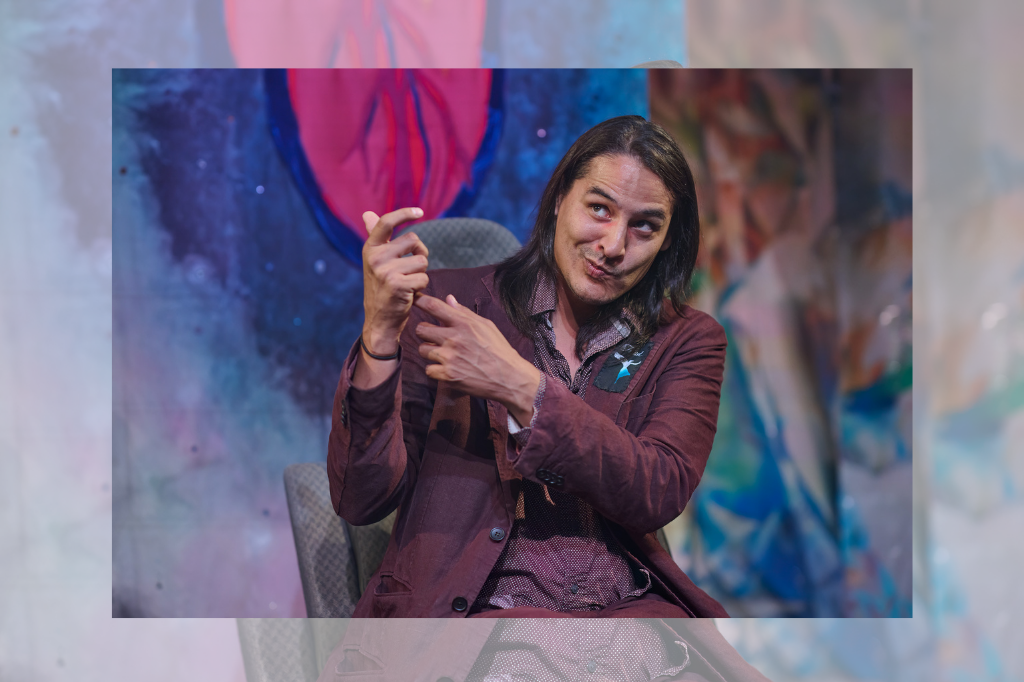 iPhoto caption: Photo by Michael Cooper.
Everyone Robert loves has a terrible fate befall them. No, literally. In Cliff Cardinal’s new one-man, 80-minute show at VideoCabaret (produced in association with Crow’s Theatre), Robert’s long list of potential lovers and friends meet a variety of horrific ends as soon as he declares his devotion. Horse-crushed windpipes, overdoses, career-ending amputations, and heart attacks are just some of the fates awaiting everyone Robert cares about. Easier, then, he decides, to care for nobody and nothing.
In (Everyone I Love Has) A Terrible Fate (Befall Them), Cardinal spins an absurdist tale of self-acceptance singed with cigarette butts, a cocaine-fueled fever dream with an acid wit that sometimes has a difficult time keeping up with its own relentless ideas.
Director and dramaturg Karin Randoja gives us a nifty triptych of a space for the rangy Cardinal to work his weird magic. JB Nelles’ set features three panels, half-tapestry and half-tattoo, bursting with life (or death); they feature the words “LOVE,” “CURSED,” and “FATE,” with designs of a heart held in a pair of hands, another pierced by a sword, and a body struck by lightning.
Each panel has a corresponding chair that conveys a different emotion; there’s a wooden chair to the left draped with a floral hand towel, the slightly askew pantry behind it making it feel like a dated but well-loved home where the contents could topple at any moment. A wicker chair to the right with a probably hand-knit blanket in a 1970s colour scheme draped over it could either be a comfort object or décor in a seedy drug den.
Robert spends most of his time on the middle seat, a reclining chair that’s either for a gamer or ripped out of the front seat of a car; it’s controllable to his whims, but gray, cold, personality-free. Lighting designer Raha Javanfar’s specific spotlighting makes the most out of the tapestries’ symbolism, causing them to glow and pulse with life at opportune moments.
The delight of Cardinal’s monologue lies in the offbeat, jagged imagery it creates. The world he creates is close to our own but as slightly askew as the shelves behind him; asteroids crash into the earth, a critically endangered white rhino leads a support group (wait for the glorious prop), and the universe abounds with the potential for dark magic. These touches of the fantastical make the show more interesting than it would be if it was just a character study of a man whose fear of connection leads to toxicity. They’re exciting, and I found myself wishing that Cardinal would lean into the unusual more strongly in the first half of the show, so that there’s more cohesive world-building when we as the audience are first making sense of the world the play inhabits.
(Everyone I Love Has) A Terrible Fate (Befall Them)’s unique spin on our universe is both its strength and hindrance; when it succeeds, it feels new and different, but when the quirks simply exist rather than serving a thematic purpose, it feels like the play is throwing a bunch of images at the wall to see what sticks.
Cardinal, similarly, throws himself into the character with aplomb, sneeringly daring us to take everything he says at face value, while talking as fast as possible. Robert hopes that we hate him enough to make it through the show with our lives intact. He offers no sympathy to others, deflecting it at every turn. To be fair, he also asks for no sympathy, either from the audience or from himself; it’s implied that if he ever dares to love himself he’ll disappear as quickly and brutally as everyone else.
As the run continues, Cardinal’s eager storytelling will likely settle down; for the moment, the performance is a bit rushed, causing a number of stumbles, stops, and starts as Cardinal sometimes trips over the twisting, elaborate language in his script. This may be partially due to a mismatch between Cardinal’s down-to-earth stage presence and the tone of the writing, which contains more writerly flourish than natural speech. It’s a conflict that fits in the characterization, as Robert’s desperation to connect with the audience wars with his arch attempt to keep us at bay, but one that’s too messy to work as a performance quirk. His deliberate address to the audience, laced with antagonism, works more effectively to keep us on our toes and at arm’s length.
When Robert slips up and makes a genuine audience connection, however, it zings and stings; for example, when he talks about his tumultuous relationship with his mother and his fear for her safety, later echoed in his tentative, worried interactions with the child of one of his girlfriends, and his eventual sudden, desperate desire to be a father.
“Maybe if I hate her enough,” he says of the woman who raised him, “she’ll live forever.”
(Everyone I Love Has) A Terrible Fate (Befall Them) runs at VideoCabaret (10 Busy St.) until November 12. Tickets are available here.
Intermission reviews are independent and unrelated to Intermission’s partnered content. Learn more about Intermission’s partnership model here.

Ilana Lucas
Ilana Lucas is a professor of English in Centennial College’s School of Advancement. She is the President of the Canadian Theatre Critics Association. She holds a BA in English and Theatre from Princeton University, an MFA in Dramaturgy and Script Development from Columbia University, and serves as Princeton’s Alumni Schools Committee Chair for Western Ontario. She has written for Brit+Co, Mooney on Theatre, and BroadwayWorld Toronto. Her most recent play, Let’s Talk, won the 2019 Toronto Fringe Festival’s 24-Hour Playwriting Contest. She has a deep and abiding love of musical theatre, and considers her year working for the estate of Tony winners Phyllis Newman and Adolph Green one of her most treasured memories.
LEARN MORE iPhoto caption: Members of the company of 'Narnia.' Photo by Dahlia Katz.
REVIEW: Bad Hats’ Narnia is a joyful, heartwarming escape
The spirit of openness and the joy of discovery rule over this Narnia. Open the wardrobe and see.
 iPhoto caption: Members of the company of 'Robin Hood.' Photo by Dahlia Katz.
REVIEW: Canadian Stage’s Robin Hood panto is anti-capitalist fun for the whole family
Following Ross Petty’s legacy of scene-stealing, Damien Atkins as the evil Prince John is easily the greatest delight of the show.
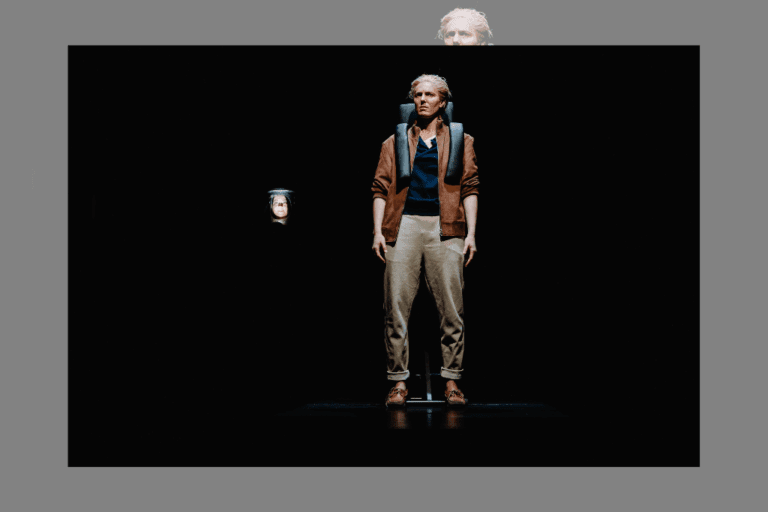 iPhoto caption: Lauren Gillis and Alaine Hutton in 'Public Consumption.' Photo by Eden Graham.
REVIEW: Lester Trips’ stylish Public Consumption captures the internet’s profound emptiness
Rather than directly representing online life, Public Consumption speculates — with virtuosity — about how the digital world affects our bodies. And the show's findings are by no means comfortable.
 iPhoto caption: Tony Ofori and Daren A. Herbert in 'Moonlight Schooner.' Photo by Dahlia Katz.
Kanika Ambrose’s Moonlight Schooner is animated and visually stunning, but its individual pieces don’t come together as neatly as I would've expected.
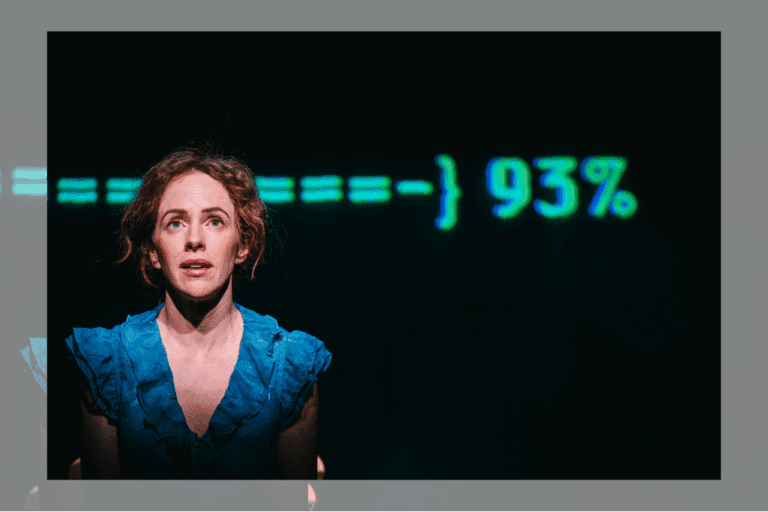 iPhoto caption: Fiona Mongillo in 'Reproduktion.' Photo by Ann Baggley.
REVIEW: Here For Now’s well-acted Reproduktion attempts to tackle too much
Amy Rutherford’s world premiere script is ambitious and the material it covers is complex — but the narrative feels disjointed.
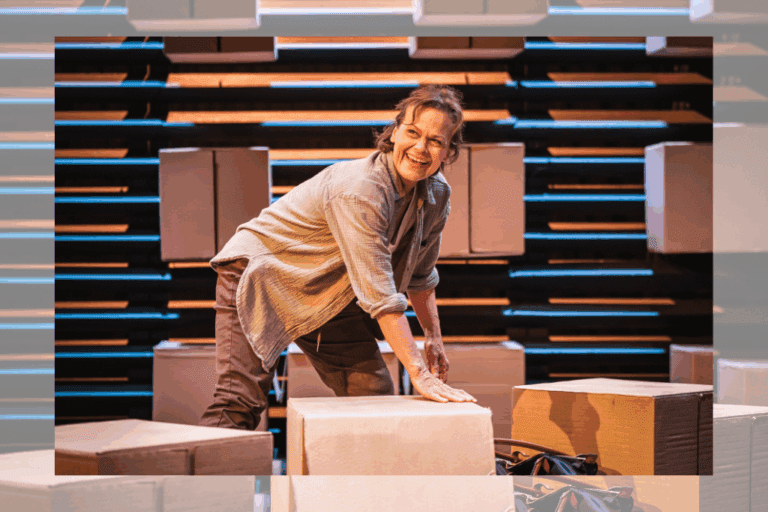 iPhoto caption: Kristen Thomson in 'Fulfillment Centre.' Photo by Elana Emer.
REVIEW: Coal Mine’s Fulfillment Centre asks how we end up alone, together
The production understands the play’s themes, yet feels limited by a script that delivers a package it never fully opens.
iPhoto caption: Members of the company of 'Narnia.' Photo by Dahlia Katz.
REVIEW: Bad Hats’ Narnia is a joyful, heartwarming escape
The spirit of openness and the joy of discovery rule over this Narnia. Open the wardrobe and see.
 iPhoto caption: Mazin Elsadig in 'The Comeuppance.' Photo by Dahlia Katz. Set design by Shannon Lea Doyle, costume design by Ming Wong, lighting design by Jason Hand.
Macabre and drama-filled yet surprisingly gentle, The Comeuppance will probably be most compelling to the around-40 crowd who share its specific touchstones and millennial angst from a high-school experience bookended by Columbine and 9/11.
 iPhoto caption: Kaylee Harwood with members of the 'Bright Star' ensemble. Photo by Dahlia Katz.
REVIEW: Garner Theatre Productions’ Bright Star coasts on charm and likability
Bright Star covers it all: thwarted love, coming of age, family drama, the power of art, the importance of remaining true to oneself. Yet co-writer Steve Martin’s wit, which blazes in plays like Picasso at the Lapin Agile, merely twinkles here.
 iPhoto caption: The company of 'Ride the Cyclone.' Photo by Taylor Long.
REVIEW: Shifting Ground Collective delivers heartfelt, overloaded Ride the Cyclone
Director 郝邦宇 Steven Hao hits the carnival bullseye when it comes to heart and fun, but just misses the top prize by expanding the cast and reducing the original’s compelling creepiness.
 iPhoto caption: Photo by Dahlia Katz.
REVIEW: Dave Malloy’s Octet vibrates with sublime vocal beauty at Crow’s Theatre
Malloy’s intricate a cappella compositions, rich with complex harmonies, are the hymns and confessionals in a show about a support group for internet addiction. Regardless of what form their ego-feeding or doomscrolling compulsions take, the characters know it’s actually about appeasing what they call “the monster” inside — that gaping maw of emptiness that begs for shiny treats in the absence of real connection.
 iPhoto caption: The company of 'The Welkin.' Photo by Dahlia Katz.
REVIEW: The Welkin careens from raucous comedy to crushing tragedy
The problem with human rights is that, if you believe in them, you have to apply them to everyone. Political opponents. Murderers. Your ex. People whose phones go off at the theatre. Women. The character of Sally puts this theory to a stress test; in bahia watson’s assured hands, she’s gleefully unlikeable, glorying in a storm of suspiciously modern swearing, lacking any flicker of conscience, and biting the hands that are trying to help her.
Comments