
Animal puppets lay bare the effects of climate catastrophe in Dimanche
 iPhoto caption: Photo by Virginie Meigné.
How can theatre engage with a crisis as enormous as climate change? One answer: go miniature.
That’s the approach Belgian theatre companies Chaliwaté and Focus take in their co-creation Dimanche, a wordless physical theatre piece that uses object theatre and puppetry — as well as mime, analogue special effects, and video work — to reflect on climate catastrophe. TO Live will present Dimanche at Meridian Arts Centre on February 21 and 22.
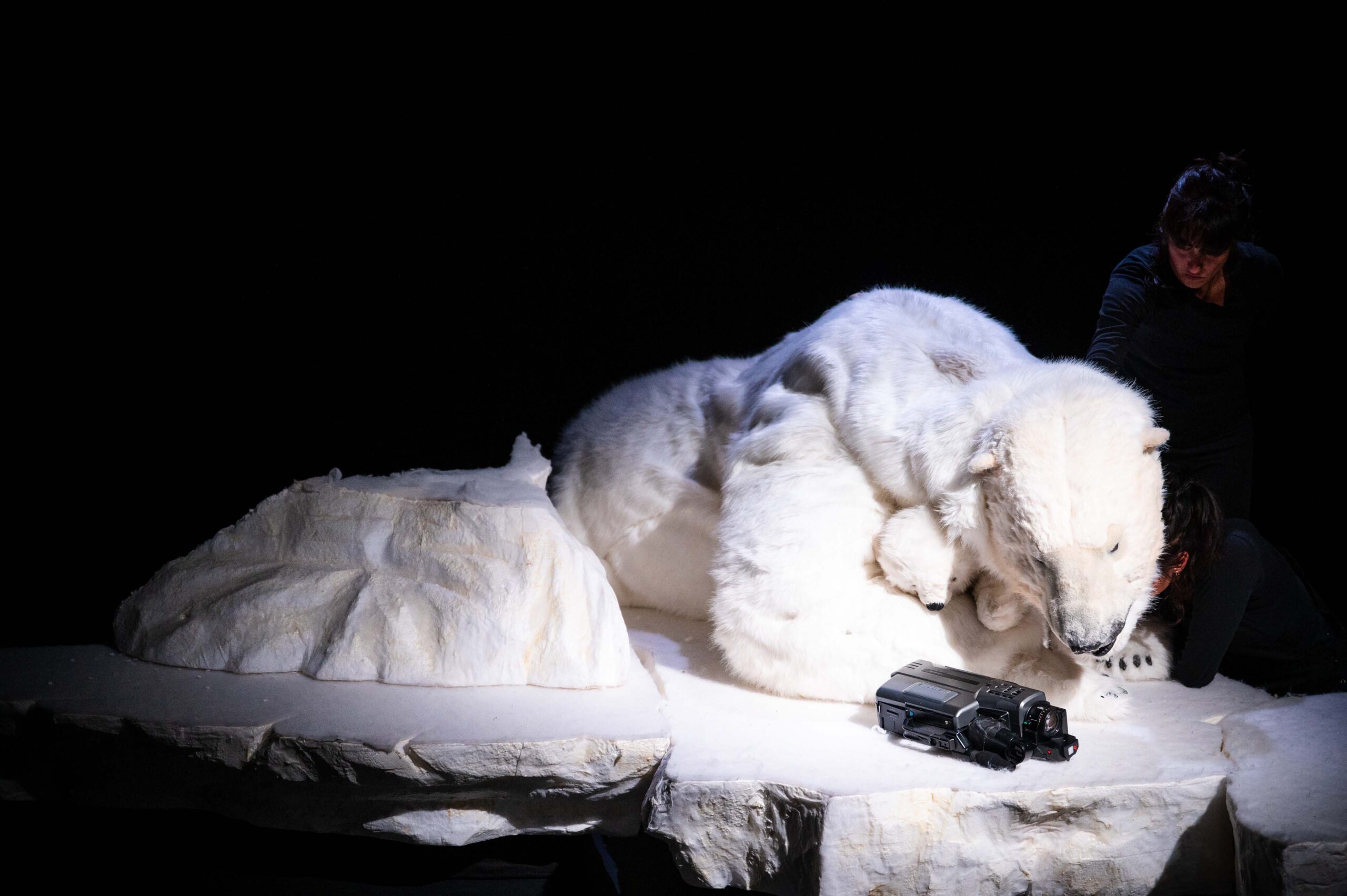
The puppets, which include detailed recreations of a polar bear and a flamingo, were created by a third company, the Belgium-based Waw! Studios. “A lot of people are quite moved by the impression of real animals,” said Sandrine Heyraud, one of the co-creators of Dimanche. Heyraud co-founded Chaliwaté with Sicaire Durieux in 2005; they collaborated with Focus’ director, Julie Tenret, to create Dimanche. All three artists also perform in the piece.
Heyraud credits Tenret with the idea of using realistic puppets. In the case of the polar bear, “The idea was to create this impression that it’s a real bear on stage,” she said. “That was a lot of work with Joachim Jannin [from] Waw! Studios. He’s a sculptor, and he really worked with us to find the perfect [weight for the bear], so that it wasn’t too heavy for us to be able to manipulate it. After, it was a lot of work in front of a mirror filming [ourselves], to be more realistic in [our] movements.”
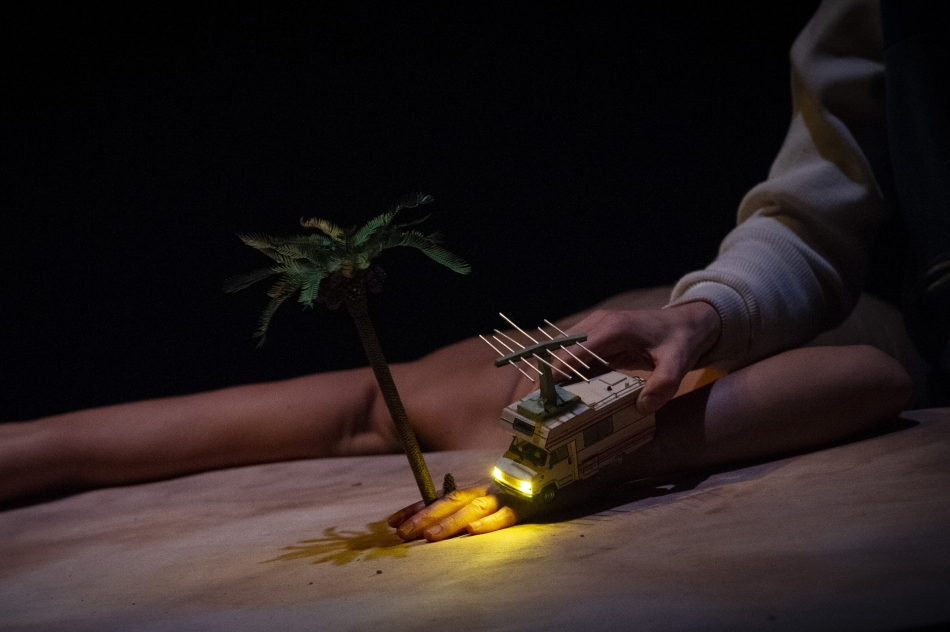
Besides puppet wildlife, Dimanche features detailed miniature landscapes and houses, plus a tiny Volkswagen. “We also use our bodies as the landscape,” said Heyraud. “It came quite naturally, using puppets and object theatre. Something that’s quite magic is that it’s shown our smallness facing nature, [and that] we are part of this nature we are harming. It’s brought another level to the subject [of climate change].”
Chaliwaté and Focus spent three years developing Dimanche. “We really blended our skills,” explained Heyraud. “Focus comes more from object theatre and puppetry. [Chaliwaté] came more from… this mix of theatre and dance.” For Heyraud, physical theatre offers a more satisfying theatrical language than conventional text-based drama. “The absence of words arouses visual creativity,” she said.
No words doesn’t mean no narrative. The creation process for Dimanche began “like a film, [with] a storyboard,” said Heyraud. “It was very precise.” The show features “two different stories that [run] parallel to each other.” In one, “three reporters… travel around the world to try to film animals that are disappearing.” The other storyline is “a more intimate view of a family trying to continue their everyday habits” despite extreme weather conditions.
When Focus and Chaliwaté began work on Dimanche in 2016, “people were not talking about climate change as much as they are now,” said Heyraud, “but it was already a subject that was scary. [Myself, Durieux, and Tenret] had children. And so [we were] looking at the future and wondering, ‘What is the world going to be?’ The starting point for Dimanche was the gap we noticed between the awareness of the need to act and our capacity to translate this consciousness into our daily lives.”
Despite the weighty subject matter, the creators have made a conscious effort to avoid being moralistic in Dimanche, and to fill the show with moments of lightness. Heyraud mentioned that one of the inspirations for the piece was a line from the comic strip Calvin and Hobbes.
“[Calvin says,] ‘I’m not in denial. I’m just very selective about the reality I accept,’” she quoted. “We always try to walk the line between tragedy and comedy. Humour brings a distance… You don’t feel so overwhelmed by the tragic parts.” For example, “there’s a scene where [the family is] trying to have dinner, but there’s a huge wind. They try to continue, but at the same time they’re [being] blown away by this storm. We were inspired by real images we saw [of] big floods in Venice. There were pictures of people shopping with Gucci bags, but with water coming up to their belly. It was crazy.”
Dimanche doesn’t just talk the talk about climate change. “When we started touring, we were confronted [by the fact that] our carbon footprint was very important,” said Heyraud. “For example, we do not take the plane for less than 10 [performances], and in Europe we always tour only by train or with our trucks, because taking the plane is really [a huge] source of pollution.” To allow the core team a break, Heyraud, Durieux, and Tenret each have two understudies who can tour in their stead. The Toronto run will feature one of these alternate teams, with actors Denis Robert, Christine Heyraud, and Julie Dacquin stepping in.
How have international audiences reacted to Dimanche’s irreverent approach to the climate crisis? “Depending on what the audience [has] experienced already of climate change, it’s more moving for them,” said Heyraud. “We went to Australia, just after the big fires [in 2020]. We felt that the audience was still shocked by what had happened, so [they had] a very strong response to the show. Sometimes people are more driven by the tragic parts, and some audiences are more driven by the comedy.”
Either way, Heyraud added, there’s something satisfying about approaching the climate crisis through art. “We are very informed in a scientific way,” she reflected. “So it’s nice to also see an artistic approach. I think it talks to people in a different way.”
Dimanche runs from February 21 to 22 at Meridian Arts Centre. Tickets are available here.
Nathaniel Hanula-James
Nathaniel Hanula-James is a multidisciplinary theatre artist who has worked across Canada as a dramaturg, playwright, performer, and administrator.
LEARN MORE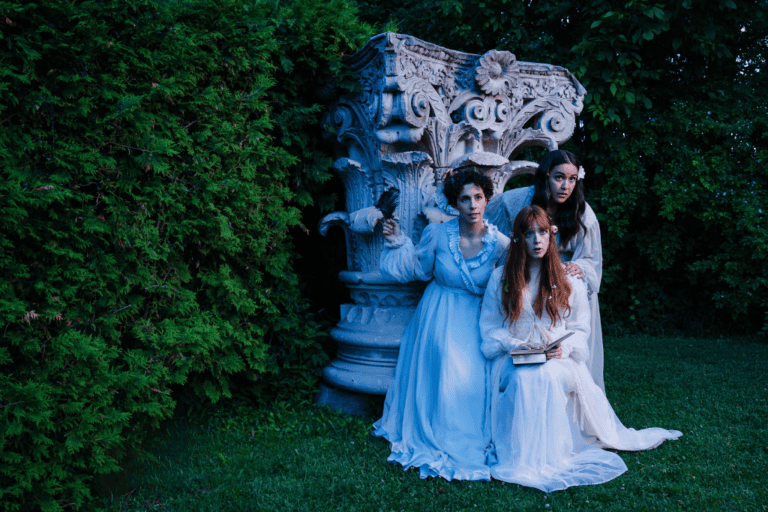 iPhoto caption: Laura Del Papa, Hilary Scott, and Lara Lucia in 'Brontë: The World Without.' Photo by Raph Nogal.
GFT’s Brontë: The World Without is a window into the ordinary lives of literary icons
Directed by Helen Juvonen in Guild Park and Gardens’ Greek Amphitheatre, The World Without follows sisters Emily, Charlotte, and Anne Brontë — the authors of Wuthering Heights, Jane Eyre, and The Tenant of Wildfell Hall, respectively.
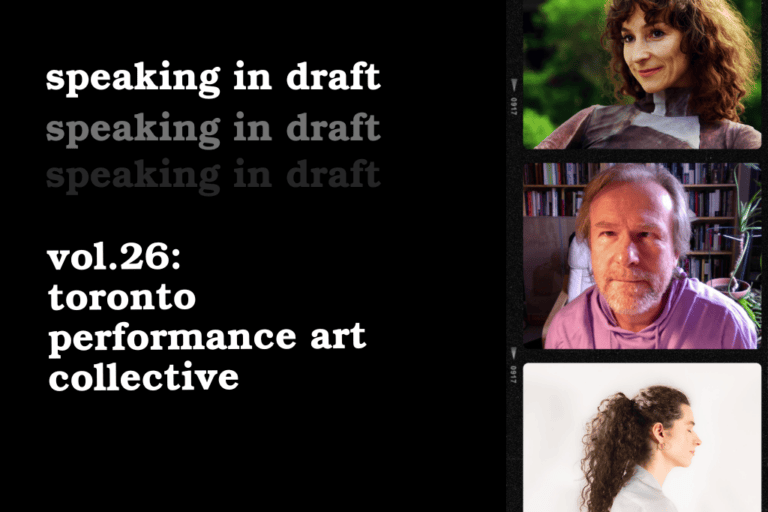 iPhoto caption: Photos of Shalon T. Webber-Heffernan, Paul Couillard, and James Knott courtesy of 7a*11d.
The organizers of the 7a*11d festival want you to know that performance art is still ‘punk as hell’
"There’s something about being live, with a sweaty, stinking, gross, dirty body, that’s just — you’re in it," says collective member Shalon T. Webber-Heffernan. "There’s some kind of alchemy going on that’s addictive to me. I think 7a*11d is sort of the dealer, if you will! It’s keeping us all hooked onto this weird obsession."
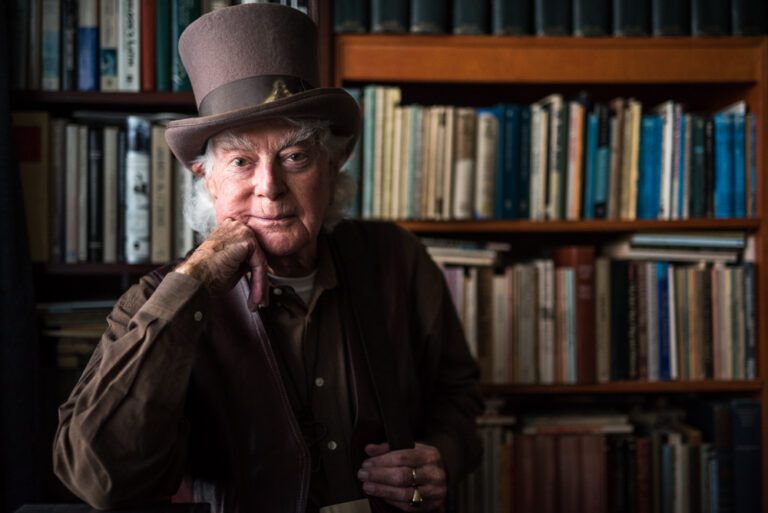 iPhoto caption: Peter Wylde for Intermission Magazine. Photo by Dahlia Katz.
In memory of Peter Wylde, the time-travelling acting teacher
What follows is an edited and condensed collage, loosely organized by theme, that only scratches the surface of Wylde’s life and impact.
 iPhoto caption: Dance Macabre cast. In photo: Keira Marie Forde (front). Back: [L to R] Uche Ama, King Cosmos, Theresa Gomes and Thomas Fournier. Photo by Tiku Romello Fisher (TRF Media).
At the 2026 Toronto Fringe, Caribbean artists stage collisions of identity, power, and desire
In separate video conversations, the lead artists behind Danse Macabre, Ex-Change of Words, and Momme Domme spoke about approaching themes of Blackness, diaspora, power, and desire.
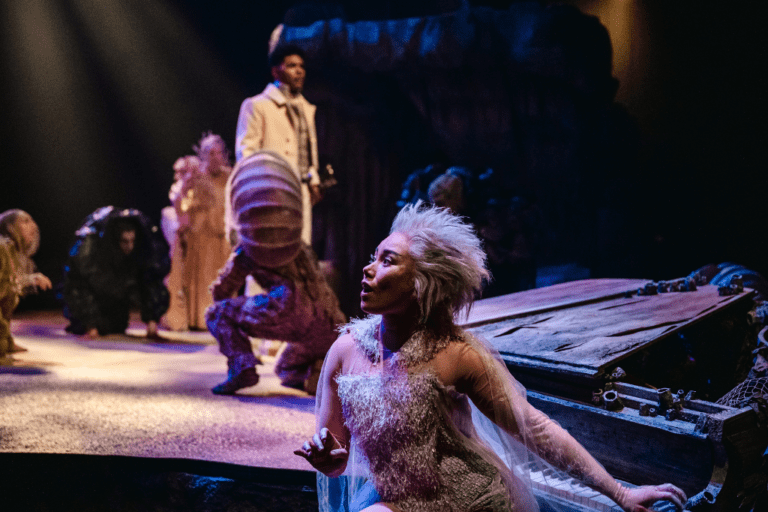 iPhoto caption: Marissa Orjalo as Ariel with members of the company in 'The Tempest.' Stratford Festival 2026. Photo by Ann Baggley.
For Marissa Orjalo, this season at Stratford is such stuff as dreams are made on
“Every day feels like a new adventure,” says Orjalo. “I always look to the people who've come before me, and they're always very generous. I'm on this journey of learning, and I hope to learn for the rest of my life.”
 iPhoto caption: Ordena Stephens-Thompson and Tony Nappo in 'The Neighbours' at Tarragon Theatre. Photo by Jae Yang.
As PlayME’s season concludes, its creators reflect on the changing world of Canadian audio drama
Chris Tolley remembers CBC's Studio 212 with a sense of awe. “It felt like you were on the Starship Enterprise holodeck,” he said. “There was this big, long table with all these different computers and servers underneath. The studio had these different staircases made out of wood and metal, and strips of concrete and wood floor, so that you could run on them and record [different sound effects].”
Comments