
Lighthouse Festival shines a light on Canadian comedies this summer
 iPhoto caption: Photos courtesy of Lighthouse Festival.
Lighthouse Festival’s new artistic director Jane Spence believes in the power of Canadian belly laughs.
“When you laugh with a character, you connect with their story,” she said in an interview. “You have more empathy and compassion for whatever their journey is. I believe that humour opens us up to each other’s life experiences. It’s what connects us.”
Running May 21 to October 5 in Port Dover and Port Colborne, Lighthouse’s 2025 summer season is the first Spence has programmed. “We’ve tried to bring a lot of very different Canadian comedies to our stage,” she said.
The New Canadian Curling Club hurries hard at the top of the lineup. Written by Mark Crawford, it’s “an underdog story about new Canadians coming to a small town, and the obstacles they face,” said Spence. “It’s very funny and heartwarming… [and while the play] touches on issues [like] peoples’ biases and racism, Mark’s humour really invites people in and shares different perspectives. You don’t feel lectured to at all.”
Spence will direct Curling Club as well as Hidden Treasures, a double bill of two little-known works by Norm Foster, whose work is a staple of Lighthouse’s programming.
My Narrator and The Death of Me, both one-acts, are “two of Norm’s most unusual pieces,” said Spence. She explained that, in contrast to Foster’s typical realism, My Narrator’s story poses the surreal question: What if your inner voice came to life and gave you relationship advice? Meanwhile, Death of Me follows a man who dies and persuades the Angel of Death for a second chance.
“It’s [rare] for Norm to play in the supernatural realm,” Spence observed.
At the same time as Lighthouse shows off jewels from Foster’s back catalogue, it will also stick to its norm — or Norm — of producing full-length Foster plays with Flight Path, a romantic farce set on adjoining apartment balconies. Lighthouse’s previous artistic director, Derek Ritschel, will direct.
Among Lighthouse’s homegrown offerings is Pinkerton Comes to Prospect, a world premiere Canadian comedy by theatre artist Jamie Williams. Directed by Steven Gallagher, Pinkerton is an homage to classic Westerns.
Williams, who has been involved with Lighthouse as an actor, director, and now playwright, developed Pinkerton through the Sneak Peek Festival — a play development initiative the company relaunched this past year after a decade-long hiatus. The festival’s readings serve as the culmination of a workshop process. (The dramaturg for the most recent iteration was Caitie Graham.) This past March, ”we had the current world premiere, [Pinkerton,] getting its final polish-up,” said Spence. “Then we had spots for two hopefuls, two plays that may be programmed on our stage in the future.” Those scripts were Baby Steps, written by Matt Gorman and Arlin Dixon; and Secret Service, by Ephraim Ellis.
“The first day of the workshops, we have professional actors read through [the scripts] and give their feedback,” Spence said. “Then the writers have two days to go away and make rewrites. The day after that, in the morning, we’ll go over all the new rewrites as a small group. Then, in the afternoon, we read in front of an audience.” During the most recent festival in March 2025, some attendees “came to all three plays, which was fabulous. It gives the writer a really good idea of what the audience’s honest reaction is.”
While the season’s focus is Canadian comedy, audiences can also expect two international titles. Ritschel will direct The Hound of the Baskervilles, a new twist on Arthur Conan Doyle’s classic tale by British duo Steven Canny and John Nicholson. Following in the footsteps of last season’s Murder at Ackerton Manor, by Steven Gallagher, Baskervilles promises to blend mystery with comedy. “Three actors wind up playing 17 different characters,” Spence said. “It’s really fast-paced and a lot of fun.”
The summer will swing to a close with Memories of the Rat Pack, a show written by Christopher McHarge about the lives of Frank Sinatra, Dean Martin, and Sammy Davis Jr.
Through the mainstage programming and events like Sneak Peek, Spence said that she hopes to honour Lighthouse’s role as a hub for playful, big-hearted theatre.
“Lighthouse has such a supportive audience,” she reflected. “We’ve been lucky in our recovery since the pandemic because of their loyalty — their trust that they’re going to be able to come here for some good, solid entertainment.”
Lighthouse’s summer season runs May 21 to October 5 in Port Dover and Port Colborne. You can learn more here.
Lighthouse Festival is an Intermission partner. Learn more about Intermission’s partnership model here.
Nathaniel Hanula-James
Nathaniel Hanula-James is a multidisciplinary theatre artist who has worked across Canada as a dramaturg, playwright, performer, and administrator.
LEARN MORE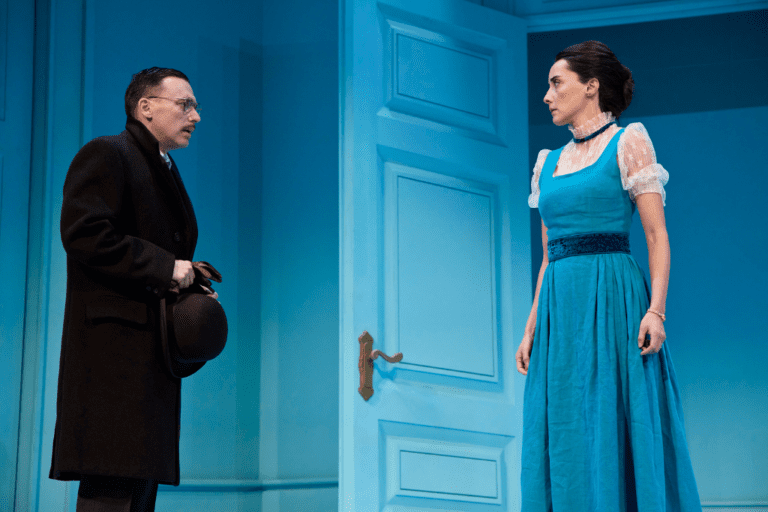 iPhoto caption: (L to R) Ron Pederson (Nils) and Alexandra Lainfiesta (Nora) in 'A Doll's House.' Photo by HarderLee.
Anita Rochon, director of A Doll’s House at Theatre Calgary, knows a good play has your back
“[I know] the rhythms and aspects of humanity that she’s interested in exploring,” Rochon said. “I’m always attracted to the complex, troubled, imperfect human. Ibsen and Herzog invite in complexity.”
 iPhoto caption: Headshots of Signy Lynch, Martin Julien, Anita Majumdar, Donna-Michelle St. Bernard, and Derrick Chua.
Five theatre professionals champion Canadian plays that deserve more life
Across the country, second productions are rare, especially for shows that premiered pre-pandemic. With this in mind, I spoke to five theatre folks about the Canadian play that each of them thinks deserves another live production.
 iPhoto caption: 'Dance Me,' choreographed by Andonis Foniadakis, Annabelle Lopez Ochoa, and Ihsan Rustem. Photo by Marc Montplaisir.
“It’s very ambitious,” says artistic and executive director Alexandra Damiani. “Each choreographer has a clear vision and language. Leonard Cohen wrote, ‘There is a crack in everything, that’s how the light gets in.’ When I see Foniadakis work with Cohen’s music, he finds the cracks between the notes, beats, and words.”
 iPhoto caption: Jasmine Case for Intermission Magazine. Photo by Dahlia Katz. Shot at The George Street Diner.
Jasmine Case’s role in Clyde’s at Canadian Stage gives the dynamic performer plenty to chew on
“She’s a mother who has a child that deals with epilepsy,” says Case. “I grew up with epilepsy. I had a grand mal seizure as a kid. So I have a weird understanding of her relationship to her child.”
 iPhoto caption: Headshot by Andy Moro.
“A big part of what I consider this writing to be is an honoring of ancestors that I will never meet in person,” says Beagan. “[That includes Indigenous] ancestors who [may only be] distantly related to me, or not actually bloodline-related to me at all, because it feels like we have to do that wherever we are in this colonized nation."
 iPhoto caption: Photos of Eric Woolfe (by Dahlia Katz), Catherine Savoie, Evan Klassen (by Jerry Grajewski), and Heather Redfern.
"Arts centres are going to have to apply to a new housing and infrastructure ministry program, which hasn’t been created yet, in order to access funds," says Heather Redfern, executive director of the Cultch in Vancouver. "So I’m very concerned that federal [funding] for cultural infrastructure in this country has completely disappeared."
Comments