
In Conversation: Victoria Urquhart, Spur-of-the-Moment Shakespeare Collective
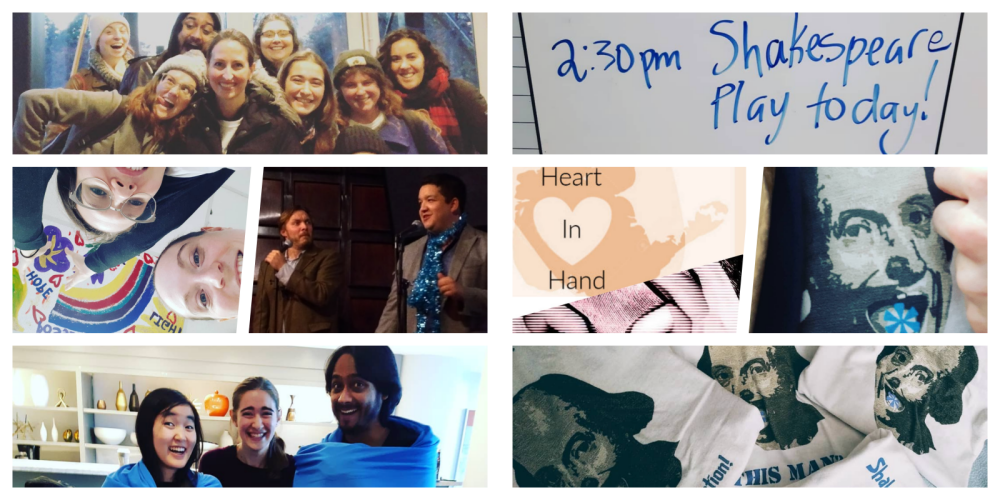
A literal accident brought Shakespeare to Toronto hospitals. In the summer of 2010, Hogtown collective Spur-of-the-Moment was delighting and terrifying passengers on the Bloor-Danforth line with guerilla performances of the Bard’s best-known works. The project sought to capitalize on the mid-aughts flash mob craze while offering fledgling theatre grads the chance to ply their trade. When an actor (unrelated to any guerrilla subway performances) sliced her thumb open and landed in the ER, she caught a segment about the company on the waiting room TV. A fellow patron loudly proclaimed that the company should bring their talents to hospitals to help folks pass the time and the idea for a marriage between classical theatre and healthcare was born.
Admittedly, it took a while for Artistic Director Victoria Urquhart to act on it. The private forum of a hospital seemed a strange direction for a company mandated to work in public space. But any lingering doubts vanished after a trial run in her grandmother’s senior’s home. The pilot version revealed the wealth of possibility offered by this type of unconventional site, providing a needed escape for residents and a platform for emerging artists to reach an untapped market.
SOTM’s current program tours scenes and monologues from both famous and lesser-known works to hospitals, hospices, shelters, and seniors homes around Toronto and across the GTA. The show combines classical text, contemporary poetry, and a dash of the company’s own writing to deliver the Bard in a stripped down and accessible format.
I caught up with Urquhart to chat about the company’s work, the particulars of performing in hospitals, and how the show is changing lives.
On the big question, “Why Shakespeare?”
Ha! This is always grant question number one. Seriously. Every Shakespeare company gets challenged on this, and honestly, it depends on the jury. I have a lot of personal reasons for working with Shakespeare; my mom was big on it, the poetry feels like algebra sometimes, and it hits me in weird and different ways. There’s always a big question of the value of presenting work where people aren’t going to understand everything being said. But there’s actually this really magical thing that happens when folks are put in a state of not-knowing and have to relate to the work in a different way. That being said, if you flip some variables by mixing up the text or the language, you start to level the playing field, which can create a different kind of connection. In terms of “Why Shakespeare in hospitals?” our audiences are in a constant state of waiting; for results, for diagnoses, for answers, along with a myriad of other draining experiences that can lead to a loss of self. Folks going through healing processes still seek out artistic and communal experiences. The rhythm and imagery gives something for people to latch on to in many different ways and to use it in whatever way they need it—distraction, catharsis, reflection, inquiry, all the same reasons why we see theatre in the first place.
On the company’s interest in lesser known works
I’m a sucker for the underdog! But seriously, the focus of this year’s show was on the idea of “family”, and when we go into the lesser-known Shakespeare works we’re also getting some different definitions of what it means to be connected in this way. In Pericles and King John, we see family as a very political thing; there’s a lot of talk about power in the context of those relationships. In another set of works, including Two Gentlemen of Verona, Timon of Athens, Cymbeline, and The Winter’s Tale, we start to dig into the context of family as a set of friendships. And then there’s a battle between the power elements and definitions of family in Sir Thomas Moore, Two Noble Kinsmen, and The Passionate Pilgrim. I wanted to shift away from the definition of family in the way it’s traditionally thought of in Shakespeare (birthright, bloodlines, and land ownership) and look at the more personal elements to work towards a modern definition. And of course we use a lot of the big ones like King Lear, Macbeth, Hamlet, and Othello. The only play we didn’t really touch was Romeo and Juliet, and I think I’m okay with that.
On the practical elements of working in hospitals
By necessity, we have to work with a stripped down format. There are no lights, very few set elements or props, and folks come in wearing their company t-shirts. The environment also dictates certain rules. There is no offstage, hence nowhere to hide. Most folks will be in chairs, so we need to create a physical language that works in that kind of space. A certain amount of the work needs to be able to be performed on its own, outside of a whole story, for when we do showings in private rooms. And of course, we need to be mindful of triggering images and social behaviours. From the perspective of a professional theatre artist, this might sound very restrictive, giving you too many limits on what you can do. But for us, it’s actually the opposite. It gives us a really cool structure to work with, offering possibilities you can’t explore in a conventional theatre environment.
On how the work is changing lives
I really need to write a book on this. There isn’t a year that goes by where I’m not surprised by the human reactions that come up. Just this week, we did a show and a man in the front who didn’t speak but was apparently getting really into the show, kept touching his heart and clutching the program to his chest. When the show was over, he opened his arms in this big beautiful gesture to the stage. I’ve been thinking about that a lot and I keep asking myself, “When was the last time I saw a piece of theatre that made me want to do that?”
SOTM are currently touring their show, Family Reunion, in hospitals, hospices, seniors’ homes, and shelters. Public performances of Family Reunion are being held as part of Heart in Hand, SOTM’s end of year gala, on Dec. 12 and 13.
For tickets to the gala, click here.
For more information on the company, click here.

Chris Dupuis
Chris Dupuis is a nomadic writer/creator/curator originally from Toronto.
LEARN MORE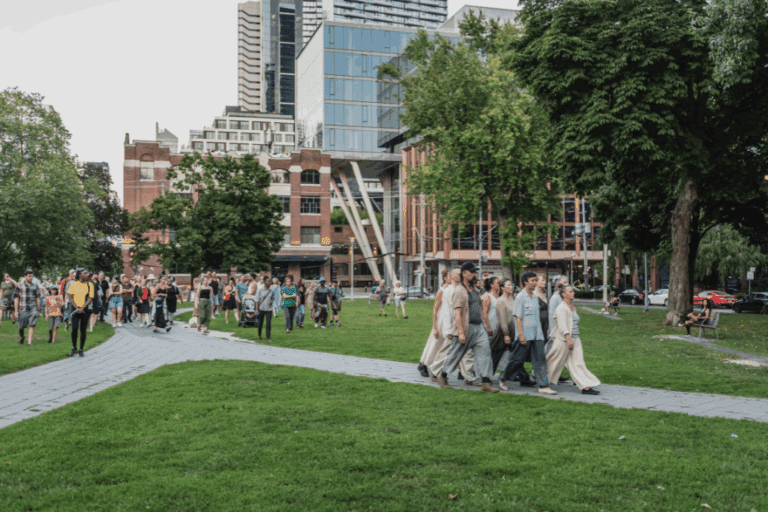 iPhoto caption: The company of 'Phalanax.' SummerWorks photo by Jae Yang.
The specter of death is omnipresent in Phalanx, one of the offerings at this August's SummerWorks Performance Festival. First presented by DNA Theatre in 1998, the current version was catalyzed in 2023, perhaps fittingly, by the passing of former artistic director Hillar Liitoja. I decided to document the creative process and to provide space for the artists involved to reflect on why they were doing the show and what they hoped to achieve.
 iPhoto caption: I Don't Even Miss You photo by Eden Graham.
Factory Theatre welcomes new audiences with shows that explore human connection
“I feel like I’m really looking to theatre for joy right now,” says artistic director Mel Hague. “I don’t mean works that are specifically funny or happy. I’m talking about something deeper where you can feel connected to the art on stage, the space that’s hosting it, the other people in the audience, and yourself.”
 iPhoto caption: Photo by Jeremy Mimnagh.
Roberto Zucco marks a new era in Buddies’ history of queer theatre
Toronto theatre can be a bit risk-averse. Artistic directors, constrained by limited funding, program obvious crowd-pleasers over boundary-pushing experiments. Playwrights, afraid to ruffle feathers, create spaces that validate the public’s...
 iPhoto caption: Image courtesy of SummerWorks.
How SummerWorks confronts a theatre industry steeped in hustle culture
“As far as our sector goes, there’s this idea that how busy you are is a reflection of your values,” says director-dramaturg Harri Thomas. “We also tend to emphasize a person’s career over the body of work they’ve produced. There are certain things that we can do at a community level, particularly when it comes to resource sharing. But we also need to consider the fact that we operate in a scarcity environment where we’re so focused on individual shows that we often neglect the larger ecology.”
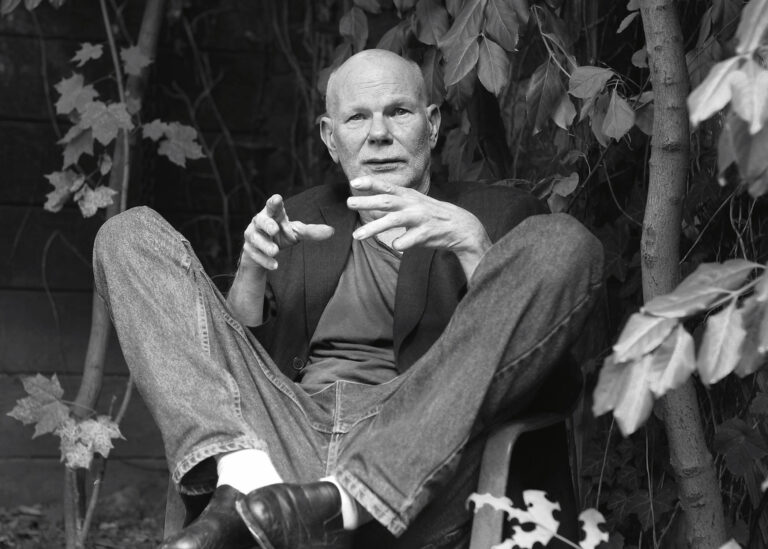
Director Hillar Liitoja was ‘pathologically uncompromising’ in his pursuit of great art
His creations brought together all the joy and terror and beauty and chaos of being alive.
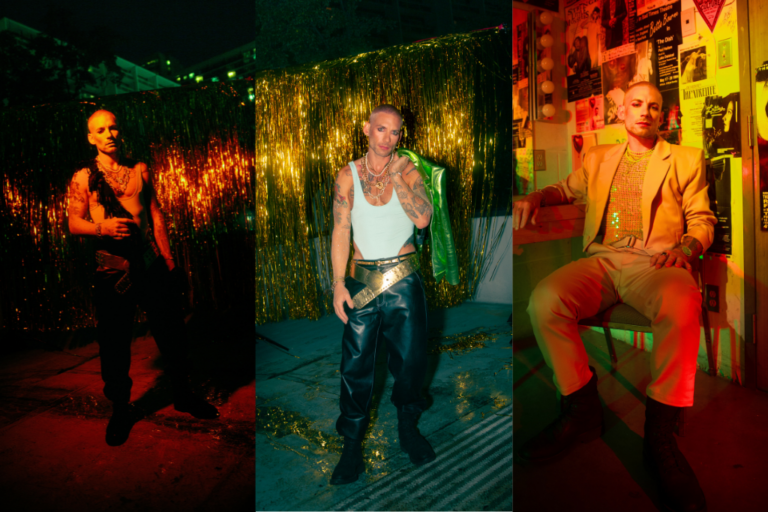
"Nightlife trends come and go," says witzel. "But there’s no reason a queer party space can’t be a creative site as well as a way to fund art."
Comments