
REVIEW: Appropriate is a masterclass in controlled chaos at Coal Mine Theatre
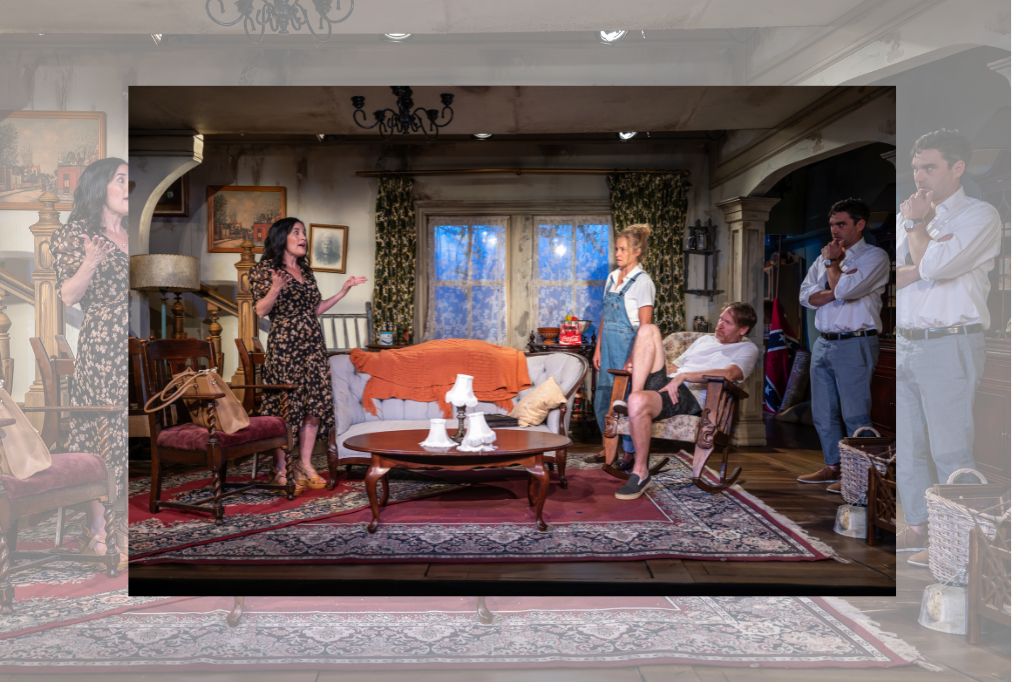 iPhoto caption: Photo by Dahlia Katz.
Stop what you’re doing.
Go to the Coal Mine Theatre website.
Buy a ticket for Appropriate, which runs until October 21. If you have plans, cancel them, and go see Appropriate instead.
Okay. You can read this review now.
Coal Mine has reclaimed its spot as one of the punchiest, most daring theatre companies in Toronto. With Appropriate, written by Branden Jacobs-Jenkins and directed impeccably by Coal Mine co-artistic director Ted Dykstra, the company offers Toronto audiences a rare treat of a production, one that provokes and entertains in equal parts.
The play’s prone to spoilers – you’ll get the most out of it without knowing what comes next – but broadly, it’s a story in three parts that follows the Lafayette family, who have arrived at their family plantation (yes, in 2014) to divvy up the remnants of the recently deceased patriarch’s estate. When one of the grandchildren gets their hands on an album filled with photos of dead Black people, all hell breaks loose. Was Grandpa a bigot? Could the disturbing pictures be sold to recoup some of the money from his botched estate? What other secrets might the plantation hold?
It’s a family drama about a deeply fucked-up family – with episodes of pedophilia, incest, and flagrant racism to spare – but importantly, it’s a family penned by a Black playwright, a distinction that becomes increasingly important to remember as the play descends into hate-fuelled madness, showcasing whiteness at its ugliest time and again. Appropriate covers an impressive gamut of white stereotypes, including a crunchy granola girlfriend, a creepy uncle, and a teenage boy destined for mediocrity; if you can think of a white American archetype, it’s probably in there. While, yes, these characters are frequently the butt of the joke, they’re real, breathing people too, impressively fulfilling their roles as both characters and symbols. Jacobs-Jenkins makes his social points without over-explaining them, and never does the importance of his message, about the karmic logic of racial appropriation, obfuscate the story of the play – in short, the writing is excellent.
The direction, too, can be thanked for how widely Appropriate swings (and hits); Matthew G. Brown, who is Black, is assistant director alongside Dykstra. The Coal Mine space has, as per usual, been transformed such that it is nearly unrecognizable, in a proscenium arrangement that makes the teeny venue feel much larger than it is. Co-set designers Steve Lucas and Rebecca Morris have built out the Lafayette estate with impressive attention to detail, making the cramped home feel like an antiquated space vast with opportunities for the actors to rage and devolve. A chaotic fight scene that squeezes every member of the large cast onstage is a highlight; a squirmy vignette involving two of the teenage children at their most awkward is another.
These directorial stunners are brought to life by a knockout group of actors. Raquel Duffy stars as Toni, the grieving daughter pushed into near-psychosis by her bitter, unforgiving past. Amy Lee is Rachael, a Jewish woman from New York who has never felt included in the Lafayette family, despite marrying into it and bearing children with Beau, the family man masquerading as a Democrat (he’s played brilliantly by Gray Powell). Alison Beckwith is River, the hippie-wannabe 23-year-old with eyes on Frank, whose monstrous past haunts him in the delicate, complex layers displayed by Andy Trithardt.
Not once in Toronto have I experienced a play in which so many people in the audience screamed in unison at an onstage image. It takes a very special piece of art to make that many people cringe at once in such beautiful, messy synchronicity – that moment, and you’ll know the one I mean when you see the show, will stay burned in my memory forever. Kudos especially to child actor Ruari Hamman, who plays Ainsley, Rachael and Beau’s youngest son.
I’ll admit, Coal Mine hasn’t wowed me since their production of The Antipodes in early 2022, also directed by Dykstra. Last year’s season, though impressively produced in the aftermath of a devastating fire, felt incomprehensibly dark, a mosaic of disturbing stories bound together by their lack of levity. The Antipodes, one of the first shows to be produced in the city post-pandemic, was, for me, a gold standard in Toronto theatre, one Coal Mine hadn’t met again until now.
Well. New gold standard achieved.
Appropriate runs at Coal Mine Theatre until October 21. Tickets are available here.
Intermission reviews are independent and unrelated to Intermission’s partnered content. Learn more about Intermission’s partnership model here.

Aisling Murphy
Aisling is Intermission's former senior editor and the theatre reporter for the Globe and Mail. She likes British playwright Sarah Kane, most songs by Taylor Swift, and her cats, Fig and June. She was a 2024 fellow at the National Critics Institute in Waterford, CT.
LEARN MORE iPhoto caption: Toronto Fringe promo photo by Robbie Harper.
REVIEWS: Toronto Fringe Festival 2026
This collection of Toronto Fringe Festival capsule reviews will be updated throughout the festival with writing from 10 different critics.
 iPhoto caption: Photo by Aisling Murphy.
In the darkest months of Yukon winter, it’s all about the Sun Room
I’m here for a week in January as a guest of Nakai Theatre, a hub for theatrical experimentation and outside-the-box programming in Canada’s westernmost territory.

Armchairs, tattoos, and an online theatre magazine
When I started at Intermission, my world was limited to the confines of an armchair. Arts journalism was a high it felt dangerously fruitless to chase. The life stretched ahead of me was amorphous and frightening, a chasm filled with hand sanitizer and immigration concerns. It was worth crying over a spilled kombucha and scrubbing at the stain.
 iPhoto caption: Liz Appel headshot courtesy of Liz Appel.
Five questions with Wights playwright Liz Appel
Intermission spoke with Appel over email for a brief Q&A about Wights, now playing at Crow’s Theatre until February 9.

Call for applications: Publishing and editorial assistant
Intermission Magazine is seeking a dynamic and collaborative individual to join our team.
 iPhoto caption: What Writing Can Do: The 2025 Musical Theatre Critics Lab
Announcing What Writing Can Do: The 2025 Musical Theatre Critics Lab
What Writing Can Do is timed to coincide with the Grand and Theatre Aquarius’ co-production of Waitress, which will serve as a jumping-off point for discussions throughout the Lab.
 iPhoto caption: A Christmas Story production still by Dahlia Katz.
REVIEW: A Christmas Story feels fresh at Theatre Aquarius
If you want to catch A Christmas Story before it closes, good luck — the show is close to sold out, and with the talent on that stage, it’s not hard to see why.
Comments