
REVIEW: Guild Festival Theatre’s ambitious Heratio wanders through a thicket of subplots
 iPhoto caption: Janelle Hanna in 'Heratio.' Photo by Raph Nogal.
Spoiler warning: This review discusses the story of Heratio in detail, including a couple of plot twists.
If Shakespeare’s Hamlet had been granted a fanfiction sequel, it might look something like Genevieve Adam’s Heratio — a highly inventive, sometimes messy, and thoroughly entertaining take on what unfolds after the bloody finale. Equal parts reverent and rebellious, Adam’s script plunges into the smouldering wreckage of Hamlet, twisting its narrative with conspiracies, disguises, and a heavy dose of meta-humour. It’s an interesting tribute to the original: boldly reimagined, and occasionally tripping over its own ambition.
For audiences unfamiliar with every twist of Shakespeare’s tragedy, a quick refresher on Hamlet might be helpful before taking in Heratio, which reconfigures the original story in surprising ways. Developed through the Guild Festival Theatre’s In Conversation With Classics new play program, Heratio holds the distinction of being the first newly written play to premiere at Scarborough’s Greek Theatre in the Guild Park — a milestone for a company better known for staging established works.
The premise is instantly intriguing: Horatio (Janelle Hanna), the primary survivor of the original’s death-filled climax, is secretly a woman who disguised herself as a man to gain an education. What’s left of the court of Elsinore now belongs to Fortinbras (Jack Davidson), a king clad in regal red and gold. Around him orbit a cast of mostly new characters: Columbine (Rashaana Cumberbatch), sister to the late Guildenstern; Violet (fight and intimacy director Siobhan Richardson), a peasant woman as well as Fortinbras’ covert right hand; Rue (Phoenix Fyre), a Finnish worker in Violet’s employ; and Queen Gertrude (Philippa Domville), brought back to life in a resurrection twist I won’t further spoil.
Domville’s Queen steals the show, and commands the stage from her first appearance, whether sparring verbally with Horatio, flirting shamelessly with Fortinbras, or engaging in a spirited dance sequence that oozes sensuality. She’s magnetic, funny, and layered — so much so that you almost wish the play bent itself around her more decisively.
Despite being the title character, Horatio never fully owns the stage — a flaw rooted as much in Helen Juvonen’s direction, which at times falters in navigating the play’s tonal shifts, as in the uneven writing itself. Hanna delivers occasional flashes of wit and emotional complexity, but Horatio’s overly serious tone dampens her impact. Her disguise as a man — a classic Shakespearean device — is more often than not played with solemn realism rather than the playful self-awareness and charm found in his comedies. That tonal choice makes the disguise harder to buy, particularly when the final reveal carries little real dramatic escalation or weight.
Horatio’s head-to-toe gray costuming helps communicate the character’s androgynous visual appearance (production design is by Nancy Anne Perrin), but Hanna’s higher-pitched voice undercuts the illusion, and her shift in delivery after the reveal is so subtle it barely registers. Perhaps that’s intentional: from the moment Horatio and Rue are introduced, Rue — played by the genderfluid Fyre — immediately sees through the disguise. This leaves Horatio visibly flustered, but it also diminishes the dramatic tension of the climax.
Fyre’s performance of Rue, meanwhile, is a standout, grounding the play’s moments of grief with nuance while keeping the energy buoyant and engaging. Despite Fyre’s strong performance, the chemistry between Rue and Horatio feels underwhelming, which is a shame given the production’s overall delightfully queer undertones. Rue even explicitly states that Horatio was in love with Hamlet, an acknowledgement that mirrors both popular fanfiction and scholarly readings of the original text.
The play thrives on political intrigue, as characters driven by ambition and promises of wealth navigate a court full of secrets and shifting loyalties, with ghostly visitations and demands for vengeance recalling Hamlet’s core themes.
And yet, that same thoroughness is the play’s Achilles’ heel. Subplots crowd the narrative, and the necessity of explaining the altered post-Hamlet world slows the pace. Moments of genuine poignancy about grief and survival — like Rue’s reflections on moving forward after loss — are rare, as these characters are, in my view, not granted enough space or emotional weight to resonate fully amidst the loss, dense scheming, and power plays.
The production is self-aware, even poking fun at itself on several occasions: Fortinbras references the “before-times” and quips, “We can’t do verse, say it in plain words.” Although I managed to mostly follow along (Hamlet is one of my favourite Shakespeare works), I suspected from some confused faces in the audience around me that many struggled to catch up with the pacing; the dense exposition and complex plotting can make following the tangled post-Hamlet politics challenging without a refresher.
Though Heratio sometimes buckles under its scope, it never stops surprising. Its feminist reimagining of Horatio, the Queen’s boisterous presence, and brilliant callbacks reward close attention.
And, in one final wink to Denmark’s royal court, you can pick up a danish at the concession.
Heratio runs at Guild Festival Theatre until August 24. Tickets are available here.
Intermission reviews are independent and unrelated to Intermission’s partnered content. Learn more about Intermission’s partnership model here.

Krystal Abrigo
Krystal is Intermission's Publishing and Editorial Coordinator. A Scarborough-based writer of Philippine and Egyptian descent, she graduated cum laude with an Honours BA in Professional Writing from York University, specializing in Book Publishing and Corporate/Organizational Communication. She enjoys reading bell hooks, Audre Lorde, and James Baldwin. At any given moment, you can probably find her at a concert or on a long walk somewhere in Toronto.
LEARN MORE iPhoto caption: Members of the company of 'Narnia.' Photo by Dahlia Katz.
REVIEW: Bad Hats’ Narnia is a joyful, heartwarming escape
The spirit of openness and the joy of discovery rule over this Narnia. Open the wardrobe and see.
 iPhoto caption: Members of the company of 'Robin Hood.' Photo by Dahlia Katz.
REVIEW: Canadian Stage’s Robin Hood panto is anti-capitalist fun for the whole family
Following Ross Petty’s legacy of scene-stealing, Damien Atkins as the evil Prince John is easily the greatest delight of the show.
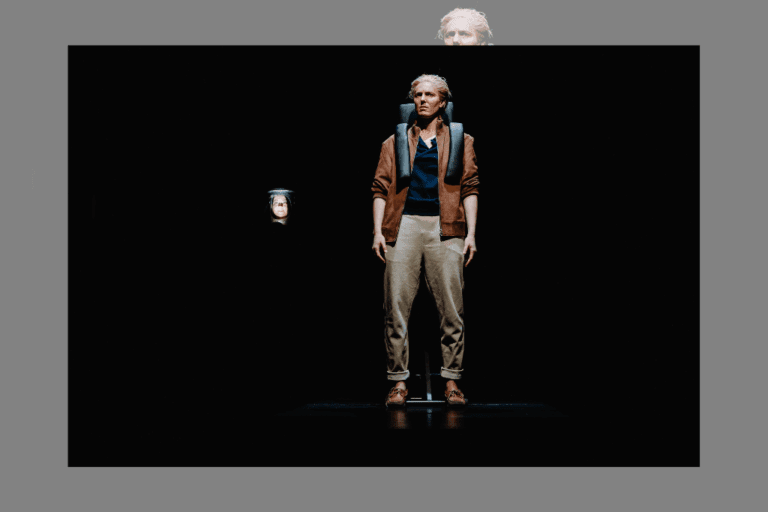 iPhoto caption: Lauren Gillis and Alaine Hutton in 'Public Consumption.' Photo by Eden Graham.
REVIEW: Lester Trips’ stylish Public Consumption captures the internet’s profound emptiness
Rather than directly representing online life, Public Consumption speculates — with virtuosity — about how the digital world affects our bodies. And the show's findings are by no means comfortable.
 iPhoto caption: Tony Ofori and Daren A. Herbert in 'Moonlight Schooner.' Photo by Dahlia Katz.
Kanika Ambrose’s Moonlight Schooner is animated and visually stunning, but its individual pieces don’t come together as neatly as I would've expected.
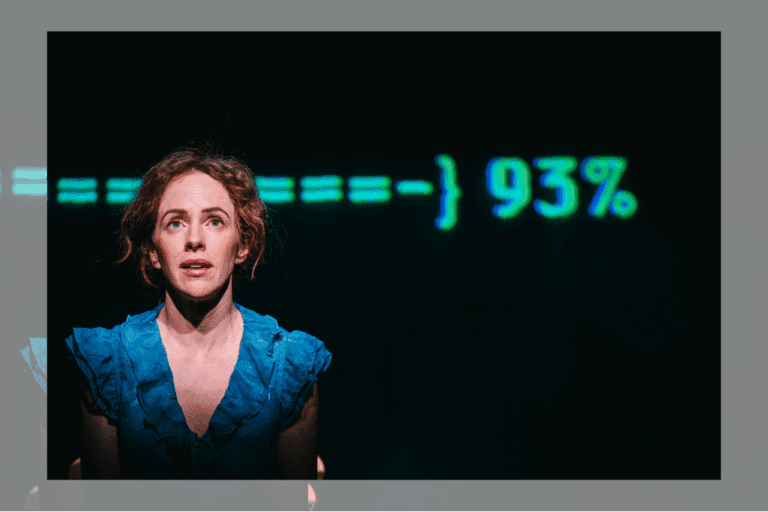 iPhoto caption: Fiona Mongillo in 'Reproduktion.' Photo by Ann Baggley.
REVIEW: Here For Now’s well-acted Reproduktion attempts to tackle too much
Amy Rutherford’s world premiere script is ambitious and the material it covers is complex — but the narrative feels disjointed.
 iPhoto caption: Kristen Thomson in 'Fulfillment Centre.' Photo by Elana Emer.
REVIEW: Coal Mine’s Fulfillment Centre asks how we end up alone, together
The production understands the play’s themes, yet feels limited by a script that delivers a package it never fully opens.
 iPhoto caption: (L to R) Kelsey Verzotti, Kennedy Kanagawa, and Ma-Anne Dionisio. Photo by Tim Nguyen.
Theatre Calgary announces casting for world premiere musical The Tale of the Gifted Prince
Starring as Prince Ren is Kennedy Kanagawa, known for his recent Broadway appearance in Into the Woods. Joining him is Ma-Anne Dionisio as the Woman, and Kelvin Moon Loh as the King and Magistrate.
 iPhoto caption: Headshot by Andy Moro.
Tara Beagan wins 2025 Governor General’s Award for drama
Published by Playwrights Canada Press, her multilingual play Rise, Red River connects environmental devastation with the intergenerational impacts of colonial violence.

Announcing the ON Criticism: 2025/26 Theatre Critics Lab cohort
Caelan Beard (Brampton), Alexandrea Marsh (London), Phillip Dwight Morgan (Toronto), Izzy Siebert (London), Joe Szekeres (Oshawa), and Hunter Weaymouth (Hamilton) will work with Intermission senior editor Liam Donovan and editorial director Karen Fricker in this six-month-long training and professional development program.
 iPhoto caption: A headshot of Jonathan Church. Photo courtesy of The Stratford Festival.
Stratford names Jonathan Church as its new artistic director
“The Festival is fortunate to have attracted such a celebrated and accomplished artistic leader,” wrote Stratford executive director Anita Gaffney in a press release.
 iPhoto caption: Liz Der, Vivien Endicott-Douglas, Philippa Domville, and Sofia Rodriguez. Photo by Dahlia Katz.
Chelsea Woolley world premiere to kick off 2025-26 Nightwood season
A highly physical and unexpectedly comedic work, Enormity, Girl, and the Earthquake in Her Lungs explores refuge, resilience, and survival. At its centre is Vic, a young woman who finds herself in a shelter under extraordinary circumstances.
 iPhoto caption: A stock image of Lighthouse Festival Theatre in Port Dover.
Lighthouse Festival reveals 2026 summer lineup
“Our 2026 season is bursting with stories we can’t wait to share with you,” wrote artistic director Jane Spence in a press release.
Comments