
REVIEW: Guild Festival Theatre’s ambitious Heratio wanders through a thicket of subplots
 iPhoto caption: Janelle Hanna in 'Heratio.' Photo by Raph Nogal.
Spoiler warning: This review discusses the story of Heratio in detail, including a couple of plot twists.
If Shakespeare’s Hamlet had been granted a fanfiction sequel, it might look something like Genevieve Adam’s Heratio — a highly inventive, sometimes messy, and thoroughly entertaining take on what unfolds after the bloody finale. Equal parts reverent and rebellious, Adam’s script plunges into the smouldering wreckage of Hamlet, twisting its narrative with conspiracies, disguises, and a heavy dose of meta-humour. It’s an interesting tribute to the original: boldly reimagined, and occasionally tripping over its own ambition.
For audiences unfamiliar with every twist of Shakespeare’s tragedy, a quick refresher on Hamlet might be helpful before taking in Heratio, which reconfigures the original story in surprising ways. Developed through the Guild Festival Theatre’s In Conversation With Classics new play program, Heratio holds the distinction of being the first newly written play to premiere at Scarborough’s Greek Theatre in the Guild Park — a milestone for a company better known for staging established works.
The premise is instantly intriguing: Horatio (Janelle Hanna), the primary survivor of the original’s death-filled climax, is secretly a woman who disguised herself as a man to gain an education. What’s left of the court of Elsinore now belongs to Fortinbras (Jack Davidson), a king clad in regal red and gold. Around him orbit a cast of mostly new characters: Columbine (Rashaana Cumberbatch), sister to the late Guildenstern; Violet (fight and intimacy director Siobhan Richardson), a peasant woman as well as Fortinbras’ covert right hand; Rue (Phoenix Fyre), a Finnish worker in Violet’s employ; and Queen Gertrude (Philippa Domville), brought back to life in a resurrection twist I won’t further spoil.
Domville’s Queen steals the show, and commands the stage from her first appearance, whether sparring verbally with Horatio, flirting shamelessly with Fortinbras, or engaging in a spirited dance sequence that oozes sensuality. She’s magnetic, funny, and layered — so much so that you almost wish the play bent itself around her more decisively.
Despite being the title character, Horatio never fully owns the stage — a flaw rooted as much in Helen Juvonen’s direction, which at times falters in navigating the play’s tonal shifts, as in the uneven writing itself. Hanna delivers occasional flashes of wit and emotional complexity, but Horatio’s overly serious tone dampens her impact. Her disguise as a man — a classic Shakespearean device — is more often than not played with solemn realism rather than the playful self-awareness and charm found in his comedies. That tonal choice makes the disguise harder to buy, particularly when the final reveal carries little real dramatic escalation or weight.
Horatio’s head-to-toe gray costuming helps communicate the character’s androgynous visual appearance (production design is by Nancy Anne Perrin), but Hanna’s higher-pitched voice undercuts the illusion, and her shift in delivery after the reveal is so subtle it barely registers. Perhaps that’s intentional: from the moment Horatio and Rue are introduced, Rue — played by the genderfluid Fyre — immediately sees through the disguise. This leaves Horatio visibly flustered, but it also diminishes the dramatic tension of the climax.
Fyre’s performance of Rue, meanwhile, is a standout, grounding the play’s moments of grief with nuance while keeping the energy buoyant and engaging. Despite Fyre’s strong performance, the chemistry between Rue and Horatio feels underwhelming, which is a shame given the production’s overall delightfully queer undertones. Rue even explicitly states that Horatio was in love with Hamlet, an acknowledgement that mirrors both popular fanfiction and scholarly readings of the original text.
The play thrives on political intrigue, as characters driven by ambition and promises of wealth navigate a court full of secrets and shifting loyalties, with ghostly visitations and demands for vengeance recalling Hamlet’s core themes.
And yet, that same thoroughness is the play’s Achilles’ heel. Subplots crowd the narrative, and the necessity of explaining the altered post-Hamlet world slows the pace. Moments of genuine poignancy about grief and survival — like Rue’s reflections on moving forward after loss — are rare, as these characters are, in my view, not granted enough space or emotional weight to resonate fully amidst the loss, dense scheming, and power plays.
The production is self-aware, even poking fun at itself on several occasions: Fortinbras references the “before-times” and quips, “We can’t do verse, say it in plain words.” Although I managed to mostly follow along (Hamlet is one of my favourite Shakespeare works), I suspected from some confused faces in the audience around me that many struggled to catch up with the pacing; the dense exposition and complex plotting can make following the tangled post-Hamlet politics challenging without a refresher.
Though Heratio sometimes buckles under its scope, it never stops surprising. Its feminist reimagining of Horatio, the Queen’s boisterous presence, and brilliant callbacks reward close attention.
And, in one final wink to Denmark’s royal court, you can pick up a danish at the concession.
Heratio runs at Guild Festival Theatre until August 24. Tickets are available here.
Intermission reviews are independent and unrelated to Intermission’s partnered content. Learn more about Intermission’s partnership model here.
Krystal Abrigo
Krystal is Intermission's Publishing and Editorial Coordinator. At any given moment, you can probably find her at a concert, or on a long walk somewhere in Toronto (or elsewhere).
LEARN MORE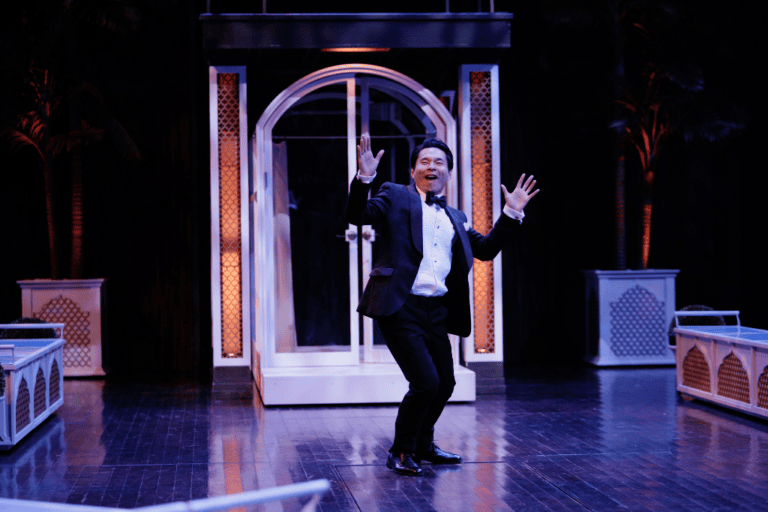 iPhoto caption: Michael Man as Dr. Wilson Wong in 'The Tao of the World.' Stratford Festival 2026. Photo by David Hou.
Meet Michael Man, the versatile actor playing Gollum at the Stratford Festival
Dr. Wong and Gollum are just two of the three roles Man is playing in his second consecutive season at Stratford. He also appears in a smaller role as Robin Starveling, one of the mechanicals, in A Midsummer Night’s Dream, giving him the opportunity to move between wildly different theatrical worlds over the course of a single season.
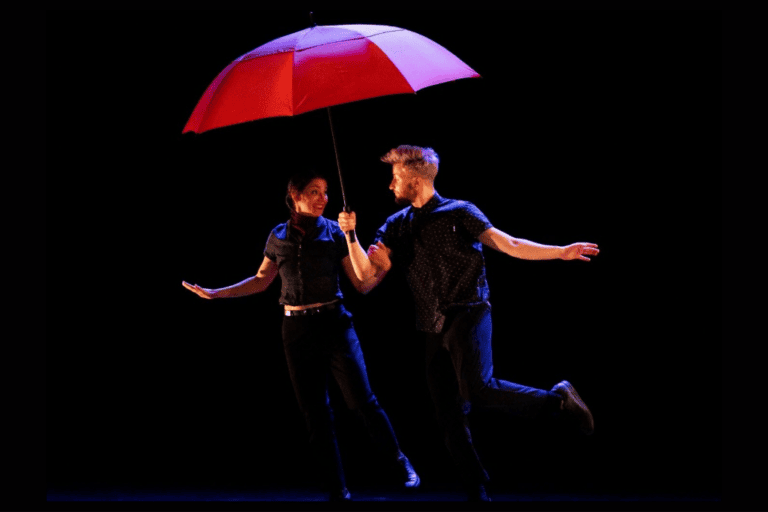 iPhoto caption: Compagnie de Fakto's 'C'est la vida.' Photo by Julie Cherki.
Alliance Française Toronto unveils 2026-27 season at Spadina Theatre
International theatre and dance will play at the downtown venue alongside live music, free cinema, exhibitions, and more.
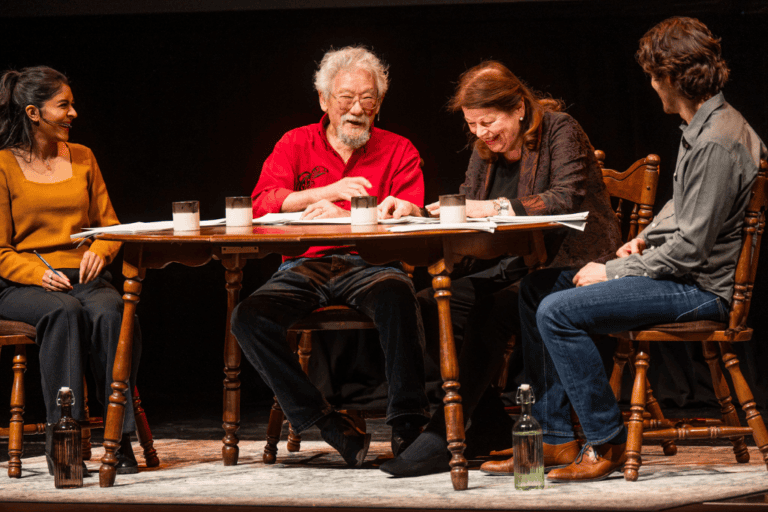 iPhoto caption: Sturla Alvsvaag, Tara Cullis, Michelle Mohammed, and David Suzuki in 'What You Won't Do For Love.' Photo by Dahlia Katz.
David Suzuki and Lester Trips to headline Factory Theatre’s fall season
In addition to its lineup of full productions, Factory will host work-in-progress presentations of Provisions and Ghost River Theatre and Macromatter's Soft Squishy Things in its Studio Theatre during the SummerWorks Performance Festival, running from August 6 to 16.
 iPhoto caption: Toronto Fringe promo photo by Robbie Harper.
REVIEWS: Toronto Fringe Festival 2026
This collection of Toronto Fringe Festival capsule reviews will be updated throughout the festival with writing from 10 different critics.
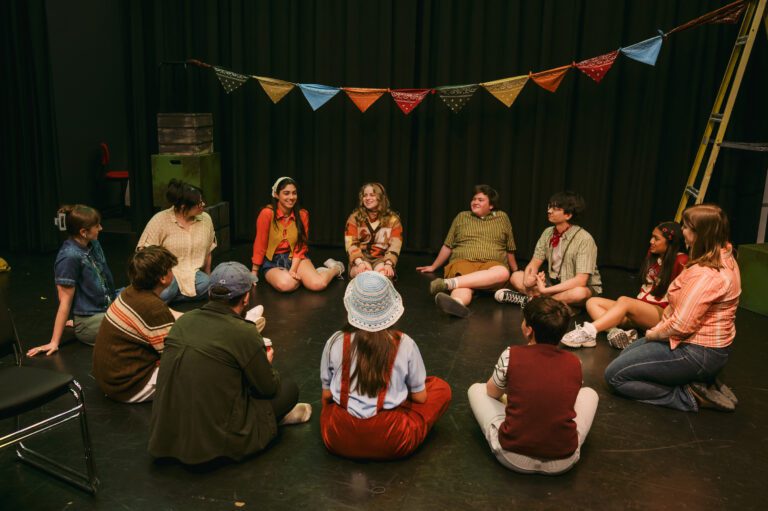 iPhoto caption: Kayla Morgan, Jordan Gurbin, Fern Wallenberg, Elliot Metcalf, Arabella Ho,
John Beer Principe, Alicia Goncalvez, and Cameron Kuwayti in 'Camp!'
iPhoto caption: Kayla Morgan, Jordan Gurbin, Fern Wallenberg, Elliot Metcalf, Arabella Ho,
John Beer Principe, Alicia Goncalvez, and Cameron Kuwayti in 'Camp!'
Double trouble: Meet the artists taking on multiple shows at this year’s Toronto Fringe
The Toronto Fringe Festival returns for its 38th edition this summer, bringing a total of 123 shows to 27 venues across the city over 13 days. As always, the festival’s lottery-selected lineup is packed with artists exploring different forms, stories, and styles — and some are even taking on multiple projects.
 iPhoto caption: Amaka Umeh, Astrid Van Wieren, and the Ensemble in 'Narnia.' Photo by Dahlia Katz.
TAPA unveils 2026 Dora Award nominees
The general theatre division is tightly contested. The Welkin, Rogers v. Rogers, Through the Eyes of God, and Le malentendu (a.k.a. The Misunderstanding) are tied for the most nominations, with five each.
Comments