
REVIEW: TfT delivers humour and cruelty in striking rendition of Camus’ Le Malentendu
 iPhoto caption: Christina Tannous and Béatrice René‑Décarie in 'Le Malentendu.' Photo by Mathieu Taillardas.
The French-Algerian philosopher Albert Camus is notable for his writings on life’s futility, absurdity, and lack of meaning, but also for his embrace of life’s many pleasures, particularly playing soccer, courting women, and going to the beach. It’s not surprising that these simple things are precisely those the characters in Le Malentendu cannot grasp. In Théâtre français de Toronto’s compelling new production of Camus’ 1943 play, director Karine Ricard (also the company’s artistic director) banishes all earthly joy from the scene, leaving behind an almost lunar coldness.
The action takes place in a small, landlocked inn with a dwindling clientele — due both to the unnamed region’s lack of touristic appeal and the two owners, Martha (Béatrice René‑Décarie) and her mother (Christina Tannous), who have begun robbing and murdering their wealthy visitors. The sparse set (by John Doucet) and muted, utilitarian costumes (by Melanie McNeill) stand in striking contrast to the dream of a sun-filled seaside, which Martha evokes repeatedly and poetically, desperate to change her circumstances and flee the inn.
One day, Martha’s long-absent brother, Jean (Ziad Ek), arrives unannounced from the seaside where he lives with his wife Maria (Jenny Brizard). He has become a rich man in his 20-year absence, a fact which makes him a target for his family’s deadly scheme. Although he aims to reunite with his mother and sister, they fail to recognize him, and he — for reasons unclear even to himself — makes the decision not to correct the deadly misunderstanding.
The cast admirably grapples with the text’s slightly tricky tone, which veers from absurd to wistful to devastating; Camus wrote the French dialogue in a direct, dry style that keeps us at a slight remove. Tannous is a particular standout as the Mother — she brings both weary warmth and gentle irony to a character who has accepted the futility of life and only longs to rest. Tannous and René‑Décarie are compelling counterparts: Martha matches her mother’s passivity with energy, practically vibrating with dissatisfaction and restlessness. While the ferocity of René‑Décarie’s performance began to wear on me as the play shifts from black comedy to Greek tragedy, she is pitch-perfect when embodying its absurdity.
The production also features strong performances from Brizard as Maria, who brings an unwelcome vitality to the cold inn and its cynical owners, and Mehdi Rostami, who composed and performs a beautifully melancholy musical accompaniment as the inn’s butler. Tannous and René‑Décarie lend their impressive voices to a small number of songs (with lyrics by Geneviève Cholette, who also assisted Ricard in the show’s direction), which are well suited to the piece’s tone but too few in number to feel fully integrated.
Le Malentendu really shines when it comes to atmosphere. Camus wrote Le Malentendu in France during the Nazi occupation, and the play is fittingly claustrophobic and hopeless, the characters penned in and alienated. Although some clues and Camus’ background suggest the play is likely set in Algeria, Ricard’s staging leaves the era and location ambiguous. The costumes feature contemporary fabrics styled in ways that seem almost futuristic. The focus is on the characters and the stifling ambiance that surrounds them. An imposing wall of black metal panels dominates Doucet’s set, and as the actors remove the panels one by one, they reveal nothing behind the wall but the unforgiving light of sunset and sunrise.
It’s an elegant representation of the play’s nihilism: if we were to strip away our façades, we would find no meaning, no morality or deity, only the world’s indifference. But the show ends, intriguingly, with a projected image that slightly shifts the meaning of the play. Whereas the text ends on one character’s unambiguous refusal to acknowledge the other, Ricard’s ending suggests that even in the face of overwhelming and random cruelty, we still hold out hope that there is an idyllic and sunny place out there where we might finally find some peace.
Presented in French with English surtitles, Le Malentendu runs at The Theatre Centre until November 15. More information is available here.
Intermission reviews are independent and unrelated to Intermission’s partnered content. Learn more about Intermission’s partnership model here.
Gabrielle Marceau
Gabrielle Marceau is a writer, critic, and editor living in Toronto. She has contributed essays, criticism, and (occasionally) poetry to Sight and Sound, Geist, Mubi Notebook, Cinemascope, Reverse Shot, and Arc Poetry, among others. She is the founding editor of In The Mood, a triannual online journal about film and pop culture.
LEARN MORE iPhoto caption: Photo by Mathieu Taillardas.
REVIEW: Feu Mr. Feydeau! takes charming liberties with a famous playwright’s life
Feu Mr. Feydeau! is an effortlessly enjoyable historical fantasy that takes on death, the creative act, and life's bittersweet disappointments.
 iPhoto caption: Samca production still by Barry McCluskey.
REVIEW: Samca is a disturbing, unique production that explores folklore and womanhood
The feminist folklore play, written by and starring Natalia Bushnik and Kathleen Welch, is an engrossing and sometimes frightening experience, perfect to kick off the scary season.
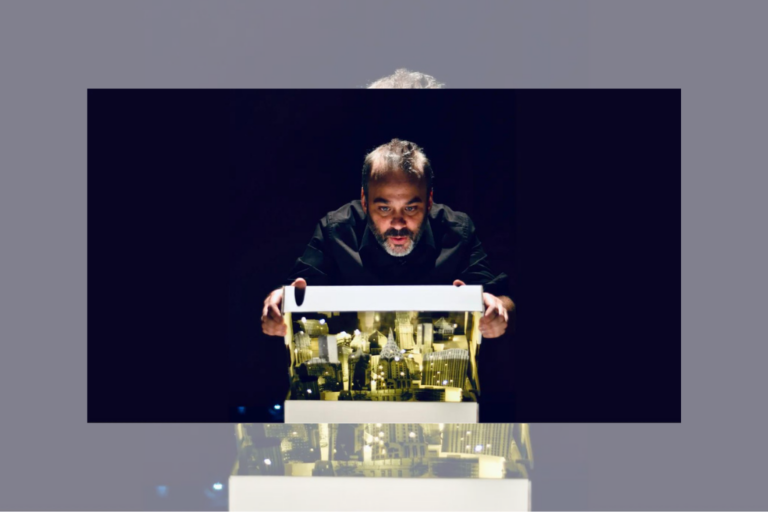 iPhoto caption: Photo by Marie-Julie Garneau
This is a powerful, deeply-felt performance about the treacherous but necessary work of tracing personal and political histories.
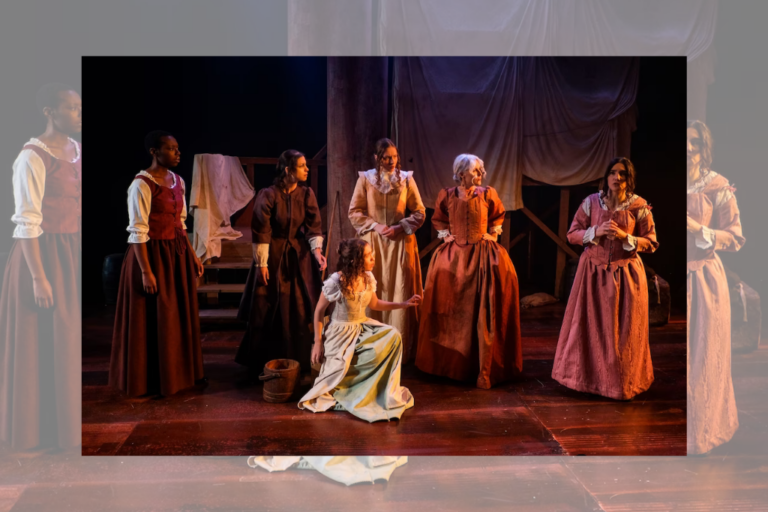 iPhoto caption: Photo by Mathieu Taillardas.
REVIEW: Filles du Roi is an entertaining, thoughtful reappraisal of French Canadian history
Sébastien Bertrand takes these women out of the symbolic realm, giving them fully formed identities.
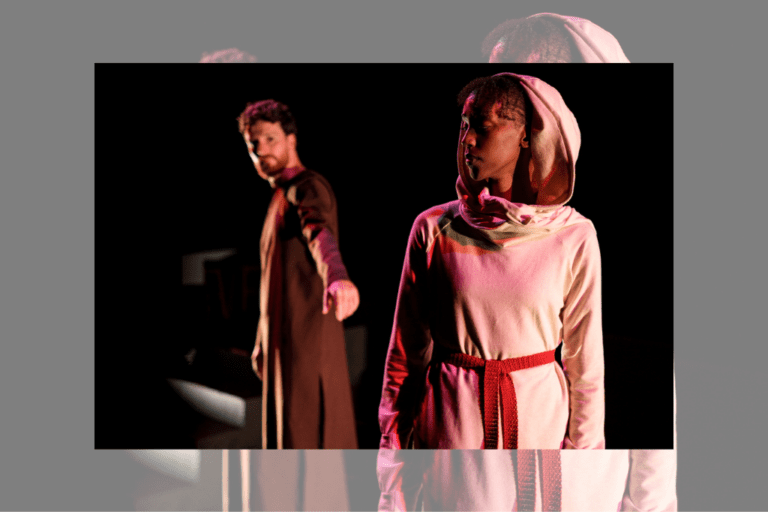 iPhoto caption: Photo by Mathieu Taillardas.
REVIEW: Convictions thoughtfully explores myth in the modern world
Lara Arabian and Théâtre français de Toronto have created a provocative, timely new work that intelligently explores the contradictions of immigration, family, and faith
 iPhoto caption: Photo by Francisco Castro Pizzo.
REVIEW: asses.masses is an endurance performance that takes boredom as its subject
By the sixth or seventh hour, I indeed felt like a worker at the factory of cultural production. I began to ask myself if the demands of the job were too high, if the compensation was fair, and if I felt fulfilled or alienated from working for the proverbial man.
Comments