
REVIEW: Maanomaa, My Brother at Canadian Stage/Blue Bird Theatre Collective
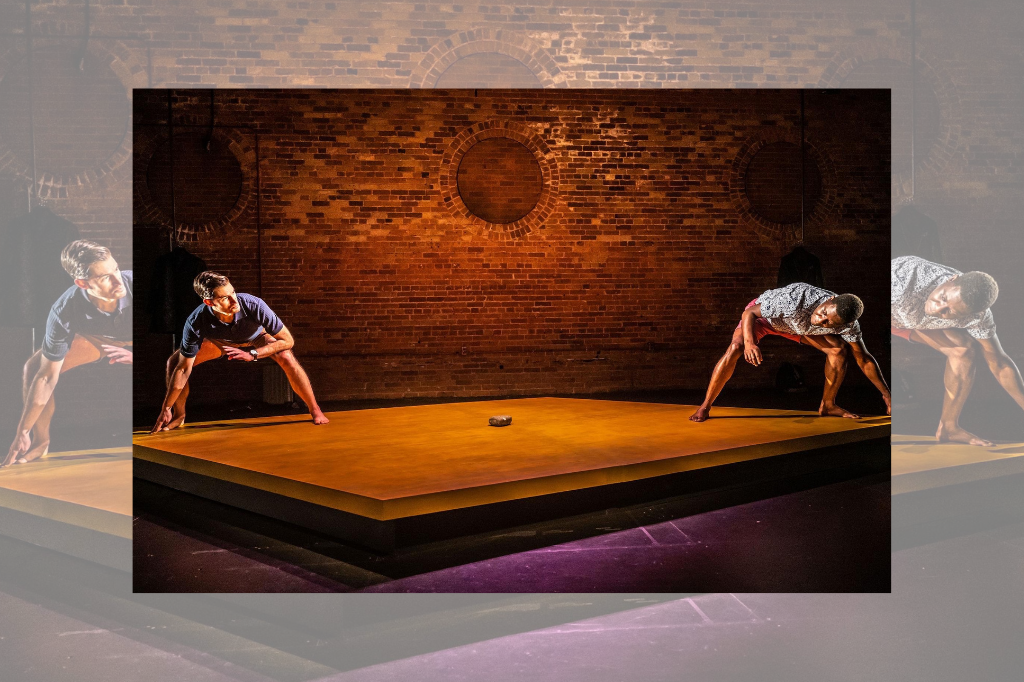 iPhoto caption: Photo by Dahlia Katz
Shows like Maanomaa, My Brother don’t come around too often.
Bursting with charm, wit, and emotional intelligence, the Canadian Stage/Blue Bird Theatre Collective two-hander grabs its audience by the throat, never letting go as it thrusts them into memories of Ghana past and reflections on Ghana now. Co-created by Tawiah M’Carthy and Brad Cook, the play, almost musical in its dance between Twi and English languages, asks us to ponder the delicate thread between childhood and adulthood — how the sidewalk games and nursery rhymes of our earliest years might come home to roost as we age.
Bluntly, the piece is superb.
Directed with total precision by Philip Akin, Maanomaa starts like many stories of unbridled rage: in an airport. We meet Kwame (M’Carthy) en route to his family homestead in Ghana, a house not far from the nursery school he attended as a child. He’s here for a funeral, we learn, travelling from Canada, reacquainting himself with a language it seems he’s not had to speak for many years. His short-sleeve, button-up shirt is untucked over his khaki shorts: the business casual of a hot climate.
Enter Will (Cook): white, surprisingly fluent in Twi, evidently uncomfortable. He, too, is en route to Ghana, and when he arrives, it’s clear he has roots there in Accra, the capital.
When Kwame and Will meet, the air in the theatre instantly changes: these two gentle, clearly personable men become stiff, stilted, awkward. Something happened, long ago — but what?
Cue tucked shirts.
All at once these grown men become children, signified by this subtle change in costuming and masterful, sensitive physical direction from Akin. At times Maanomaa veers from theatre to dance and back again — Akin never abandons verbal storytelling, but uses gesture and movement to complement it, adding a third language, that of the body, to the Twi-English duet we can hear.
It doesn’t take much to suspend disbelief that these fine adult actors are eight-year-olds, hunting in the forests of Ghana for an elusive bird, playing with rocks, and pranking each other. The two are best friends, desperate to learn each other inside and out: Will practices his Twi with Kwame’s grandfather, while Kwame asks questions about that far-off dreamland, Canada. They’re close in the way only little boys can be, with no logic or concern for what might happen next.
Until they aren’t.
M’Carthy and Cook’s creation is gutsy in its avoidance of specificity around the thing we’re most curious about: the division between Kwame and Will. Something happened, we discover, something terrible, something that caused Kwame great personal loss — but what? We don’t know. The maneuver around the exact context of Kwame’s father’s death is thoughtful, brave, abstract, stunning. Whatever you call it, this choice elevates Maanomaa’s highly choreographed storytelling, just as much as Joanna Yu’s smart, subtle costumes, and the minimal, angular set, co-conceived by M’Carthy, Cook, and co-creator Anne-Marie Donovan. And that set sure is something— really just a small, raised platform centre stage. It’s on that platform where the most visceral childhood memories unfurl, moments of naive intimacy between boys on the cusp of manhood.
Maanomaa, My Brother may wiggle personal grief from its socket, eliciting tears, stirring familial memories — it surely did for me, surprising me with its affective power. The play, clocking in at a tight hour, is so very empathetic in its storytelling. This is no trauma porn, nor is it trying to drag its audience down into the depths of its characters’ inner turmoil. Maanomaa is a marvel of writing, acting, and directing, and for me, the unparalleled standout of this year’s season at Canadian Stage. See it, see it, see it.
Maanomaa, My Brother runs at Canadian Stage April 11–30, 2023.
Aisling Murphy
Aisling is Intermission's former senior editor and the theatre reporter for the Globe and Mail. She likes British playwright Sarah Kane, most songs by Taylor Swift, and her cats, Fig and June. She was a 2024 fellow at the National Critics Institute in Waterford, CT.
LEARN MORE iPhoto caption: Photo by Aisling Murphy.
In the darkest months of Yukon winter, it’s all about the Sun Room
I’m here for a week in January as a guest of Nakai Theatre, a hub for theatrical experimentation and outside-the-box programming in Canada’s westernmost territory.

Armchairs, tattoos, and an online theatre magazine
When I started at Intermission, my world was limited to the confines of an armchair. Arts journalism was a high it felt dangerously fruitless to chase. The life stretched ahead of me was amorphous and frightening, a chasm filled with hand sanitizer and immigration concerns. It was worth crying over a spilled kombucha and scrubbing at the stain.
 iPhoto caption: Liz Appel headshot courtesy of Liz Appel.
Five questions with Wights playwright Liz Appel
Intermission spoke with Appel over email for a brief Q&A about Wights, now playing at Crow’s Theatre until February 9.

Call for applications: Publishing and editorial assistant
Intermission Magazine is seeking a dynamic and collaborative individual to join our team.
 iPhoto caption: What Writing Can Do: The 2025 Musical Theatre Critics Lab
Announcing What Writing Can Do: The 2025 Musical Theatre Critics Lab
What Writing Can Do is timed to coincide with the Grand and Theatre Aquarius’ co-production of Waitress, which will serve as a jumping-off point for discussions throughout the Lab.
 iPhoto caption: A Christmas Story production still by Dahlia Katz.
REVIEW: A Christmas Story feels fresh at Theatre Aquarius
If you want to catch A Christmas Story before it closes, good luck — the show is close to sold out, and with the talent on that stage, it’s not hard to see why.
Comments