
REVIEW: Ex Machina’s leather-clad Macbeth is slick, current, and unmistakably Quebecois
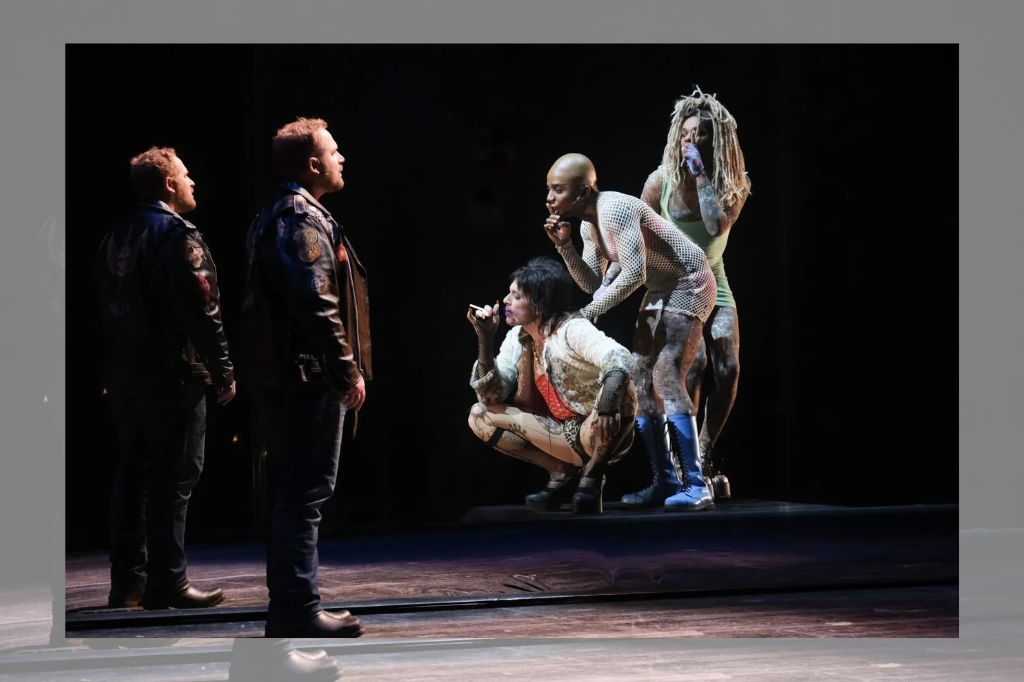 iPhoto caption: Members of the company of 'Macbeth.' Photo by Yves Renaud.
William Shakespeare has long been an emblem of Anglophone culture in the Quebecois social imaginary. Michèle Lalonde’s iconic 1968 protest poem “Speak White” evidences as much, invoking Shakespeare’s sonnets and gentle language as it decries the condition of Francophone Quebeckers under Anglophone cultural imperialism. These associations have not impeded Quebec artists and audiences from engaging with and reimagining the Bard on their own terms. After all, as Lalonde notes in the poem’s second stanza (translated by Albert Herring): “We [Francophones] are not deaf to the genius of a language.”
Since the Quiet Revolution of the 1960s, Shakespearean adaptations in Quebec have evolved in response to the local political climate, notes scholar Jennifer Drouin. These productions have broached heated subjects such as the October Crisis, the 1980 and 1995 referendums, and the AIDS epidemic. Ex Machina’s recent production of Macbeth at Quebec City’s Le Diamant theatre built on this legacy on a narrative level by setting the story in the midst of the Quebec Biker War of 1994. This violent conflict between two motorcycle gangs over control of Montreal’s drug trade spanned nearly a decade and left over 160 dead. Chrome choppers replace highland destriers and leather chaps replace woollen tartans in this production, but its text and staging maintain Shakespeare’s original themes of fate, ambition, and struggle for power.
Given that this production premiered in English at the Stratford Festival last year, I was curious how director Robert Lepage, who is known for his collaborative approach and willingness to modify shows as they run, might adapt the work for a Francophone context. By layering narrative adaptation, rich linguistic translation, and visual elements of mass media, Lepage delivers a Macbeth that is current and compelling.
The production uses a 1978 translation by playwright Michel Garneau, which departs from conventions of French translations of Shakespeare by embracing a Quebecois vernacular. Where previous translations, influenced by French Classicist drama and its notion of bienséance (propriety, decorum), favoured an elevated literary register, Garneau’s translation better reflects the range of language registers in Shakespeare’s work, from noble to vulgar. This tradaptation (a portmanteau of the French words for translation and adaptation coined by Garneau) is driven by a question: If Macbeth had been written by a settler of New France instead of by an Englishman in 1606, what language and metaphors would emerge?
Garneau’s Macbeth thus has a dual purpose: to restore Shakespeare’s popular resonance and to demonstrate the nuance and expressive capacity of the Quebecois language. In concrete terms, the text uses historic French-Canadian terms (aparcevance, guibou), liberal contractions, and certain vowel shifts (roi becomes roé, une becomes eune, certain becomes çartain, et cetera), among other strategies. These choices yield a language that feels ancient and weighty on stage even to my Allophone ears, but remains intelligible to a contemporary Quebecois audience.
The curtains open on a dark scene: upon crystalline black water, two rough men on a motorboat dispose of a corpse under cover of night. The body goes overboard and the stage plunges into darkness again. As the light returns, we find ourselves submerged in the watery depths alongside the bundled body spotlit from above. Projections on a scrim create the effect of sunlight refracted through water and bubbles floating to the surface. Tethered to the ground by an anchor, the body slowly rises to remain suspended centre-stage. Cue a title card and opening credits, projected in bright white serif lettering around the body. This gravity-defying title sequence instantly recalls a slick Hollywood film or prestige streaming series, perhaps helping 21st-century audiences ease into the story.
The men often drive around the stage on motorbikes. Deft movement direction by Olivier Normand sustains visual interest in what could have quickly become a tired stunt. The riders’ ease astride their choppers lends credibility to their 1990s motorcycle subculture. Together with meticulous sound design by John Gzowski, Normand’s dizzying choreography reinforces a cinematic tone throughout the play.
Evident care has been put into other elements of stagecraft and design. Macbeth’s castle is a neon-lit rural motel, conceived by Ariane Sauvé as a dynamic puzzlebox which unobtrusive stagehands assemble and disassemble throughout the play. A handful of moments elicited gasps of delight from my fellow theatregoers. For instance, near the beginning of the second half, gas pumps explode into barbeque grills to transition from murderous arson to a banquet.
The production uses projections, scrims, and infinity mirrors to seamlessly render ghostly apparitions and to amplify the number of characters on stage at crucial moments. The use of mirrors means that at times the audience is faced with its own reflection, just behind the characters. This visual effect both challenges the willing suspension of disbelief so prized in theatre and tacitly implicates viewers in the action unfolding on stage. While this feature first struck me as distracting, it seems perfectly fitting that a production so attuned to the visual language of mass media should echo the black mirrors of phone and television screens.
Shakespeare’s play dwells on gender and its relationship to power, from Lady Macbeth calling upon the spirits to “unsex” her, to the Witches’ ambiguous gender presentation. Lepage’s production keeps close to the original text in this regard: while the story is enmeshed in the hypermasculine realm of organized crime, it’s the women who particularly stand out to me. The weird sisters, arrayed in the livery of streetwalkers, capture the frailty and fury of feminine alterity, and would be equally at home in a John Waters film. Violette Chauveau’s Lady Macbeth shines for her vigour and delicacy. She is striking in a black leather bodice, hoop earrings, and the dyed bordeaux locks ubiquitous to a certain generation of québecoises. Dominique Quesnel is a delight as the Porter. By leaning into the archetype of the matante (auntie), an old-fashioned or unrefined busybody, she elevates the character’s bawdy wit and elicits empathy for her mistress as her fortune turns.
Lepage’s Macbeth brings local resonance and contemporary vigour to Shakespeare’s classic. It’s a spectacular show that’s worth watching in Garneau’s 17th-century Quebecois, even if your French is a little rusty. The production will run at Ottawa’s National Arts Centre French Theatre from June 5 to 13, including a show with English surtitles on June 11, if your interest is piqued.
Macbeth runs at the National Arts Centre from June 5 to 13. More information is available here.
Liuba de Armas wrote this review as part of Page Turn, a professional development network for emerging arts writers, funded by the Canada Council for the Arts and administered by Neworld Theatre.
Intermission reviews are independent and unrelated to Intermission’s partnered content. Learn more about Intermission’s partnership model here.

Liuba de Armas
Liuba de Armas is a working-class arts writer and curator based in Montreal, with roots in Ciudad Nuclear, Cienfuegos, Cuba. She holds a Master's degree in art history from McGill University and has curated exhibitions at Latitude 53, MSVU Art Gallery, Hermes Gallery, and the Khyber Centre for the Arts. She is one of two co-editors of Beyond the Gallery: An Anthology of Visual Encounters (Laberinto Press, 2021) and is a member of Neworld Theatre's Page Turn program (2025-27).
LEARN MOREComments
Leave a Comment
 iPhoto caption: Uma and Selma Gahd at Les Prix Frankies. Photo by Cindy Lopez.
Hot off covering Festival TransAmériques, Intermission is back reviewing Montreal theatre at this year’s FringeMTL, featuring 105 shows in more than 25 venues.
 iPhoto caption: 'Vampyr.' Photo by Nicolas Calderon.
REVIEWS: Festival TransAmériques 2026
The 20th edition of Montreal’s FTA does right by its name, featuring a curated lineup of 25 theatre and dance productions with roots mostly in the Americas. This year, Intermission presents its most comprehensive FTA coverage ever, with four critics publishing a total of 16 capsule reviews — responses that will appear below over the course of the two-week festival.
Excellent analysis of a great work. I thought the Garneau translation worked much better than the same mise en scene performed by Stratford actors. At least it made more sense.