
REVIEW: Monster and Here Lies Henry offer truth, lies, and divine stage action
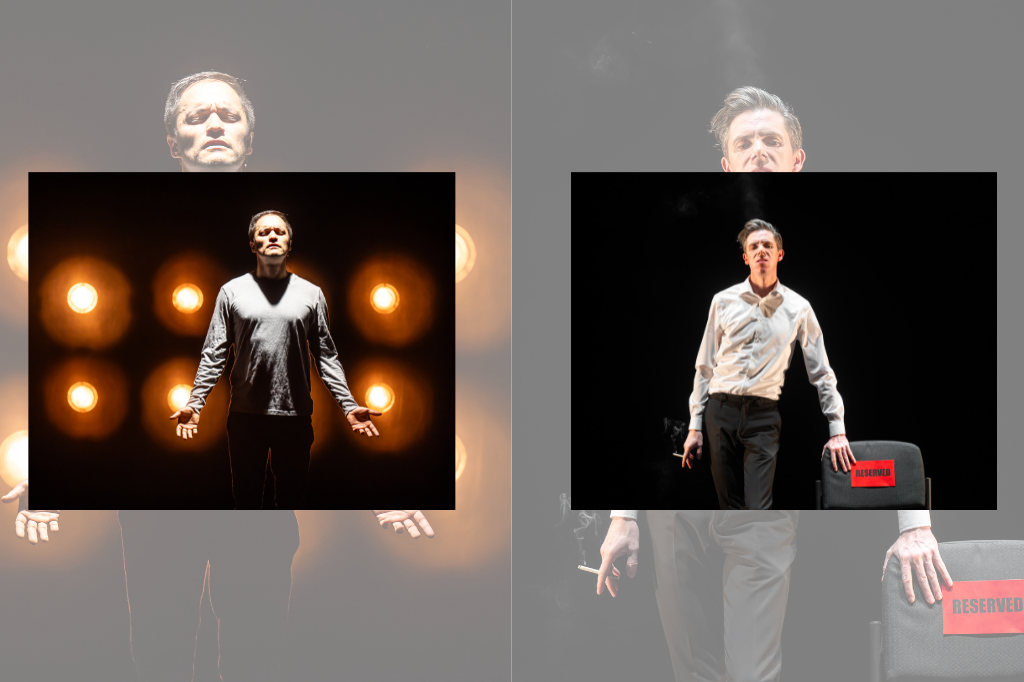 iPhoto caption: Photos by Dahlia Katz
A pair of one-man plays by Daniel MacIvor, now playing at Factory Theatre, explore what it means to watch. Though the shows starred the playwright when they debuted in the mid-late 1990s, with dramaturgy and direction by longtime collaborator Daniel Brooks (who died this May), Factory has passed them on to a new group of artists. The first, Monster, starring Karl Ang and directed by Soheil Parsa, is a tightly wound flame-thrower of a show, its unhappy characters brought to lively life by way of unrestrained play. The second, Here Lies Henry, starring Damien Atkins and directed by Tawiah M’Carthy, is a piercingly simple meditation on the grand lie that is theatre. (The former runs in the Factory Studio, the latter in the Mainspace.)
The plays exemplify MacIvor’s dramaturgy of the moment; nearly impossible to grasp as totalities, they’re better understood the same way they’re experienced: as a forward-flowing stream of vivid theatrical action. This demands presence on the part of the viewer. A willingness not to worry about what came before or what’s up next. And though I say “demands,” to exist like this — in the here and now, unbothered by anything but what’s unfolding on stage — isn’t an oppressive requirement but a profound freedom.
Perhaps this is why the plays now include references to social media. In Monster, there’s talk of the jarring sounds Instagram stories conjure; and in Here Lies Henry, the protagonist says he doesn’t “do socials,” before revealing he’s on the still-obscure Mastodon and Bluesky. These are the sites fighting for our eyeballs, our lives — but this duo of MacIvor plays thinks through other, less pernicious ways of paying attention to the world around us.
Monster starts in darkness — the dimming of lights before a film, a voice says, though the moment might also be read as the time preceding Earth’s creation, for light soon reveals our narrator and his name is Adam.
The lad’s no Garden of Eden-frolicking beacon of goodness, however. In a menacing voice fit for a cartoon villain, he makes devilish proclamations in percussive prose: “I’d rather be an ocean to a drowning man than a drink to a man in the desert. I’d rather be a fire to a forest than a fire to a 40-day blizzard. I’d rather be a flood to a village of 10 than a dam to a nation of millions.”
Over Monster’s 70-minute runtime, Ang transforms into 15 other characters, all in similarly dark states of mind. Their lives intersect just barely, with the story of a basement hacksaw patricide providing the gruesome connective tissue. Excitable teenager Monty, who lived next door, tells the murder’s tale in obsessive detail; then there’s Joe, a recovering drug addict, who has the idea of making it into a Hollywood blockbuster; and don’t forget Al and Janine, a married couple locked in perma-squabble, who attend the completed film in theatres.
Monster is all dirt, filth, the hangover after a long night out. The roving monologues go on longer than one expects, drawing the audience into the mind of the character speaking so completely that it’s a shock when the joyride ends and Adam’s sinful smirk returns.
Designers Trevor Schwellnus (set, lighting) and Thomas Ryder Payne (sound) sculpt these peaks and valleys with volcanic theatricality. Ang remains on a small, black downstage platform for just about the entire show. A rectangle of eight bulbs acts as backlight, flashing forward at the audience during key sequences. When they’re off, Ang seems to float in darkness, and footlights angled at his face offer creepy under-lighting. Meanwhile, Payne makes use of melodramatic swells of music, horns and strings with jazz touches, to summon feeling with speed.
Ang matches the design’s intensity, turning in an explosive performance. Perhaps because his performance essentially is the show, he allows himself to be totally unrestrained; there’s no furniture or other actors he must adjust himself to, so his body gets to be creator and film director of Monster’s entire fiction and the daemons that permeate it.
That’s the play’s glory: though Adam’s parable is monstrous, even nihilistic, the show’s playful form forbids despair. Everyone loves the movies, after all.
While Monster almost overflows with information, an existential emptiness suffuses Here Lies Henry. After entering through a narrow portal of light that stretches from floor to ceiling, the wiry titular character stumbles forward, terrified by the audience’s gaze. Over the 80 ensuing minutes, the nervous man drifts through a scatter of seemingly unrelated ideas — he sings “On the Sunny Side of the Street,” tells bad jokes, talks about Law and Order, and so forth.
Henry soon reveals he’s obsessed with fibbing. He offers clues as to the source of this pathology, but, realistically, there’s no reason to believe them. The real importance of this claim is that it imbues the show with a metaphorical undertone. For what is theatre but an elaborate lie? And while most plays confront the audience with artificial representations of reality, the intelligence of Here Lies Henry is that the audience gets to do the confronting: their presence is what makes Henry’s knees shake with fear. (Or so it seems — for isn’t the character himself a fiction?)
Sometimes, Henry seems at war with the theatrical apparatus. Once, he mentions a “strange dream,” prompting the lights (by Andre du Toit) and sound (by Olivia Wheeler) to become eerie — but he quickly cuts them off with the correction that “it wasn’t that strange.” And an exultant sequence sees Henry alternate between berating the audience verbally and dancing to music in nightclub lighting; but later, when he tries to re-summon the colourful effect, the design doesn’t oblige. Despite the sparse stage, these evolving rules allow the show to produce the sensation of free fall.
Atkins’ performance is physically specific, laden with tics, yet his voice tends toward softness: we see the stage-frightened Henry fighting to turn thoughts into words, and then struggling to squeeze those words out of his body, into the crowd. It’s a bread-knife-sharp performance, but not an obvious one. Lean forward and listen closely, or be deceived.
Here Lies Henry’s profundity comes from its simplicity. It asks questions about the theatre — how we watch it, why we watch it, what it brings us — through space and silence, a suited figure bordered by an empty stage. Henry claims the greatest lie of all is Time, which may well be so — but why, then, are these moments so divine?
Monster and Here Lies Henry run at Factory Theatre until December 17. Tickets are available here.
Intermission reviews are independent and unrelated to Intermission’s partnered content. Learn more about Intermission’s partnership model here.
 iPhoto caption: Mike Nadajewski in 'All the Cows Are Dead.' Photo by Dahlia Katz.
REVIEW: Two critics compare reactions to TIFT’s new musical All the Cows Are Dead
Liam wrote about observing the production's rehearsal process. Shivani viewed the musical without any insider knowledge. On the way home from seeing the show in Barrie, they discuss.
 iPhoto caption: Louise Pitre in 'Kimberly Akimbo.' Photo by Emelia Hellman.
REVIEW: Mirvish’s well-cast Kimberly Akimbo never stops surprising
The simple and the unconventional meld radiantly throughout Jeanine Tesori and David Lindsay-Abaire's Tony Award-dominating 2021 musical.
 iPhoto caption: Athena So, Mike Nadajewski, Taylor Garwood, and Ben Page in rehearsal for 'All the Cows Are Dead.' Photo by Dahlia Katz.
What I discovered at rehearsals for TIFT’s world premiere musical All the Cows Are Dead
I’m sure most new musicals have interesting rehearsal processes — but it helped my excitement level that All the Cows Are Dead is a site-specific, existential two-hander from one of Ontario’s most risk-taking companies. There'll also be countless balloons.
 iPhoto caption: L to R, top to bottom: 'The 39 Steps' (photo by Raph Nogal), 'Benevolence' (photo by Jae Yang), 'The Born-Again Crow' (photo by Jeremy Mimnagh), 'Dimanche' (photo by Thomas Müller), 'Last Landscape' (photo by Fran Chudnoff), 'The Merchant of Venice' (photo by Kyle Purcell), 'Slave Play' (photo by Dahlia Katz), 'Waiting for Godot' (photo by Elana Emer), 'The Welkin' (photo by Dahlia Katz).
Twelve indelible moments of performance from 2025
With the lights fading on another year of fleeting thrills in dark rooms, we asked 12 Ontario performing arts writers to reflect on a moment that stayed with them. The results mainly stem from Toronto theatre productions, but there are a few surprises weaved in.
 iPhoto caption: Connor Mitton and members of the company of 'Sex Dalmatian’s Hot Holiday Spectacular.' Photo by Jeremy Mimnagh.
REVIEW: Sex Dalmatian’s Hot Holiday Spectacular is a peppermint-coated acid trip
Rock Bottom Movement’s surrealist mandate is on full display in this 15-dancer fantasia, which begins with an invitation to let go: “The only thing you need to know is not to know anything at all,” pronounces the Mayor of Sex Dalmatian, the evening’s narrator and the mayor of the titular canine’s mind.
 iPhoto caption: Tom Rooney in 'Rogers v. Rogers' at Crow's Theatre. Photo by Dahlia Katz.
REVIEW: Tom Rooney dazzles in world premiere of Michael Healey’s Rogers v. Rogers
Rooney and Healey skewer the Rogers family with a disarmingly relaxed virtuosity that the surrounding Crow's Theatre production sometimes supports, and sometimes lets down.
Comments