
REVIEW: Nervous Hunter’s Bonnes Bonnes combines laid-back ingredients to flavourful effect
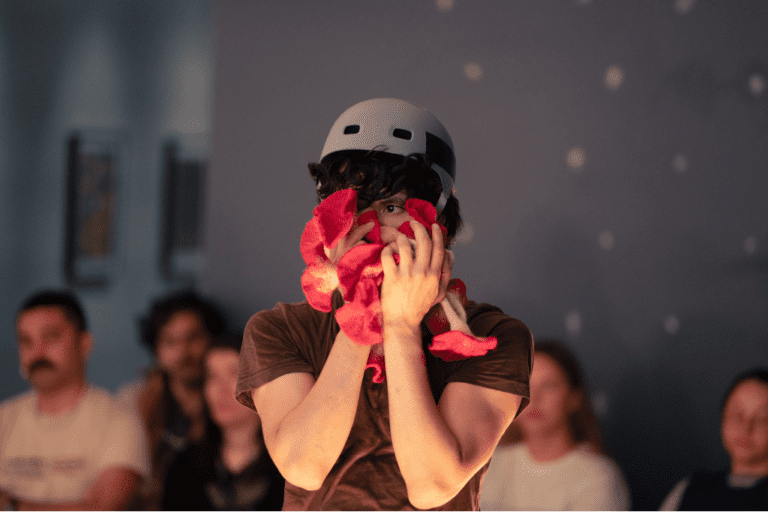
 iPhoto caption: Meilie Ng, Wai Yin Kwok, and Sophie Gee in 'Bonnes Bonnes.' Photo by
Eden Graham.
iPhoto caption: Meilie Ng, Wai Yin Kwok, and Sophie Gee in 'Bonnes Bonnes.' Photo by
Eden Graham.
A lot of plays use intensity to grab the audience’s attention, but sometimes it’s more meaningful for characters to simply hang out.
Bonnes Bonnes, co-written by Tamara Nguyen and director Sophie Gee, uses Jean Genet’s classic 20th-century drama Les Bonnes (The Maids) as a jumping-off point for three Canadian women’s reflections on their relationship to their Chinese heritage. This layered exploration spans personal childhood memories, shared cultural touchpoints, and even global economics.
What makes the show so welcoming is its playful atmosphere. Nguyen and Gee nestle the show’s insights into a relaxed conversation between friends; the resulting production, from Montreal-based company Nervous Hunter, exudes great warmth.
Playing at Factory Theatre in a co-presentation with Théâtre français de Toronto (TfT), Bonnes Bonnes ran for a few days in un-surtitled English, before switching to surtitled French. I saw both versions, and they depict the same story: the play’s three characters — who share first names with actors Gee, Meilie Ng, and Wai Yin Kwok — gather to preview Sophie’s new short-film adaptation of Les Bonnes. As the rough cut progresses on a downstage laptop (mirrored in rear projection for the audience), the trio makes chili sauce out of shallots, peppers, and garlic, occasionally pausing the video to chat.
Wai Yin is a first-generation immigrant from Hong Kong, but Sophie grew up in Alberta and Meilie in Quebec. Their different backgrounds prompt debate that’s friendly on the surface, but sometimes carries an undercurrent of tension.
For instance, when Sophie passes around an online recipe for chili sauce, Wai Yin questions why she doesn’t already know how to make it. Later, after Meilie says she’d like to use goggles while cutting chilis, Sophie jumps on the opportunity to showcase her experience, remarking that her family never needed protective eyewear. And the Canadian-born pair occasionally point out Wai Yin’s cultural blindspots, like not having seen Crazy Rich Asians. But there’s also plenty of concord: the three women agree that their cooking project is more authentic with the channel China Central Television running on a TV in the background (set and prop design by Maryanna Chan), and that Wai Yin’s physical reenactment of the difference between white and Chinese people’s posture is hilarious.
Languages interweave interestingly. While, in the French version, Meilie speaks fluent Quebecois, Sophie employs a kind of Franglais, often switching to English in emotional moments or when she can’t find the French translation of a word like “acknowledge.” The fact that Meilie is more practiced in the language they’re speaking should give her a little more power — except it turns out Sophie knows more Mandarin than Meilie, which comes in handy a few times, balancing out the linguistic dynamic. When they perform the English script, though, everyone is totally at home in the primary language, and we lose some of this complexity. (Mai Yin speaks all three languages with confidence, so she’s a steady, grounding force in both versions.)
In the French version, English surtitles accompany every line of French and English dialogue. Given TfT’s commitment to providing a 100 per cent French-accessible experience for their Francophone audience members (the company brings its own front-of-house team to rental venues), I was a little surprised that the surtitles didn’t switch to French for Sophie’s digressions into English. When it comes to the snatches of Mandarin, the production plays with non-translation more intentionally, surtitling the dialogue with Chinese characters — a choice that refracts the play’s ruminations on identity back at the audience, inviting us to consider our own relationship to the script’s three languages.
No matter the version of Bonnes Bonnes, Sohpie’s film is mostly in subtitled French (with projection design by Amelia Scott), and she says she’d like Wai Yin and Meilie to watch it with the eyes of “cultural consultants,” a notion that prompted laughter at both performances, presumably because the term implies a seriousness incongruent with the informal setting. Like the original Genet play, the film’s early scenes feature two maids role-playing as their rich offstage employer, known only as Madame. Two actors of Chinese origin play the maids: one is Chara Foo Tai Wei, a new face, but the other is again Meilie Ng, though the Meilie chopping chilis has no memory of appearing in the film — a curious ambiguity that doesn’t end up taking on much significance.
An overlap between the play’s two layers is the question of cultural assimilation: the maids’ desire to wear the jewels of their white mistress parallels the play’s other debates about Chinese-Canadian identity. At one point, Sophie confesses that her very desire to do Genet likely stems from an education that valorized the western canon. Toward the end of the show, Bonnes Bonnes’ two worlds further collide; I won’t spoil exactly how, but it relates to conceptions of labour, and China’s growing economic dominance on the global stage.
That’s a lot of thematic material for a 95-minute show, but Nguyen and Gee weave it smoothly into the friends’ conversation. Sophie, Meilie, and Wai Yin relax on stools as they prepare the sauce; the text, in both versions, feels highly colloquial and everyday, with the actors’ open, downstage-facing body language almost welcoming the audience as part of the friend group.
Overall, the vibe is lovely, and as Bonnes Bonnes continues to tour, I recommend the show to anyone who tends to find theatre stiff or uptight. It’s a nice reminder that productions can think, play, chill — and chili — all at once.
Bonnes Bonnes ran at Factory Theatre from April 15 to 26. More information is available here. The production plans to tour into 2027.
Intermission reviews are independent and unrelated to Intermission’s partnered content. Learn more about Intermission’s partnership model here.
Liam Donovan
Liam is Intermission’s senior editor. He lives in Toronto. His Substack newsletter is available at loamdonovan.substack.com.
LEARN MORE iPhoto caption: Ping-Hsiang Wang in 'Retina Maneuver.' Photo by Hang Su.
REVIEW: At this year’s SummerWorks Performance Festival, physical storytelling is central
From a dancer becoming a canine to a shy theatre director practicing his swordsmanship, the shows I’ve seen so far use performers’ bodies to dramatize defiance.
 iPhoto caption: Anna Morreale and Luca McPhee perform in 'From Stardust' at the 2025 MADGEN Theatre Festival. Photo by Dave Klassen.
MADGEN Theatre Festival returns to the Danforth
Theatre of the Beat selected four producers under the age of 30 to receive paid mentorship from Toronto theatre-makers. From August 20 to 22, each member of the cohort mounts a new one-act Canadian play.
 iPhoto caption: Steven Sutcliffe and company in 'Twelfth Night.' Photo by Dahlia Katz.
REVIEW: High Park Twelfth Night pays tribute to the crazy things we do for love
As the play’s events ping-pong between seriousness and frivolity, Caroline Toal’s Viola appears constantly aware of the dangerous contradictions in the air, remaining guarded against the chaos' pull — and yet never entirely abandoning the possibility of enchantment.
 iPhoto caption: Paul Gross in 'Waiting for Godot.' Photo by David Hou.
Why Paul Gross thinks Waiting for Godot is ‘one of the great achievements of human creativity’
“The audience is with you. You bring them in. There isn't a big division between the stage and the audience,” says Gross, currently playing Vladimir in Waiting for Godot at the Stratford Festival. “They’re the final piece of the storytelling. We need them to complete the circle.”
 iPhoto caption: Karl Ang, Ivy Charles, Daniel Maslany, Mariya Khomutova, and Alon Nashman in 'The Division.' Photo by Dahlia Katz.
Productions at Crow’s and Theatre Passe Muraille win top honours at the 2026 Dora Awards
This evening at Meridian Hall, the Toronto Alliance for the Performing Arts (TAPA) announced the recipients of the 46th annual Dora Awards, celebrating local theatre, dance, and opera.
 iPhoto caption: 'Golden Rez Dog.' Photo by Philippe Latour.
Creations from Denmark, Hong Kong, Iran, Mexico, and beyond feature in this year’s SummerWorks Performance Festival programming.
Comments