
REVIEW: This year’s Bealtaine Theatre Festival featured accordions, ketamine, and James Joyce
 iPhoto caption: Danny O’Mahony and Emily Kilkenny Roddy in 'Bellow.' Photo by Ste Murray.
The Bealtaine Theatre Festival, produced by the Canada Ireland Foundation (CIF), offers Toronto’s arts ecosystem two welcome things.
First and foremost, the festival serves up a curated program of contemporary theatre from Ireland — appreciated, in a city that punches below its weight in terms of international performing arts offerings from countries it doesn’t border (despite the efforts of Luminato Festival, Aluna Theatre’s RUTAS Festival, and SummerWorks Performance Festival).
And, as of this year, Bealtaine is based on the waterfront at the Corleck, a new year-round venue for the CIF, located across from Doug Ford’s latest epicentre of municipal interference. As Intermission staff writer Nathaniel Hanula-James noted in his introduction to a recent column on venue management, Toronto’s theatres have fought off skyrocketing rents decently well, with openings mostly offsetting closures, and the Corleck is another piece of good news — although during this year’s just-concluded Bealtaine festival, the multi-arts blackbox space was still under construction and not yet licensed to pour stouts.
Bealtaine, pronounced byal-tin-uh, refers to a Gaelic celebration of summer that officially arrives on May 1; the 2026 festival ran from May 21 to June 7. I saw three of the four featured productions, and the most interesting was Bellow, from the Dublin-based devised theatre company Brokentalkers. Somewhat like the Edinburgh-bound Canadian two-hander Big Stuff, which opposes a married couple’s approaches to guarding (or tossing) old objects, the production contrasts the aesthetic values of two artists: Brokentalkers co-artistic director Gary Keegan, who believes contemporary Anglophone theatre should break from its text-centred habits by prioritizing liveness and stage images; and Danny O’Mahony, a leading Irish accordionist whose practice revolves around his homeland’s traditional music.
Where Big Stuff takes a combative approach, Bellow attempts to reconcile Gary and Danny’s value systems. The logic: it’s a Brokentalkers show, so it must be formally non-traditional, but it’s about Danny’s life, so it must communicate his deep bond to tradition. As Danny shares his life story, from childhood prodigy to troubled adolescent to reflective middle-aged man, Gary breaks in with narration about the difficult creative process of blending the artists’ sensibilities.
The show becomes more image-based as it progresses. At first, Danny recounts his life plainly, alternating between virtuosic musical interludes and monologues of quiet truth. Gradually, Gary layers on additional theatrical elements, including a mask, clouds of haze, a gun, synthesizers, hand microphones, and a dancer named Emily Kilkenny Roddy. The power of Brokentalkers’ approach becomes evident: symbolism and abstraction pile up without obscuring the marrow of Danny’s récit. And so the show becomes a testament to the rich possibilities of dialogue between different generations and artistic communities. Maybe that fluffy adjective “interdisciplinary” means something after all.
Bellow resonates on a visceral level, but at times the contrast between Gary and Danny’s artistic philosophies is too neatly drawn. The ideals Gary shares about experimental theatre-making are similar to ones that have been around for decades, making them a tradition of their own — one the artist clearly feels a grave responsibility to respect. Defining the boundary between tradition and experimentalism isn’t always straightforward, and I was surprised the show barely acknowledged this.
Still, I found Bellow to be a deft piece of programming in the context of Bealtaine. Though the festival appeals to theatre-lovers, it also targets audiences interested in Irish culture more broadly. And on that front the show is a two-in-one: it’s both a concert from an excellent traditional Irish musician and an introduction to one of the country’s most prolific theatre companies.
If Bellow got audiences hooked on Brokentalkers’ vibe, the next week offered a chance to see another of their creations: Masterclass, presented at the Corleck by Luminato Festival. (Personally, I was off in Montreal.) The other couple of productions at Bealtaine were one-act solo shows — both charming, in different ways.
When it comes to Irish culture, You’ll See…, created by the children’s theatre company Branar, is even more pedagogical than Bellow: it’s a breezy summary of Ulysses appropriate for ages eight and up. With generous alacrity, performer and co-adaptor Helen Gregg flips through a large pop-up version of the book, designed and created by Maeve Clancy. She maneuvers small cupboard cutouts, narrating the journey of the novel’s protagonists, melancholy poet Stephen Dedalus and ordinary adman Leopold Bloom, through a sea of supporting characters living in Dublin on June 16, 1904. (The show is directed by Marc Mac Lochlainn, the other co-adaptor.)
While even young audience members could probably have handled a little more information about why Joyce’s novel is as important as it is — which I think could be accomplished without uttering “modernism” — it’s overall a very positive thing that Branar is introducing Gen Alpha to a literary touchstone in a manner so playful and encouraging. And at 45 minutes, the production is excellently paced.
Chicken, co-written by performer Eva O’Connor and director Hildegard Ryan, centres talking poultry and is credited to the company Sunday’s Child Theatre — but it isn’t at all for children. In this feverish cartoon of a monologue, performed in the round, O’Connor plays Don Murphy, an Irishman and celebrity cock who’s appeared in films next to such stars as Michael Fassbender and Colin Farrell. The show traces his life from growing up in county Kerry to discovering ketamine as an actor in the U.S. to having his first bird-on-bird sexual experience.
In a sense, Chicken is one joke stretched out to an hour — making it impressive how fresh it stays. An illogical intrigue that’s fun to follow is how much (or how little) Don’s universe resembles ours… and to what degree he is in fact a chicken. Because, when Don recounts his previous roles in films, it very much sounds like he’s an animal actor. But then sometimes he talks about hanging out in a trailer or attending the Oscars, and you wonder. The script also births a healthy flock of poultry puns; “cocksplaining” and “living claw-to-beak” made it into my notes.
But most of the production’s success lives on a physical level. Wearing a stunning sequined chicken suit designed by Bryony Rumble, O’Connor steals through the empty space, fluttering her hands every step or two; she slyly stares down audience members, relishing every brash beat of her madcap monologue. Why does Don circle the space like he’s on the hunt? What makes him so sure of his importance, and yet so blissfully passionate? I can’t answer these questions, or even tell you if the play’s brush with vegan politics is intended to be taken seriously. But I was hypnotized.
The 2026 Bealtaine Theatre Festival ran from May 21 to June 7. More information is available here.
Intermission reviews are independent and unrelated to Intermission’s partnered content. Learn more about Intermission’s partnership model here.
Liam Donovan
Liam is Intermission’s senior editor. He lives in Toronto. His Substack newsletter is available at loamdonovan.substack.com.
LEARN MORE iPhoto caption: Devon Michael Brown as Rusty Charlie with members of the 'Guys and Dolls' company. Stratford Festival 2026. Photo by Ann Baggley.
“It's so exhausting, but it's really rewarding when you get to dance so full-out,” says Devon Michael Brown. “You get to use your technique and your training to the fullest extent.”
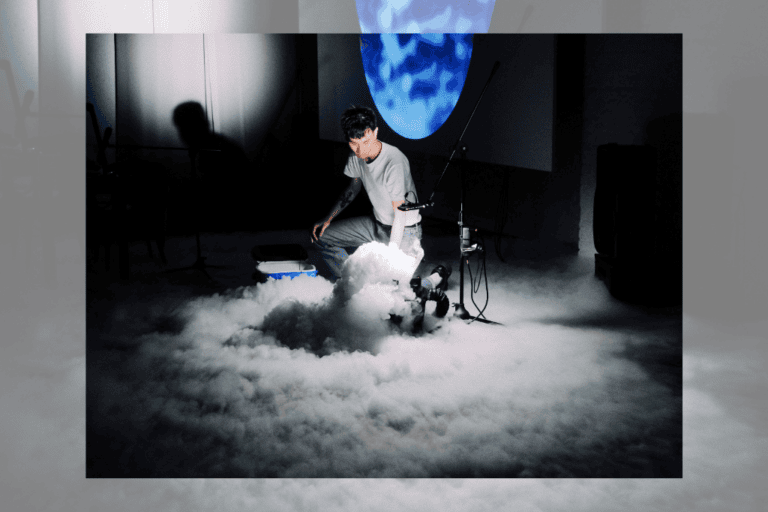 iPhoto caption: Ping-Hsiang Wang in 'Retina Maneuver.' Photo by Hang Su.
REVIEW: At this year’s SummerWorks Performance Festival, physical storytelling is central
From a dancer becoming a canine to a shy theatre director practicing his swordsmanship, the shows I’ve seen so far use performers’ bodies to dramatize defiance.
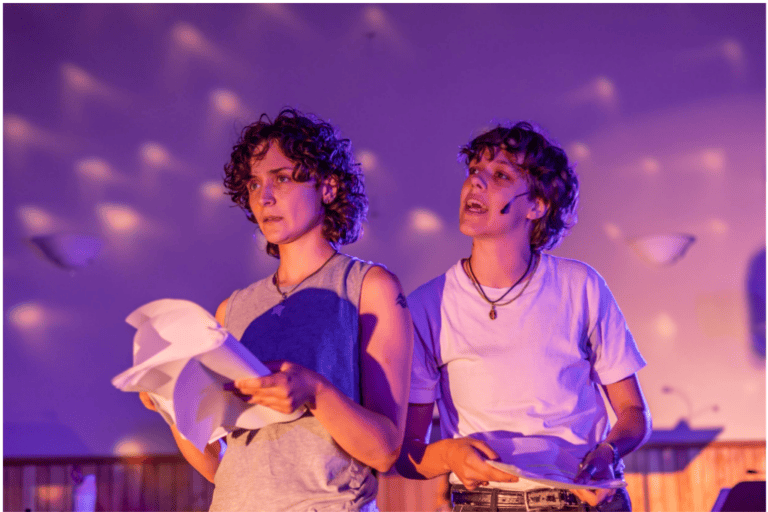 iPhoto caption: Anna Morreale and Luca McPhee perform in 'From Stardust' at the 2025 MADGEN Theatre Festival. Photo by Dave Klassen.
MADGEN Theatre Festival returns to the Danforth
Theatre of the Beat selected four producers under the age of 30 to receive paid mentorship from Toronto theatre-makers. From August 20 to 22, each member of the cohort mounts a new one-act Canadian play.
 iPhoto caption: Steven Sutcliffe and company in 'Twelfth Night.' Photo by Dahlia Katz.
REVIEW: High Park Twelfth Night pays tribute to the crazy things we do for love
As the play’s events ping-pong between seriousness and frivolity, Caroline Toal’s Viola appears constantly aware of the dangerous contradictions in the air, remaining guarded against the chaos' pull — and yet never entirely abandoning the possibility of enchantment.
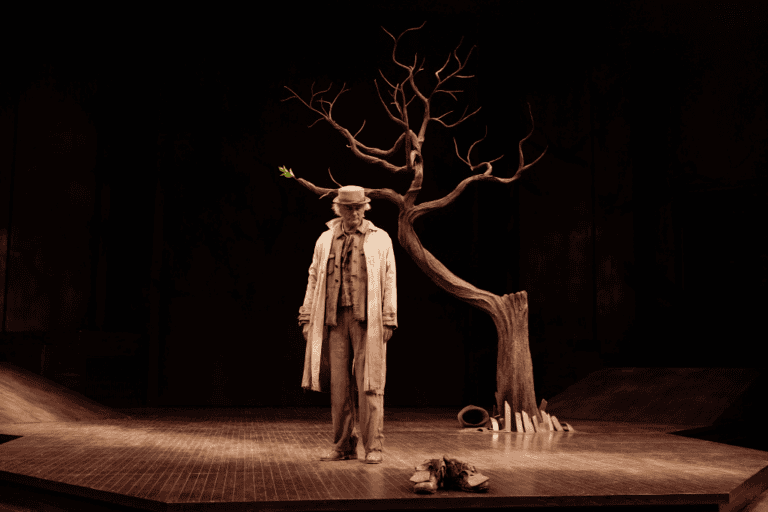 iPhoto caption: Paul Gross in 'Waiting for Godot.' Photo by David Hou.
Why Paul Gross thinks Waiting for Godot is ‘one of the great achievements of human creativity’
“The audience is with you. You bring them in. There isn't a big division between the stage and the audience,” says Gross, currently playing Vladimir in Waiting for Godot at the Stratford Festival. “They’re the final piece of the storytelling. We need them to complete the circle.”
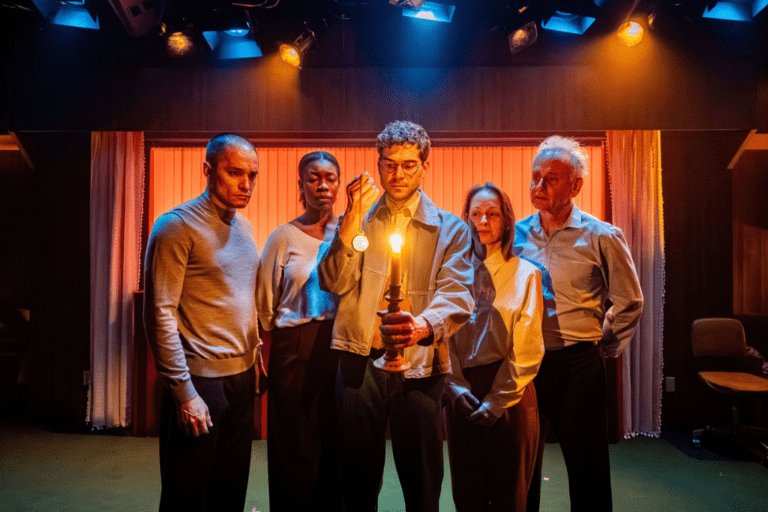 iPhoto caption: Karl Ang, Ivy Charles, Daniel Maslany, Mariya Khomutova, and Alon Nashman in 'The Division.' Photo by Dahlia Katz.
Productions at Crow’s and Theatre Passe Muraille win top honours at the 2026 Dora Awards
This evening at Meridian Hall, the Toronto Alliance for the Performing Arts (TAPA) announced the recipients of the 46th annual Dora Awards, celebrating local theatre, dance, and opera.
Comments