
Three genre-blurring SummerWorks productions meditate on memory and loss
 iPhoto caption: Photo of 'the body symphonic' by Giuseppe Follachio.
As Toronto swelters in successive heatwaves, your ice cream isn’t the only thing melting.
At the annual SummerWorks Performance Festival, which favours bold formal experiments, the lines separating artistic disciplines promise to become just as liquid. During this August’s iteration of the curated, city-spanning event, three productions blur the boundaries between choreography and concert.
Bleu Néon, choreographed and performed by Châu Kim-Sanh, fuses the artist’s movement practice with Vietnamese rap to reflect on diasporic experiences of nostalgia. In Graveyards and Gardens, choreographer Vanessa Goodman and composer Caroline Shaw duet within a circle of orange XLR cables and glowing lamps, conjuring an abstract meditation on grief and memory. And during the body symphonic, Charlie Khalil Prince processes grief and rage regarding events in his home country of Lebanon through a mix of dance, live music, and soundscape.
Beyond their blending of forms, these works resonate with each other on multiple wavelengths.
In a joint Zoom interview, Châu and Goodman both described stepping outside their comfort zones to create their respective pieces. When Châu began developing Bleu Néon in 2019, she soon decided that Vietnamese rap would be central to the piece. There were only two problems. Though Châu’s parents are from Vietnam, she grew up in France and isn’t fluent in Vietnamese. Also — she didn’t know how to rap.
“I worked with a Vietnamese rapper who lives in Toronto [named] Jay V,” said Châu. “I gave him a bunch of notes and journals, and Jay wrote… pages and pages” of lyrics in Vietnamese. (In a full-circle moment, Jay V will open Châu’s August 12 performance with a 15-minute set — the first time the artists will have performed onstage together.)
It took Châu a year to learn Jay V’s raps, as well as how to deliver them properly, with support from several mentors. At first, she said, her rapping was “extremely shy, because I didn’t want to be inappropriate.” But one teacher, Vladimir “‘7Starr”’ Laurore, offered Châu advice that stuck: “’Rap music is about being confident. If you want to respect the practice, you have to get out of this shyness.’” That moment helped her grow both as a performer and as a person, she explained.

Goodman’s biggest hurdle was overcoming a longstanding fear of singing. Early in her training, she had even decided not to attend the dance program at Toronto Metropolitan University (then Ryerson), “because there was a singing component in the dance department.”
In 2015, Goodman then found herself paired with Shaw for a five-minute improvisation as part of Vancouver’s Modulus Festival. A composer and musician, Shaw “really changed me as an artist,” said Goodman. “She cracked something open in me.” These days, she added, “I can’t seem to make a work where I’m not somehow vocalizing or looping sound.”
The body’s tools for vocalizing are central metaphors in Graveyards and Gardens. “Caroline often talks about our mouth [and] skull being chambers… built for sound,” Goodman said. In performance, Graveyards creates its own immersive sonic chamber using spatial audio, “different loop pedals, analog technology, record players, and cassette players.”
The image of a chamber is also part of the work’s discursive reflection on memory, archive, decomposition, and regeneration. Goodman remembered how “one of the things that happened when we were in [the creation phase] was that Notre Dame burned down in France. Cathedrals are [also chambers] made for sound. We were thinking about [those] beams of wood that [held so much] history.”
Prince, for his part, has taken the beams that — figuratively — held up his piece, and demolished them: the body symphonic that SummerWorks audiences will experience is a wholesale reimagining of an earlier version.
In a phone interview, the Lebanese artist described how he created that first iteration in response to “events that I was experiencing where I’m from, namely the [2020] explosion in Beirut, and the failed revolution” of 2019, and the “rage [and] grief” he felt at the time.
Over the years, however, “the more I performed it, [the more I felt] I was stepping into that emotional role… in a way that didn’t feel authentic to me anymore.” The new work, which Prince first shared in New York last year, is “a transposition of the old piece, but for a different time” and political moment.

By now, another parallel between these three works may have become clear: Each one dances with loss in a different way — loss of language, loss of archive, loss of life.
The artists were keen to connect those losses to larger cycles of change, both within the work, and within themselves. Prince described how, at the end of every performance, he embraces a loss of control and a return to vulnerability.
In “the last 10 minutes of the piece, I often don’t know what’s going to happen,” he said. “My only score is to move towards a place of exhaustion.” It’s “always a vulnerable place, but [one] that I ultimately enjoy.”
Châu and Goodman’s lives have changed in parallel ways since premiering their pieces: They’ve both become mothers.
“I’ve lost the ability to remember nouns,” said Goodman, “[which] apparently is common after postpartum. So I have a totally different relationship to memory from when [we started touring].”
As well as having a child, “I lost my father [in the years] since I premiered [Bleu Néon],” said Châu. “I [found] myself in between the process of losing and giving birth. I realized, once we lose our parents, it’s like our roots are cut. My relationship to Vietnam, my connections to my ancestors… [I’ve found that I have] to create it for myself” — and, she noted, with the next generation in mind.
Similarly, for Goodman, the SummerWorks run of Graveyards and Gardens will be charged with a sense of how precious family can be.
“My grandmother, [who lives in Toronto], is 101, and I don’t get to see her [often],” she said. “I’m literally bringing the show to Toronto because she’s the reason why I started dancing.”
SummerWorks Performance Festival runs from August 7 to 17. Tickets are available here.
SummerWorks Performance Festival is an Intermission partner. Learn more about Intermission’s partnership model here.
Nathaniel Hanula-James
Nathaniel Hanula-James is a multidisciplinary theatre artist who has worked across Canada as a dramaturg, playwright, performer, and administrator.
LEARN MORE iPhoto caption: Portrait of Eric Woolfe. Photo by Dahlia Katz.
Eric Woolfe’s inventive horror theatre is a monster mash of artistic influences
For the past 26 years, Eldritch Theatre’s director of the uncanny has given ghoulies, ghosties, and long-legged beasties of all kinds a spot in the limelight, in productions that serve up puppets, magic, and a crumbling castle’s-worth of uncanny influences, including schlock-horror B-movies, Shakespeare at his bloodiest, and the fiction of H.P. Lovecraft.
 iPhoto caption: Nate Yaffe in 'Rot Hat.' Photo by Kinga Michalska.
This year’s SummerWorks Performance Festival strives to make accessibility intrinsic
The curated festival’s 36th edition features a range of works by Disabled and neurodivergent artists where the medium is very much the message.
 iPhoto caption: Laura Del Papa, Hilary Scott, and Lara Lucia in 'Brontë: The World Without.' Photo by Raph Nogal.
GFT’s Brontë: The World Without is a window into the ordinary lives of literary icons
Directed by Helen Juvonen in Guild Park and Gardens’ Greek Amphitheatre, The World Without follows sisters Emily, Charlotte, and Anne Brontë — the authors of Wuthering Heights, Jane Eyre, and The Tenant of Wildfell Hall, respectively.
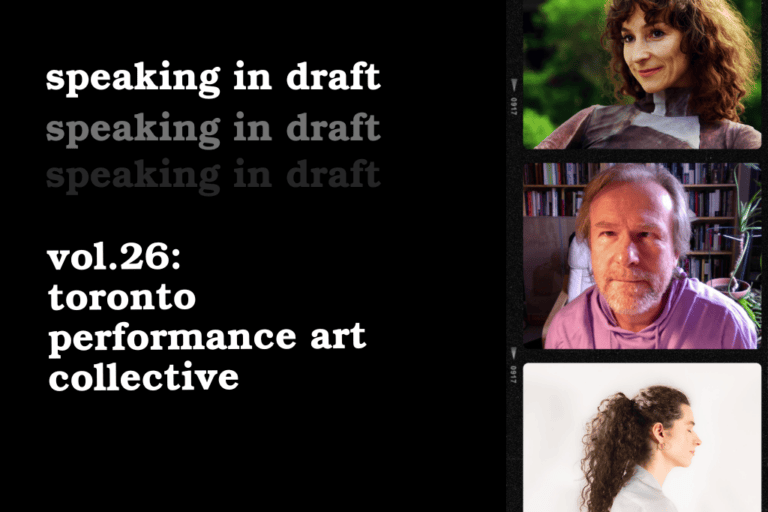 iPhoto caption: Photos of Shalon T. Webber-Heffernan, Paul Couillard, and James Knott courtesy of 7a*11d.
The organizers of the 7a*11d festival want you to know that performance art is still ‘punk as hell’
"There’s something about being live, with a sweaty, stinking, gross, dirty body, that’s just — you’re in it," says collective member Shalon T. Webber-Heffernan. "There’s some kind of alchemy going on that’s addictive to me. I think 7a*11d is sort of the dealer, if you will! It’s keeping us all hooked onto this weird obsession."
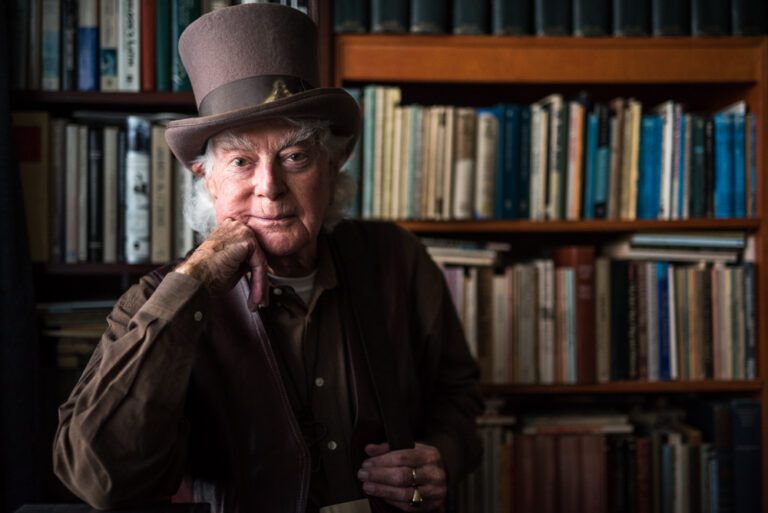 iPhoto caption: Peter Wylde for Intermission Magazine. Photo by Dahlia Katz.
In memory of Peter Wylde, the time-travelling acting teacher
What follows is an edited and condensed collage, loosely organized by theme, that only scratches the surface of Wylde’s life and impact.
 iPhoto caption: Dance Macabre cast. In photo: Keira Marie Forde (front). Back: [L to R] Uche Ama, King Cosmos, Theresa Gomes and Thomas Fournier. Photo by Tiku Romello Fisher (TRF Media).
At the 2026 Toronto Fringe, Caribbean artists stage collisions of identity, power, and desire
In separate video conversations, the lead artists behind Danse Macabre, Ex-Change of Words, and Momme Domme spoke about approaching themes of Blackness, diaspora, power, and desire.
Comments