
REVIEW: National Ballet’s scrumptious Nutcracker will melt every last Grinch-heart in town
 iPhoto caption: Isabella Kinch, Ben Rudisin and Christopher Gerty in 'The Nutcracker.' Photo by Bruce Zinger.
I was once a Nutcracker naysayer. I didn’t see it as a child, and after watching a few snoozy productions with long drawn-out party scenes told in textbook steps, I wrote the whole ballet off as an exhausted tourist attraction. I realized its necessity for kids and as a vital financial life raft — the National Ballet of Canada (NBoC)’s nearly month-long run bankrolls nearly half of their season, for example — but not as a ballet for me. But this year, the NBoC’s 30th anniversary performance of James Kudelka’s The Nutcracker melted even my own cold, Grinch-y heart. It’s a scrumptious feast for the eyes, full of youthful glee, jewel-toned wonder-worlds, and good-humoured dance.
In 1995, the NBoC wanted a Nutcracker that could compete with theatrical spectacles like Phantom of the Opera, with its chandelier crashes and labyrinthine sets. They ponied up $2.7 million and hired Broadway design king Santo Loquasto to reimagine a look distinct from Balanchine’s mid-century iteration from 1954 or Nureyev’s baroque-looking, faintly creepy staging from 1968. The result is a palatial, storybook, and unmistakably family-forward production that requires over 300 performers (drawn from an even larger pool, since casting rotates) and stage crew on each night of its annual 30-plus show run.
Kudelka, who grew up on a dairy farm in Newmarket, retooled the plot accordingly. Gone are Clara and her princely fantasy, and in her place are rival siblings Marie and Misha (National Ballet School students Ella Sachdeva and Angus Crerar), who alongside their stable-boy bestie Peter (Larkin Miller), open the show by sweeping up their farmhouse for a Christmas Eve party. Despite the decades between their ages, Crerar and Miller form boyish reflections of each other as they perform flexed-foot heel digs and playful leaps and lifts. And Miller, a new father this year, dances Act One with palpable generational tenderness.
As guests arrive to Tchaikovsky’s light opening melodies, Kudelka’s rural nostalgia erupts into a barnyard-circus revue. The show features 57 animal characters, each with oversized personalities. But the runaway hit is the mascot brown bear duet — she en pointe; he en rollerblade. We’re used to seeing ballet dancers as hyper-aligned vectors of elegance; here they’re shaggy, wobbling comedians. Their heroic teetering reminds the audience how superhuman the pointe work to come in the second act really is.
We meet the siblings’ mysterious Uncle Nikolai (Donald Thom), who whirls in a hefty coat that somehow never derails Thom’s sheer panache or crisp turns à la seconde (quick spins with one leg extended to the side, perfectly parallel to the ground). He gifts Marie a nutcracker; the children squabble, fall asleep, and at midnight their room explodes into chaos: animals burst in, twin chimneys cough up a raging Goat and Rooster, and the nutcracker evolves into a full-sized man resembling Peter (also performed by Miller) that fends off the madness before whisking the kids into another realm.
The tone pivots from manic shadow-play to celestial hush, as if the whole theatre has been gently inverted like a snowglobe. The ensuing snow scene truly switches on the ballet. As Jennifer Holman notes in her ballet history Apollo’s Angels, critics panned the 1892 premiere of The Nutcracker — with the exception of the snow scene, which was widely beloved for its impressionistic air and intricate formations.
Today, in Kudelka’s choreography, it remains a stunner with many of the same qualities to praise. Isabella Kinch, Christopher Gerty, and Ben Rusidin dazzle as the Snow Queen and Icicles. Crystalline poses and synchronized turning jumps climax in a frankly outrageously cool lift, where Kinch floats in an airborne handstand, unbothered and radiant.
After intermission, Tchaikovsky’s score unfurls like a silk ribbon, shifting to grander musicality. Act Two opens with the Sugar Plum Fairy (Geneviere Penn-Nabity) emerging from a golden Fabergé egg. Her solo is stately, athletic, and appropriately saccharine with jazzy turned-in poses and pirouettes that freeze in calm single-leg balances before touching down.
Miller, too, lofts through spinning pas de chat leaps with sugary ease. But the Nutcracker’s psychological arc strikes me as murky. Is he a wooden doll? A romantic hero? A farm kid in formalwear? Or the dreamy embodiment of a child’s wonder? Miller could credibly dance any of them, but the choreography never commits. Psychological arcs may not seem important given that The Nutcracker is a simple family show, and primarily a variety show at that, but the Nutcracker is one of the sole hinges between acts — and the namesake. Act Two could afford him more narrative weight, especially if he’s meant to be a sensitive ally to children.
Still, the cavalcade of whimsy hardly lets up. A delightful Sheep (Brenna Flaherty) and Fox (Noah Parets) lead a troupe of schoolchildren lambs who bounce adorably off-beat. And Kudelka’s non-canonical Bee (Jeannine Haller) is a clever, butt-tittering alternative to the Dewdrop or Rose Fairy. Classical roles for women are so often delicate fairies or princesses, so it’s nice to see one swapped out for a magical thing with wings rooted in reality — and technically there’s no reason it couldn’t be a unisex role.
By the time the cast gathers in a happy banquet finale, replete with goofy waiters in orange jumpsuits, I see why families travel from far and wide to see the NBoC’s singular version. Kudelka’s Nutcracker treats children as imaginative equals and adults as worthy of a sprinkling of magic, too. It’s an unwavering, saturated dream of joy you never want to wake up from.
Consider me converted.
The Nutcracker runs at the Four Seasons Centre for the Performing Arts until December 31. More information is available here.
Intermission reviews are independent and unrelated to Intermission’s partnered content. Learn more about Intermission’s partnership model here.

Lindsey King
Lindsey King is a Toronto-based freelance writer and editor with bylines in Toronto Life, Maclean's, Canadian Business, Intermission, and The Creative Independent.
LEARN MOREComments
Leave a Comment
 iPhoto caption: From left: Vivien Endicott-Douglas as Han, Rylan Wilkie as George Abbot (top left), Sara Topham as Cath (top right), Angel Lo as Anna and Liz Der as Roni in 'The King James Bible Play.' Stratford Festival 2026. Photo by David Hou.
REVIEW: The King James Bible Play both finds and fumbles profundity in translation
Corbeil-Coleman’s best-known plays, such as Guarded Girls and Scratch, centre contemporary young women circling grief, inheritance, and intergenerational trauma. It might seem like a surprise, then, that The King James Bible Play opens with five men centuries ago — but it turns out that the intergenerational trauma in this case stretches back about 417 years.
 iPhoto caption: Members of the company of 'Play Dead.' Photo by Alexander Galliez.
Play Dead trades death-defying circus tricks for bigger emotional risks
“The idea of consequences in [Play Dead] can make someone think the show is a little dreary, but we think of it more as a surreal celebration of all the little things that make up life,” says performer and People Watching co-artistic director Jérémi Lévesque.
 iPhoto caption: Melissa James and Patrick Heusinger in 'Paranormal Activity.' Photo by Johan Persson.
REVIEW: Mirvish’s Paranormal Activity summons real screams — but crashes into a cheap shock ending
It’s a spooky, cleverly staged hoot, but audiences might be distracted by one glaring narrative spectre that could use an exorcism.
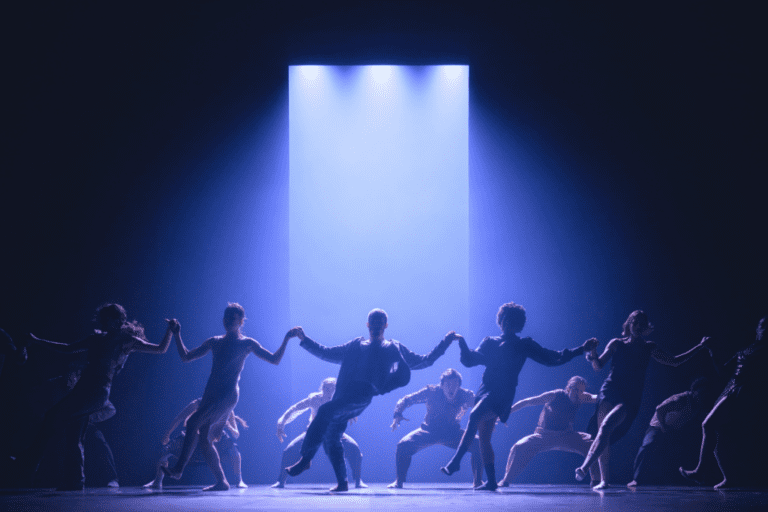 iPhoto caption: Members of the company of 'Theatre of Dreams.' Photo by Tom Visser.
It’s tough to tie Shechter’s style to any one dance lineage, but modern floorwork; commonplace gestures rendered sharp and frenzied; and loose, hip-circling movements often reserved for low-lit clubs evoke the woozy surreality of half-revealed consciousness.
 iPhoto caption: Amy Keating, Zorana Sadiq, Katherine Cullen, and Jean Yoon in 'Dance Nation.' Photo by Elana Emer.
REVIEW: Coal Mine Theatre’s Dance Nation vaults into the feral, ecstatic mess of girlhood
Played by a cast whose ages range widely, the characters exist in two tenses at once: present-day adolescence and retrospective memory, living these tender years shadowed by the adults they’ll become.
 iPhoto caption: Members of the company of 'Shucked.' Photo by Matthew Murphy and Evan Zimmerman.
REVIEW: Mirvish’s Shucked plants row after row of corny jokes
Shucked sits somewhere between a cartoon for adults and a wholesome farm musical.
Opening night was gorgeous. Couldn’t agree more with your criticisms, but it even so it was an incredible show for the whole family. Beyond worth it to see!