
REVIEW: In Playing Shylock, Saul Rubinek asks: ‘Am I Jewish enough yet?’
 iPhoto caption: Playing Shylock production still by Dahlia Katz.
“Am I Jewish enough yet?”
This year, Victoria’s Belfry Theatre cancelled a production of Christopher Morris’ 2019 Dora-winning The Runner. A monologue delivered by an Orthodox Jewish Israeli who decides to treat a young Arab woman before an IDF soldier, the play begged the audience to note the shared humanity of all parties. Written by a Canadian, it was shut down after protests accused it of centring Israeli voices, making the theatre space “unsafe” for community members.
Given these recent events, the stinging relevance of Playing Shylock, which opened on October 30 at Canadian Stage’s Berkeley Street Theatre (in association with Starvox Entertainment), may feel too close for comfort. Playwright Mark Leiren-Young here revamps his popular mid-1990s work Shylock, in which a production of The Merchant of Venice is cancelled mid-run amidst accusations of antisemitism. In this version, the lead role is no longer Jon Davies, a fictional Jewish actor who chooses to play Shylock as the villain he says Elizabethan England intended him to be, but star Saul Rubinek himself.
Leiren-Young adapts the play to fit our contemporary, hashtag-savvy world, where calls for a local cancellation can appear from any corner of the globe. Also explored are issues of identity politics in art — who is allowed to write what stories? Who may play what parts? — that feel immediately relevant. He incorporates Rubinek’s personal story, as “Saul” the actor stops the show in its second act after hearing that tonight will be its last performance.
Shawn Kerwin’s set and costume design scream “modernized Shakespeare,” presenting a Merchant set in a world on fire. The crumbling bricks of a church-cum-courtroom reveal a graffitied backdrop, spray-painted with the word JEW. Above a long, imposing table hangs the outline of an enormous, partially burnt cross crafted from wood, occasionally illuminated in gloomy and rich tones of blue (lighting by Steven Hawkins).
“Am I Jewish enough yet?” Rubinek begs, wearing, then stripping off the payos (side curls), tallis and yarmulke that turn him into Shylock. The son of Holocaust survivors who was born in a German Displaced Persons camp before immigrating to Canada with his family, he examines his father’s aspirations to act in the Yiddish theatre, where Shakespeare was often performed in translation — with an adjustment to make Shylock the hero.
Playing Shylock feels like it could not take place anywhere but the here and now, informed as it is by Rubinek and director Martin Kinch’s history with the nascent Canadian Stage, when it was called Toronto Free Theatre. Rubinek’s monologue implies that the theatre’s name change is fitting, as it is less free in both ticket prices and ability to program challenging content. That’s not to say freedom used to be total; Rubinek tells suspenseful stories of deciding whether or not to go ahead with productions that might have led to jail time, thanks to Toronto’s Morality Police.
He worries that we’re at a dangerous point where we have taken on the role of morality police ourselves, particularly those who haven’t even seen a work before condemning it. This reactionary attitude, he says, is worrying whether it comes from the right or left side of the theatre aisle.
The play’s metatheatricality is another selling point. We’re never completely sure where Rubinek the actor and the character diverge. When Rubinek slips into Shylock’s soft voice, accented with the Polish strains of his grandfather’s words, judgment shaking in every dignified mannerism like the tsking of an ever-working tongue, we’re better able to appreciate that “Saul” is just another act.
Rubinek’s stories about his family are heart-wrenching, keeping the play from slipping into “Uncle Saul at the Thanksgiving table” rant territory. Particularly stunning are moments when he talks about his father’s need to act, and about the Polish farmers who hid his parents for more than two years. Rubinek darkly relates that the husband beat his wife upon finding the hidden Jewish couple, even though he kept their secret. Can we deal with the cognitive dissonance of lauding the farmer for some actions, while condemning others?
The personal aspect gained with Rubinek’s story is both moving and ironic. If Rubinek weren’t sharing his trauma credentials, the show asks, what reactions might we have to his character’s assertion of being “Schrödinger’s minority,” deemed either non-white or white, too backward or too intellectual, uber-Communist or uber-capitalist, depending on what’s convenient to hate? Is it only acceptable if the accent he affects is his grandfather’s voice, or not even then? Am I Jewish enough yet?
While his words are peppered with spicy commentary, Rubinek’s affable personality and Leiren-Young’s use of humour make the dish go down surprisingly easily. Strangely, his claim that Merchant wasn’t written by Shakespeare winds up feeling like both his oldest and hottest take.
Even that tangent reinforces the main message — yes, theatre and acting are inherently appropriative, but in trying on, imagining, and hearing others’ stories we develop understanding and empathy, and it’s very difficult to draw a hard line without having unintended consequences. In other words, like The Runner (if more bluntly and demandingly), it begs the audience to note the shared humanity of all parties.
Maybe the discussion’s not that easy. Maybe it is. There are certainly other reasonable points of view Leiren-Young’s script doesn’t consider.
Am I Jewish enough yet?
A century ago, members of my family operated The Standard, Toronto’s Yiddish theatre, a space now occupied by an RBC branch which was once a hotbed of Jewish leftist activism. The theatre’s license was threatened when its 1933 production of Eight Men Speak, about the raid of the Toronto offices of the Communist Party of Canada, was shut down by the same police that would later target the Toronto Free Theatre. The Standard eventually disappeared from the theatre world, a victim of apathy. Watching Rubinek’s Shylock, I wondered what The Standard would look like today, or what might have happened were it still functioning when the Rubineks left the DP camp for Ottawa, a potential chance for his father to perform again.
Theatre is consistently poised on a precipice where we worry that things will shut down because people care too little, or things will shut down because people care too much. In the nexus between those two states sits Saul Rubinek, espousing the fervent hope that theatre will, instead, teach us to care for each other.
Am I Jewish enough yet?
Playing Shylock runs at Canadian Stage until November 24. Tickets are available here.
Intermission reviews are independent and unrelated to Intermission’s partnered content. Learn more about Intermission’s partnership model here.

Ilana Lucas
Ilana Lucas is a professor of English in Centennial College’s School of Advancement. She is the President of the Canadian Theatre Critics Association. She holds a BA in English and Theatre from Princeton University, an MFA in Dramaturgy and Script Development from Columbia University, and serves as Princeton’s Alumni Schools Committee Chair for Western Ontario. She has written for Brit+Co, Mooney on Theatre, and BroadwayWorld Toronto. Her most recent play, Let’s Talk, won the 2019 Toronto Fringe Festival’s 24-Hour Playwriting Contest. She has a deep and abiding love of musical theatre, and considers her year working for the estate of Tony winners Phyllis Newman and Adolph Green one of her most treasured memories.
LEARN MOREComments
Leave a Comment
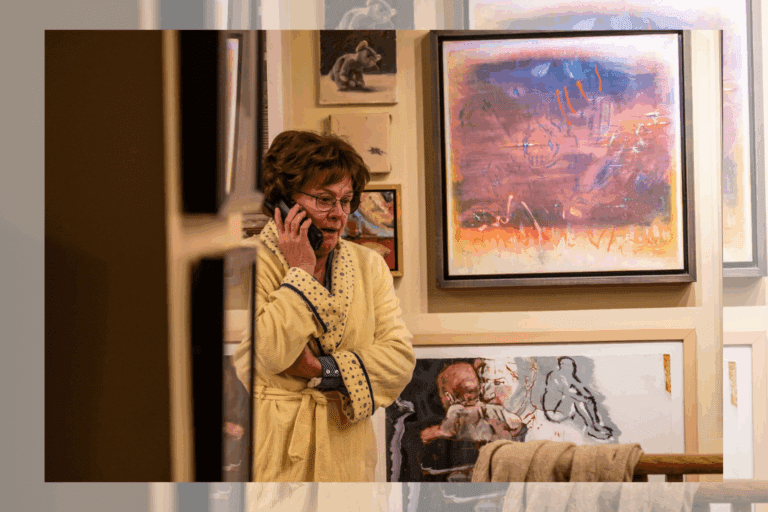 iPhoto caption: Jane Spidell in 'Twelve Dinners.' Photo by Dahlia Katz.
REVIEW: Family tensions run high in TIFT’s intimate Twelve Dinners
In the now-closed Twelve Dinners, an autobiographical play written and directed by Steve Ross, audiences received intimate access to an unvarnished version of a younger Ross through 12 evening meals with his parents.
 iPhoto caption: Members of the company of 'Narnia.' Photo by Dahlia Katz.
REVIEW: Bad Hats’ Narnia is a joyful, heartwarming escape
The spirit of openness and the joy of discovery rule over this Narnia. Open the wardrobe and see.
 iPhoto caption: Members of the company of 'Robin Hood.' Photo by Dahlia Katz.
REVIEW: Canadian Stage’s Robin Hood panto is anti-capitalist fun for the whole family
Following Ross Petty’s legacy of scene-stealing, Damien Atkins as the evil Prince John is easily the greatest delight of the show.
 iPhoto caption: Lauren Gillis and Alaine Hutton in 'Public Consumption.' Photo by Eden Graham.
REVIEW: Lester Trips’ stylish Public Consumption captures the internet’s profound emptiness
Rather than directly representing online life, Public Consumption speculates — with virtuosity — about how the digital world affects our bodies. And the show's findings are by no means comfortable.
 iPhoto caption: Tony Ofori and Daren A. Herbert in 'Moonlight Schooner.' Photo by Dahlia Katz.
Kanika Ambrose’s Moonlight Schooner is animated and visually stunning, but its individual pieces don’t come together as neatly as I would've expected.
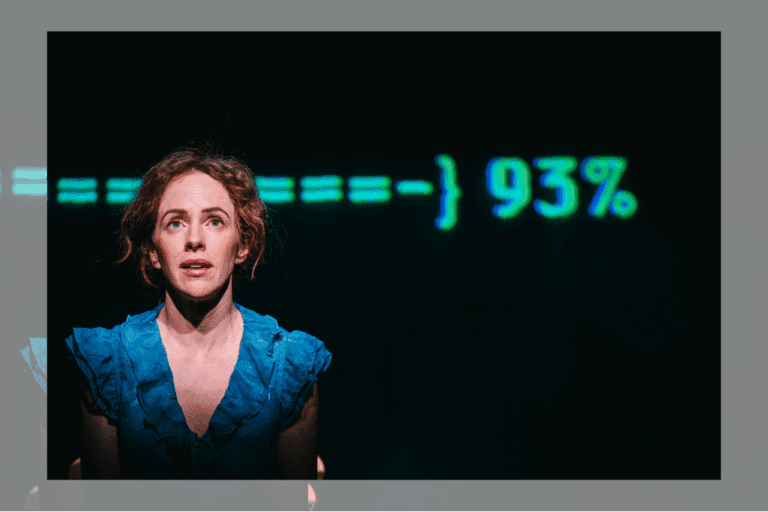 iPhoto caption: Fiona Mongillo in 'Reproduktion.' Photo by Ann Baggley.
REVIEW: Here For Now’s well-acted Reproduktion attempts to tackle too much
Amy Rutherford’s world premiere script is ambitious and the material it covers is complex — but the narrative feels disjointed.
iPhoto caption: Members of the company of 'Narnia.' Photo by Dahlia Katz.
REVIEW: Bad Hats’ Narnia is a joyful, heartwarming escape
The spirit of openness and the joy of discovery rule over this Narnia. Open the wardrobe and see.
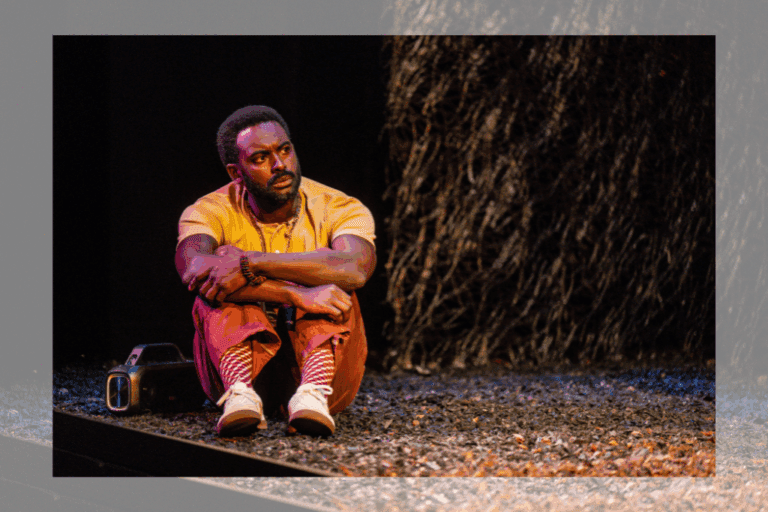 iPhoto caption: Mazin Elsadig in 'The Comeuppance.' Photo by Dahlia Katz. Set design by Shannon Lea Doyle, costume design by Ming Wong, lighting design by Jason Hand.
Macabre and drama-filled yet surprisingly gentle, The Comeuppance will probably be most compelling to the around-40 crowd who share its specific touchstones and millennial angst from a high-school experience bookended by Columbine and 9/11.
 iPhoto caption: Kaylee Harwood with members of the 'Bright Star' ensemble. Photo by Dahlia Katz.
REVIEW: Garner Theatre Productions’ Bright Star coasts on charm and likability
Bright Star covers it all: thwarted love, coming of age, family drama, the power of art, the importance of remaining true to oneself. Yet co-writer Steve Martin’s wit, which blazes in plays like Picasso at the Lapin Agile, merely twinkles here.
 iPhoto caption: The company of 'Ride the Cyclone.' Photo by Taylor Long.
REVIEW: Shifting Ground Collective delivers heartfelt, overloaded Ride the Cyclone
Director 郝邦宇 Steven Hao hits the carnival bullseye when it comes to heart and fun, but just misses the top prize by expanding the cast and reducing the original’s compelling creepiness.
 iPhoto caption: Photo by Dahlia Katz.
REVIEW: Dave Malloy’s Octet vibrates with sublime vocal beauty at Crow’s Theatre
Malloy’s intricate a cappella compositions, rich with complex harmonies, are the hymns and confessionals in a show about a support group for internet addiction. Regardless of what form their ego-feeding or doomscrolling compulsions take, the characters know it’s actually about appeasing what they call “the monster” inside — that gaping maw of emptiness that begs for shiny treats in the absence of real connection.
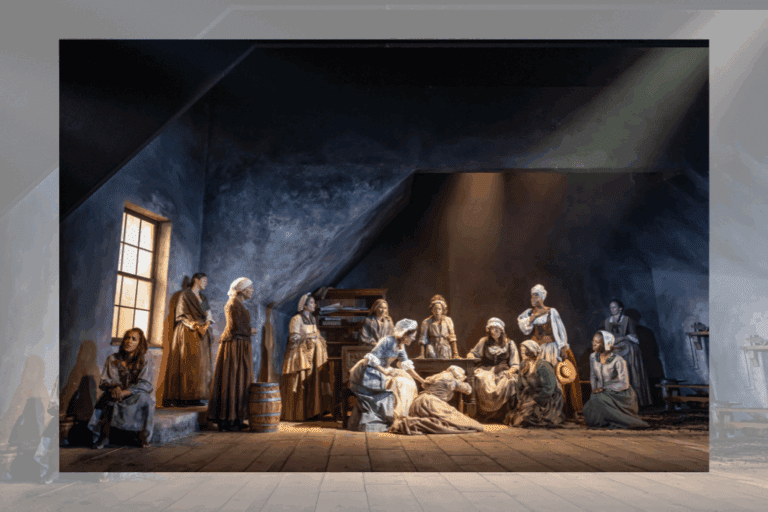 iPhoto caption: The company of 'The Welkin.' Photo by Dahlia Katz.
REVIEW: The Welkin careens from raucous comedy to crushing tragedy
The problem with human rights is that, if you believe in them, you have to apply them to everyone. Political opponents. Murderers. Your ex. People whose phones go off at the theatre. Women. The character of Sally puts this theory to a stress test; in bahia watson’s assured hands, she’s gleefully unlikeable, glorying in a storm of suspiciously modern swearing, lacking any flicker of conscience, and biting the hands that are trying to help her.
just wondering who in your family ran the yiddish theater a century ago?
my Grandfather, Isidore Axler, started the theater originally. He died in 1941
The theater was first called the Strand, then THeSTandard. It changed from live theater to a movie theater and the name was changed to The Victory, hoping that the allies would win the war. Which they did.
DR Jeff Axler