
REVIEW: Jon Fosse’s Suzannah collapses temporal planes into an endless wait
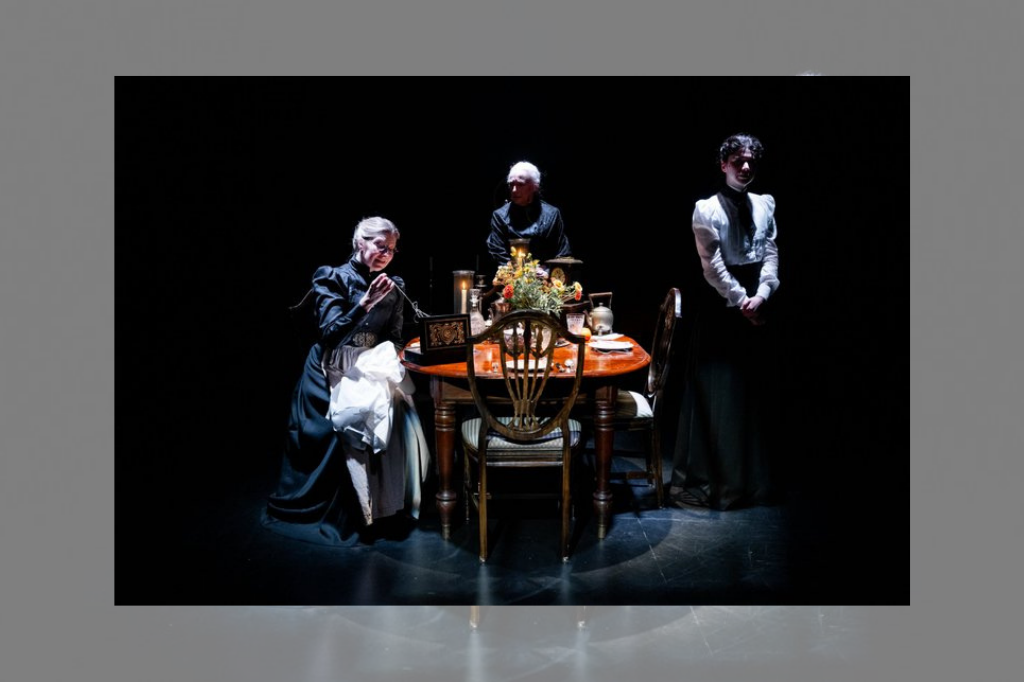 iPhoto caption: The cast of 'Suzannah.' Photo by Ann Baggley.
Few objects make perspective feel less trustworthy than a convex mirror. Take the one hanging at the centre of Jan van Eyck’s Arnolfini Portrait. Its outward-curving glass draws an entire room into miniature — the couple, the bed, scattered shoes, a small dog — revealing more than the eye could otherwise see while distorting everything it contains.
A convex mirror also hangs at the centre of Peter Hinton-Davis’s production of Suzannah — a play written by Norwegian Playwright Jon Fosse and centred on the wife of his great 19th-century compatriot, Henrik Ibsen. Suspended against a black backdrop, it reflects the thrust stage and Christina Poddubiuk’s spare set — a wooden table, four chairs, and a chest — compressing the room into its warped surface. Fosse’s script does something similar with time.
Over roughly 70 minutes, three versions of Suzannah coexist onstage: young (Brianna Rodrigues), middle-aged (Maev Beaty), and old (Rosemary Dunsmore). In May-Brit Akerholt’s rhythm-sensitive translation, their voices interlace, memories from decades apart accumulating until past, present, and recollection become difficult to distinguish. Each woman stands beside a table set for three, each waiting for someone.
“I am Suzannah Thoresen.” Bergen, 1855. A headstrong 19-year-old is waiting for Henrik Ibsen, determined to make him fall in love with her. Shoulders squared with self-possession, Rodrigues’s Suzannah is both eager and down-to-earth. She knows she is not beautiful — and that awareness makes her hand creep towards her neck and her gaze cloud. Nor is she under any illusion about Henrik: he is an awkward, not-yet-established playwright, and hardly the best match. So what? Rodrigues answers the objections with an impish laugh. Suzannah has made her choice: she will be Ibsen’s wife.
“I am Suzannah Ibsen.” December 23, 1866, Christiania — present-day Oslo. Sigurd turns seven today, and Suzannah waits for her husband and son to come home to celebrate. Yes, their family is dirt poor. Yes, Henrik’s wandering eye constantly lingers on younger women. Still, she keeps the household together and sustains his work. Behind every great man, a woman holding herself in. At one point, Beaty clamps a hand over her mouth, physically stopping the anger she has learned to swallow. Then, she sits silently at the table, mending clothes with an unsettling calm. She cries at the thought of other children mocking Sigurd’s oversized clothes, all the family can afford. Still, she endures. Still, she stays.
“I was Suzannah Thoresen.” Somewhere in the 1910s, in Christiania once again. Henrik is dead. Or perhaps he is alive, finally seated beside his wife. Nothing is certain in this splintered timeline, least of all Old Suzannah’s own mind. Except perhaps that today is her birthday, and she waits for her son to pay a visit. Dunsmore’s neatly arranged hair suggests a matronly composure. Her eyes, however, are forever turned inward, struggling to keep up with her own train of thought. She is cold, arthritic, her hands perpetually pressing against her legs. She speaks to an invisible Ibsen, a husband given to drink and always somewhere beyond her reach. Today is Suzannah Thoresen’s birthday. One wonders if that woman died the day she became Mrs. Ibsen.
Fragments of biography, repetitions, memory, and grievance shape Fosse’s collapsed chronology. They accumulate across three simultaneous temporal planes without ever coalescing into a stable portrait of Suzannah. Like the convex mirror behind them, the fuller image remains distorted. In Here For Now Theatre’s production, I found the effect hypnotic at first, then increasingly claustrophobic, as though the theatre walls were closing in around a script built on stasis.
The staging deepens that sense of confinement by repeatedly teasing the possibility of dialogue. The three Suzannahs turn toward one another, yet never quite connect, each stranded in her own temporal plane. Hinton-Davis arranges them in composed tableaux — now on a diagonal, now at different heights, their eyes often fixed somewhere above us — while Louise Guinand isolates them in narrow shafts of light. A window-like rectangle cast on the floor begins to resemble the outline of a prison cell.
That spatial and psychological confinement is, perhaps, where the play’s feminist charge lies: precisely in the failure of emancipation itself. In A Doll’s House, Henrik Ibsen gives Nora the radical conviction that she has a “duty to myself.” But unlike Mrs. Helmer, Fosse’s Suzannah never gets to slam that door. She struggles even to imagine herself except in relation to her husband. “And it’s me / who is Henrik Ibsen,” old Suzannah declares toward the end, Dunsmore giving the line a hoarse swell of despair.
“Ibsen,” perhaps, has the final word. I checked: the script repeats his name 181 times. And yet it’s Suzannah we still know so little of.
Suzannah ran at Stratford, Ontario’s Here For Now Theatre from August 19 to 30. More information is available here.
Intermission reviews are independent and unrelated to Intermission’s partnered content. Learn more about Intermission’s partnership model here.

Alessandro Stracuzzi
Alessandro Stracuzzi is a Toronto-based theatre critic and performance researcher from Italy. He holds an MA in Performance Studies from the University of Milan, and writes about contemporary theatre, performance, and experimental practices. His criticism has appeared in Stage Door, Our Theatre Voice, Stratagemmi, and Fermata Spettacolo.
LEARN MORE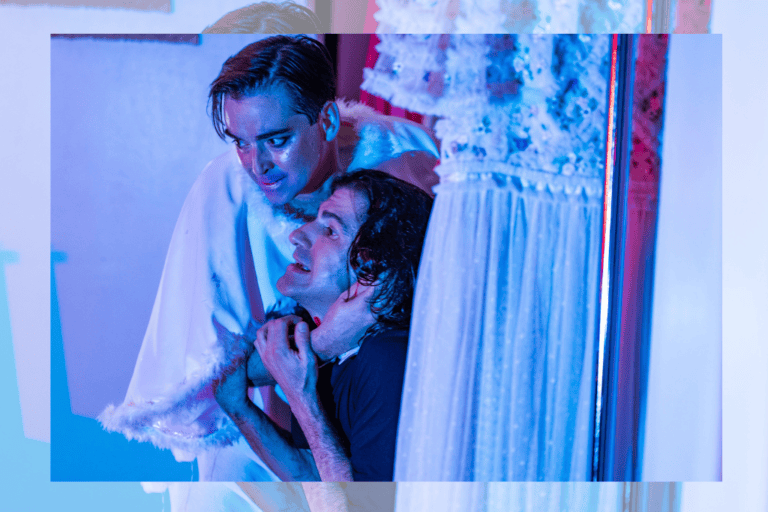 iPhoto caption: Billy Lake and Aidan de Salaiz in 'The Maids.' Photo by Dahlia Katz.
REVIEW: In Talk Is Free’s The Maids, reverence and rebellion share the same room
For all her impatience with the play, director Jillian Keiley chooses to stay rigorously within its terms, pushing its logic to an extreme and letting its contradictions show.
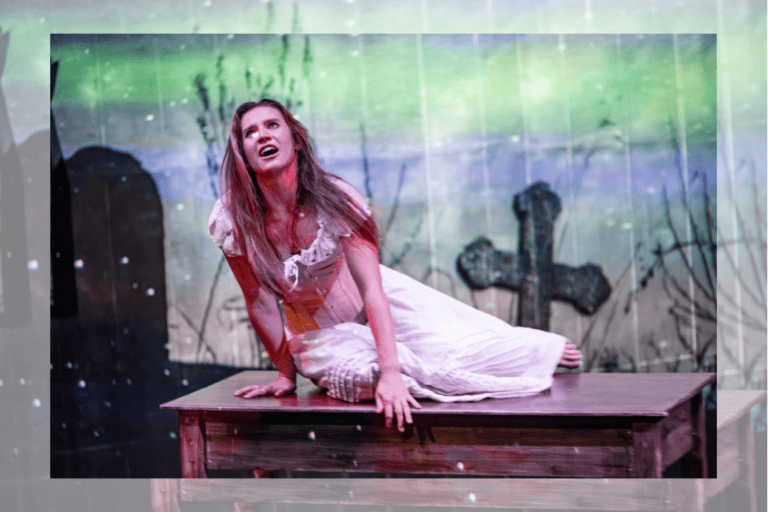 iPhoto caption: Juliana Monk in 'To a Flame.' Photo by Elana Emer.
REVIEW: To a Flame turns the deficit lens back on power
I left the theatre overstimulated, my attention stretched and my body still keyed up. For audiences willing to be swept up in that rush of sensation, that overload is part of the reward.
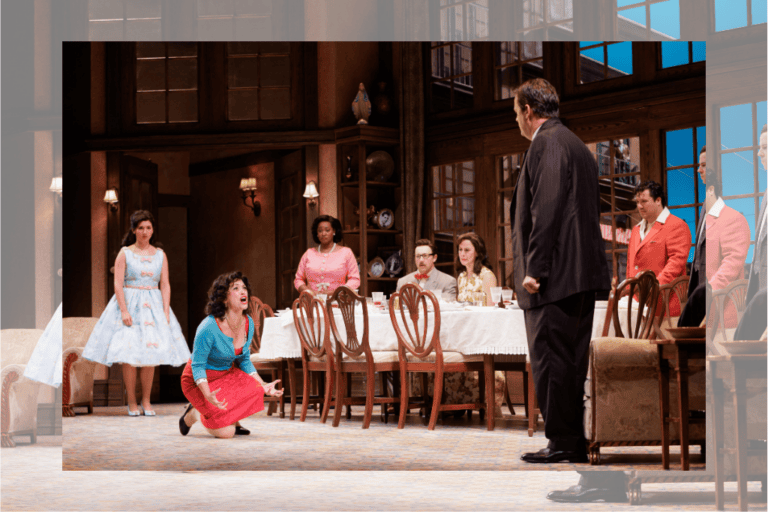 iPhoto caption: Rose Napoli as Rosa Priore (front left) and Graham Abbey as Giuseppe "Peppino" Priore (front right) with members of the company in 'Saturday, Sunday, Monday.' Stratford Festival 2026. Photo by David Hou.
REVIEW: Stratford’s Saturday, Sunday, Monday simmers into a rambunctious scenata napoletana
A pot of tomato sauce left unattended on the stove can only hold itself together for so long. So it is with the Priore family at the centre of Eduardo De Filippo's Saturday, Sunday, Monday. They bottle things up, turning every disappointment into a cordial grudge until resentment bubbles over in melodramatic eruptions.
 iPhoto caption: Photo by Jack Woolfe.
REVIEW: In Síofra at the Red Sandcastle, fairy lore curdles into communal dread
Spindle Collective’s unnerving Síofra takes us to 19th-century Ireland, where folklore gives a watchful community a language for the uncanny.
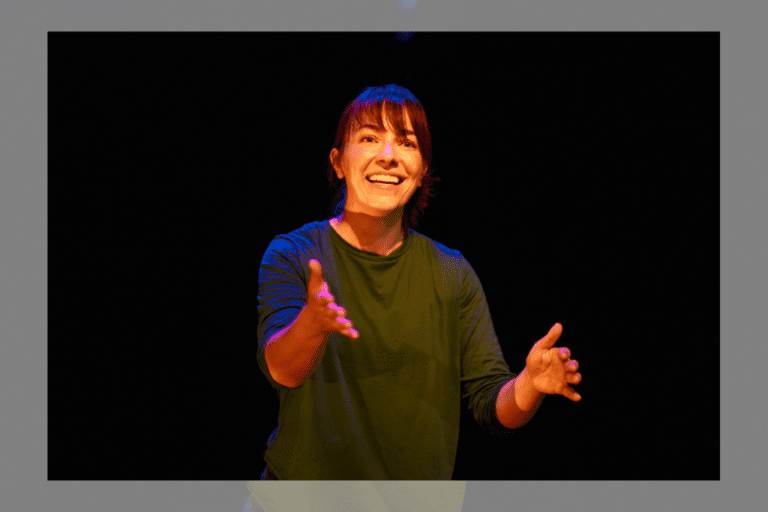 iPhoto caption: Janet McMordie in 'Vitals.' Photo by Nate Colitto.
REVIEW: In Rosamund Small’s Vitals, Toronto becomes a map of private catastrophes
The play cuts through the glossy image of health-care workers as haloed heroes, bringing us closer to people working through exhaustion, hypervigilance, and horror.
Comments