
REVIEW: To a Flame turns the deficit lens back on power
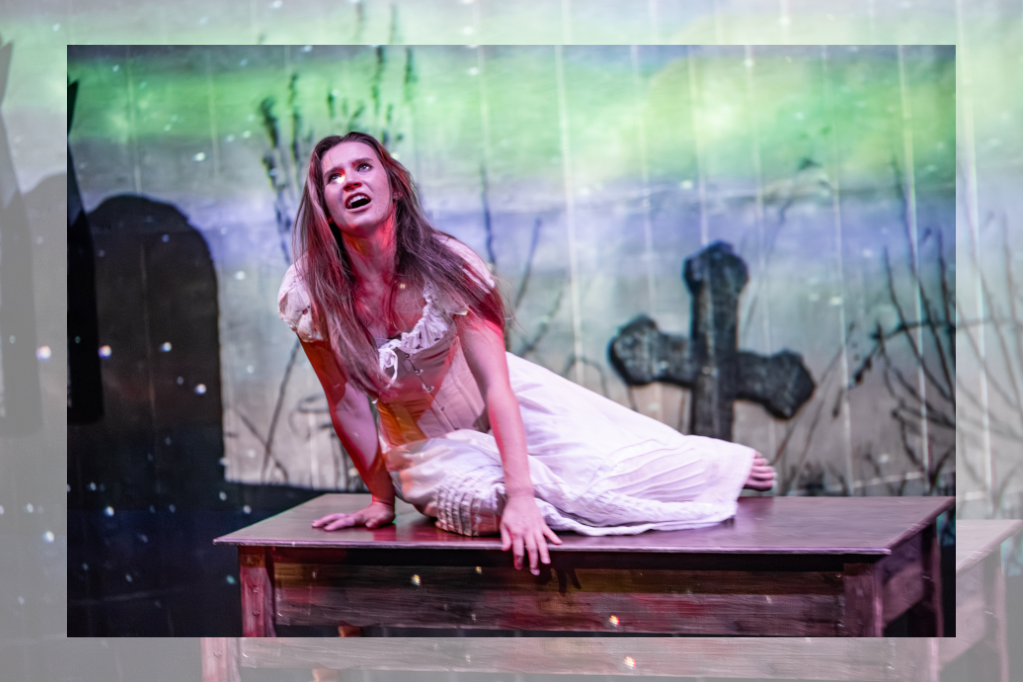 iPhoto caption: Juliana Monk in 'To a Flame.' Photo by Elana Emer.
Early in Erin Shields’ To a Flame, the impish Fanny (Juliana Monk) stamps her foot and declares, “I want a natural deficiency.” She feels left out. Both her sisters have been diagnosed with one: Harriet (Nickeshia Garrick) is Black and Madeline (Dawn Jani Birley) is Deaf, each carefully schooled in her supposed defects.
In the science-obsessed mansion where they live, progress is an imperative imposed by their much-invoked, never-seen Father. His logic treats difference as deficiency: to diagnose a deviation is to catalogue it — and, perhaps, to correct it. He trains his adopted daughters’ gaze onto the glow of erudition: Harriet receives books steeped in colonial theories of racial hierarchy; Madeline endures failed attempts to teach her to speak.
That uneasy relationship between knowledge and power animates this 90-minute Gothic horror story, a co-production of Nightwood and the Deaf-led 1s1 Theatre, in association with Modern Times Stage Company and Why Not Theatre. Upon entering the Nancy & Ed Jackman Performance Centre, you find the three actors poised onstage, their feet skittering nervously and their faces set in eerie smiles. They seem to be trying to communicate with us, only to check themselves mid-gesture.
Then Shields’ labyrinthine text begins, and onstage two languages coalesce: ASL and English. Birley, who is Deaf, and her two hearing castmates perform in both, without simply duplicating one in the other. One language sometimes trails the other by a beat; elsewhere, phrases remain untranslated. As a hearing audience member, I experienced that oscillation as an invitation to bridge the gaps myself — to attend differently and piece meaning together.
As the sisters recount their education under Father, the script unfurls in winding syntax and dark imagery that bear the imprint of Edgar Allan Poe’s “The Fall of the House of Usher,” an early inspiration for the creative process. As director-choreographer Josette Bushell-Mingo notes in the program, she and Birley first developed the material through physical improvisation, which later informed Shields’ writing.
Such movement-based exploration remains central to Bushell-Mingo’s staging. The characters fall into an anxious bodily grammar. Barefoot in raking side light, they erupt into convulsive bursts, limbs shooting in several directions at once; in another sequence, they parody a ballet lesson, circling in pliés as though they were at a barre. Again and again, the choreography disrupts the clean lines of the disciplined body, giving way to spasm and play.
Jung-Hye Kim’s minimalist set design amplifies that sense of instability. An oblique platform holds as little as a table and chair. Behind it, two tilted, dark-grey walls catch Laura Warren’s projections, situating the sisters inside a sumptuous mansion. But in imagery reminiscent of German Expressionist cinema, forms overlap and turn negative. Nothing stays fixed for long: stairs and windows warp in scale and perspective. Pseudo-scientific texts on racial anatomy flash into view. Occasionally, the projections even double the performers across the walls.
By unsettling our senses, the show asks us to encounter the world differently — a shift that extends from perception to relation. Shields’ account of colonial science is, ultimately, also a story of alliance. Garrick’s Harriet begins as the sternest of the sisters. She follows Father’s doctrine to the letter, her spine upright, her shoulders retracted. But Harriet gradually attunes herself to her sisters — to Madeline’s suffering and Fanny’s recalcitrance — allowing their experiences to dislodge the certainties she has been taught.
Through Deanna H. Choi and Jenna Geen’s sound design, I, too, became hyper-attuned. Wind, thunder, dripping water, and low vibrations keep the room in a state of uneasy alertness. Much of that unease gathers around cellist Beth Silver, seated at the platform’s edge. At first, her playing is composed and orderly. As the sisters’ world unravels, so does the music: notes distort and stretch into long, shrill tones that ripple across the skin and vibrate through the bones. Even when the production’s stylizations blur its narrative line, the pressure rarely slackens. The effect can be overwhelming: I left the theatre overstimulated, my attention stretched and my body still keyed up. For audiences willing to be swept up in that rush of sensation, that overload is part of the reward.
If Father’s authority depends upon what he deems natural, To a Flame turns that deficit lens back on the systems doing the diagnosis. It renders perceptible the coercive regime in which audism, racism, and patriarchy interlock, each policing what a body should be. But those bodies revolt. In one of the most spine-crawling sequences, the women run freely across the stage as projected moths scatter from the centre. A furtive, scuttering sound creeps through the space, lending their liberation a macabre charge.
By the end, the sisters loosen Father’s hold. They strip away their corsets. Their bodies expand.
They breathe.
To a Flame runs at the Nancy & Ed Jackman Performance Centre until October 4. More information is available here.
Intermission reviews are independent and unrelated to Intermission’s partnered content. Learn more about Intermission’s partnership model here.

Alessandro Stracuzzi
Alessandro Stracuzzi is a Toronto-based theatre critic and performance researcher from Italy. He holds an MA in Performance Studies from the University of Milan, and writes about contemporary theatre, performance, and experimental practices. His criticism has appeared in Stage Door, Our Theatre Voice, Stratagemmi, and Fermata Spettacolo.
LEARN MORE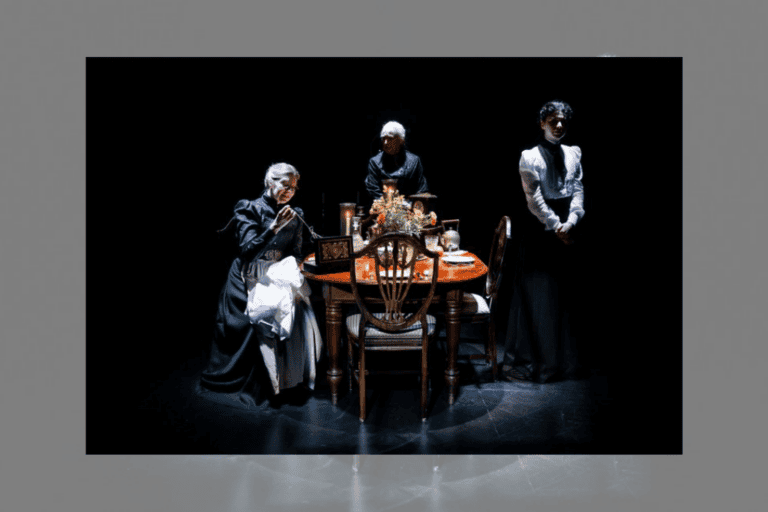 iPhoto caption: The cast of 'Suzannah.' Photo by Ann Baggley.
REVIEW: Jon Fosse’s Suzannah collapses temporal planes into an endless wait
Jon Fosse’s Suzannah fractures the life of Henrik Ibsen’s wife across three temporal planes, as fragments of biography, repetitions, memory, and grievance accumulate without ever coalescing into a stable portrait of Suzannah. The Here For Now Theatre production has closed, but this hypnotic, claustrophobic examination of a woman who struggles to imagine herself beyond her husband lingers.
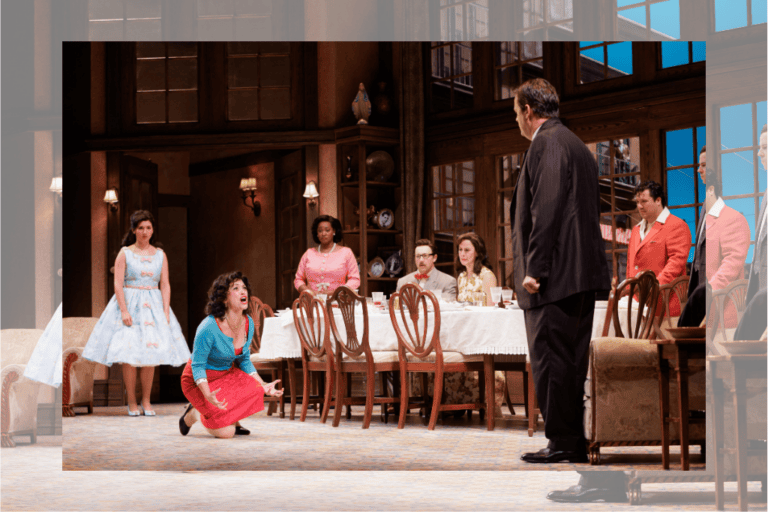 iPhoto caption: Rose Napoli as Rosa Priore (front left) and Graham Abbey as Giuseppe "Peppino" Priore (front right) with members of the company in 'Saturday, Sunday, Monday.' Stratford Festival 2026. Photo by David Hou.
REVIEW: Stratford’s Saturday, Sunday, Monday simmers into a rambunctious scenata napoletana
A pot of tomato sauce left unattended on the stove can only hold itself together for so long. So it is with the Priore family at the centre of Eduardo De Filippo's Saturday, Sunday, Monday. They bottle things up, turning every disappointment into a cordial grudge until resentment bubbles over in melodramatic eruptions.
 iPhoto caption: Photo by Jack Woolfe.
REVIEW: In Síofra at the Red Sandcastle, fairy lore curdles into communal dread
Spindle Collective’s unnerving Síofra takes us to 19th-century Ireland, where folklore gives a watchful community a language for the uncanny.
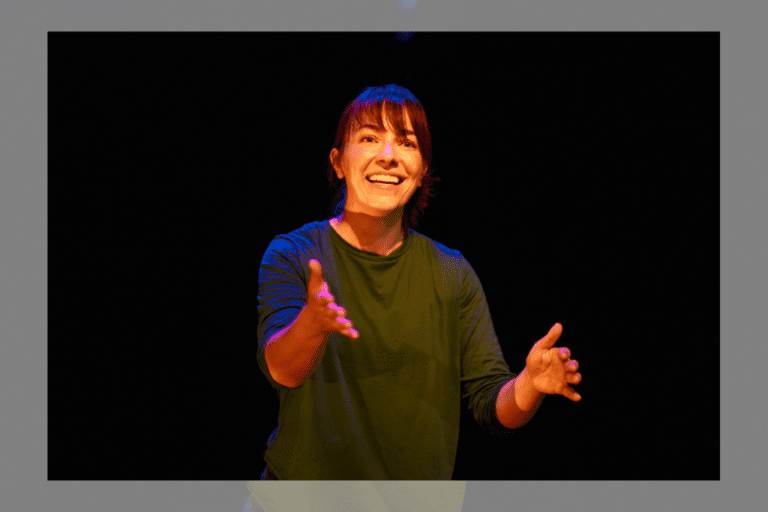 iPhoto caption: Janet McMordie in 'Vitals.' Photo by Nate Colitto.
REVIEW: In Rosamund Small’s Vitals, Toronto becomes a map of private catastrophes
The play cuts through the glossy image of health-care workers as haloed heroes, bringing us closer to people working through exhaustion, hypervigilance, and horror.
Comments