
REVIEW: TfT’s Rhinocéros soaks Ionesco’s existential malaise in broad farce
 iPhoto caption: Members of the company of 'Rhinocéros.' Photo by Mathieu Taillardas.
“An author should not have to deliver a message, because he is not a postman,” Eugene Ionesco quipped in a 1984 interview with the Paris Review. It’s one of my favourite pronouncements on theatre. I’ve highlighted it, underlined it and circled it so many times in my printed copy that the words are now barely legible. A case of too much enthusiasm obscuring the very thing it celebrates.
Something similar happens in Théâtre français de Toronto’s production of Ionesco’s Rhinocéros, performed in French with English surtitles at Canadian Stage’s Berkeley Street Theatre. Karine Ricard’s exuberant direction is keenly attuned to our political moment, as the resurgence of extremism makes this 1959 play particularly resonant. Yet at times, the production falls into a familiar trap of staging the so-called Theatre of the Absurd: trading existential anguish for comic eccentricity.
Beneath Ionesco’s bitter, neurotic laughter lies a profound mal d’être. Consider Bérenger, the unlikely hero of Rhinocéros. Over three acts, the inhabitants of his provincial town turn, one by one, into the titular animals — an allegory commonly read in relation to the rise of fascism in 1930s Europe. Bérenger alone resists the metamorphosis, only to find himself utterly isolated. By the play’s end, he even tries to turn himself into a rhino. But he cannot. Neither at home among humans nor able to join the herd, he embodies the vertigo of trying to find one’s place in a meaningless world.
But this spineless habitual drinker is hardly a paragon of virtue. Mickaël Girouard makes him a suitably pitiable figure. Shoulders slumped, face fixed in a perpetual frown, he seems almost amoebic, barely capable of holding himself upright. “Je me sens mal à l’aise dans l’existence” (“I feel ill at ease with existence”), he confesses to his friend Jean (Nicolas Van Burek), who is busy lecturing him about his negativity.
Across the stage, a logician (Sébastien Bertrand) and a proprietor (Pierre Simpson) string together increasingly preposterous syllogisms. Their crowning conclusion? Socrates was a cat. It’s a sly demonstration of how the language of reason can be twisted into nonsense. But Ricard pushes the scene toward broad slapstick. In a Mr. Bean-like routine, the proprietor repeatedly attempts to sit down, leaving the hapless logician scrambling to reposition his chair.
The production’s frenetic energy extends to its visual and musical palette. Melanie McNeill‘s costumes burst with shocking pinks, bright yellows, and clashing patterns, while Steáfán Hannigan’s festive jazz score weaves the scenes together. Yet the relentless pursuit of laughter sometimes backfires. When a rhinoceros tramples a passerby’s cat offstage, somewhere behind the audience, its owner (Christina Tannous) erupts into a barrage of shrieks and drawn-out wails. Despite the frantic effort to wring laughs from the moment, the eccentric choice landed with a thud at the performance I attended.
Beneath this clownerie, an undercurrent of disquiet occasionally breaks through, finding wonderfully poetic expression in Glenn Davidson’s set. As Bérenger repeatedly checks his forehead for signs of a horn, mirrors proliferate across the stage: there are hanging frames along the backdrop, wheeled reflective panels, and even glossy squares on the floor. The audience, too, is caught in this game of reflections, repeatedly confronted with its own image. Who, after all, is immune to the herd?
Some of Ricard’s most effective touches emerge from this design. During one scene change, the actors circle the stage, rearranging objects to a pulsing, oppressive score, their faces illuminated by the glow of their mobile phones. It’s a pointed evocation of today’s digital echo chambers, where algorithm-fed convictions can harden into extremism.
The arguments made in defence of the rhinoceroses even echo Karl Popper’s paradox of tolerance. Jean, initially horrified by the creatures, gradually becomes their defender. “Rhinoceroses are living creatures the same as us,” he declares. “They’ve got as much right to life as we have.” As Van Burek’s body contorts, his frame growing rigid and imposing, his voice swells into an animal bellow. The language of tolerance becomes a justification for surrendering to the herd.
Perhaps with fewer bizarre, buffoonish flourishes — and an interval during its 100-minute runtime — Ionesco’s provocative play would have more room to breathe. Still, there’s something admirable about TfT bringing Rhinocéros to a city whose stages teem with contemporary work but offer fewer encounters with the theatrical landmarks of the last century. (And hearing Ionesco’s words in their original French is a pleasure all its own.) More than six decades after it was written, this incendiary play still speaks to the present. It hardly needs to shout.
Rhinocéros runs at the Berkeley Street Theatre until November 8. More information is available here.
Intermission reviews are independent and unrelated to Intermission’s partnered content. Learn more about Intermission’s partnership model here.

Alessandro Stracuzzi
Alessandro Stracuzzi is a Toronto-based theatre critic and performance researcher from Italy. He holds an MA in Performance Studies from the University of Milan, and writes about contemporary theatre, performance, and experimental practices. His criticism has appeared in Stage Door, Our Theatre Voice, Stratagemmi, and Fermata Spettacolo.
LEARN MORE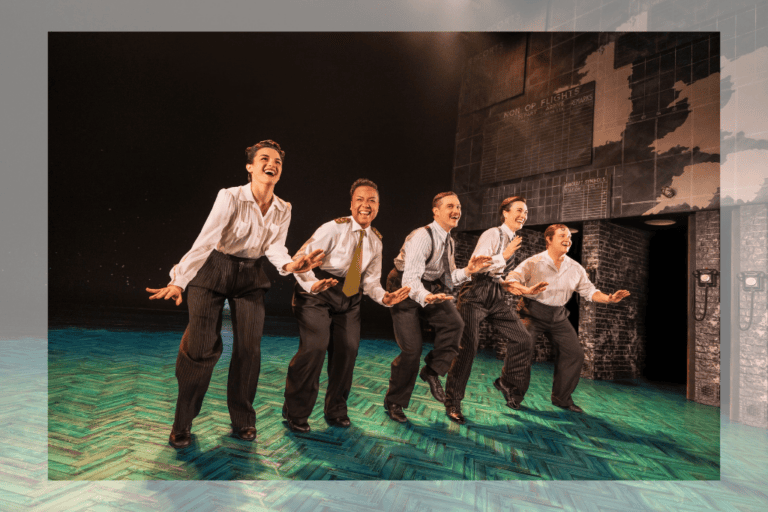 iPhoto caption: The North American tour company of 'Operation Mincemeat.' Photo by Matthew Murphy.
REVIEW: Razor-sharp and whip-fast, Operation Mincemeat is a killer musical
This gloriously over-the-top frenzy is every bit as good as the hype. And it has teeth, too: it skewers the pompous men calling the shots in wartime.
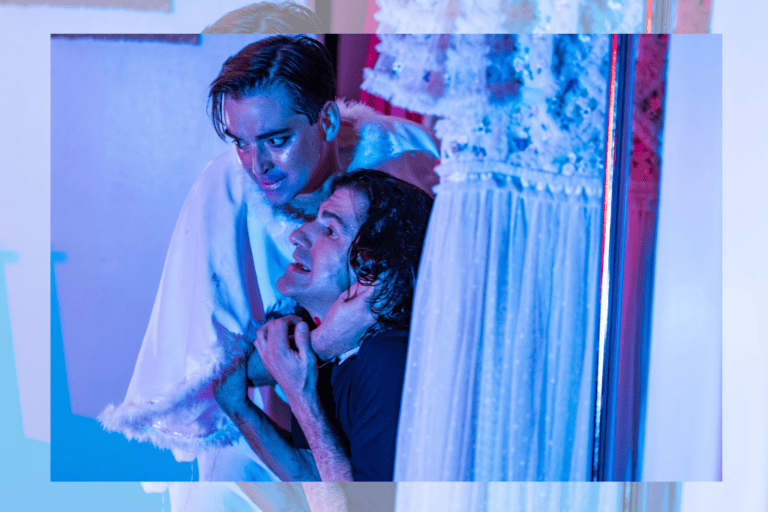 iPhoto caption: Billy Lake and Aidan de Salaiz in 'The Maids.' Photo by Dahlia Katz.
REVIEW: In Talk Is Free’s The Maids, reverence and rebellion share the same room
For all her impatience with the play, director Jillian Keiley chooses to stay rigorously within its terms, pushing its logic to an extreme and letting its contradictions show.
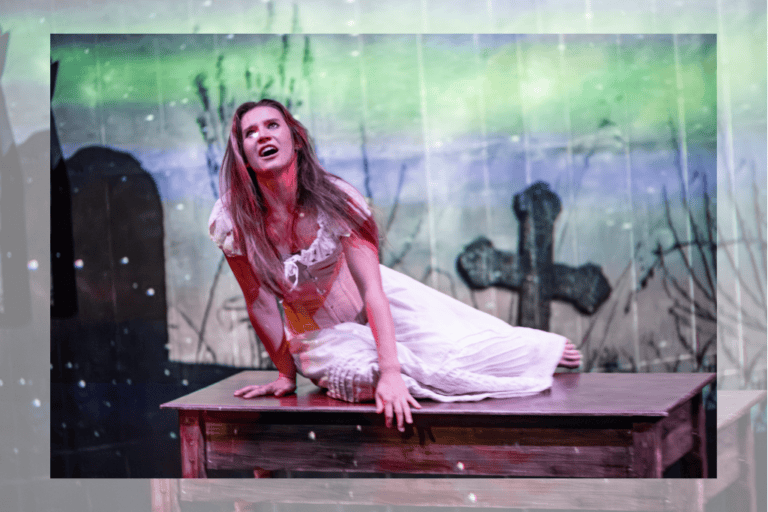 iPhoto caption: Juliana Monk in 'To a Flame.' Photo by Elana Emer.
REVIEW: To a Flame turns the deficit lens back on power
I left the theatre overstimulated, my attention stretched and my body still keyed up. For audiences willing to be swept up in that rush of sensation, that overload is part of the reward.
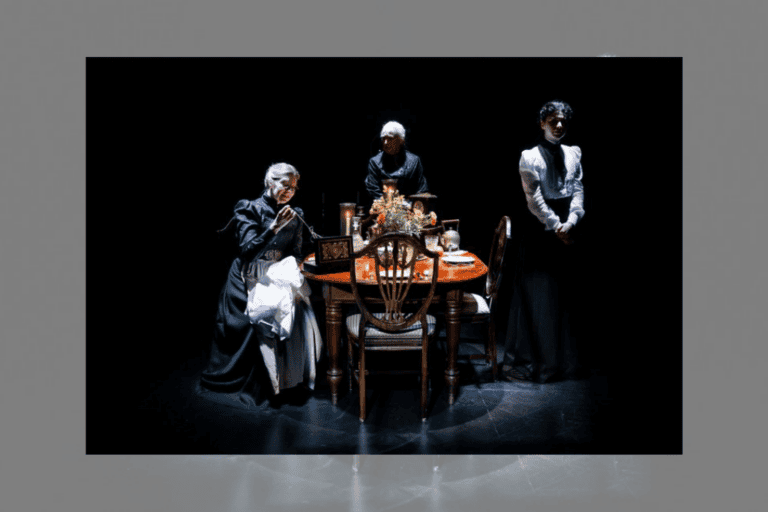 iPhoto caption: The cast of 'Suzannah.' Photo by Ann Baggley.
REVIEW: Jon Fosse’s Suzannah collapses temporal planes into an endless wait
Jon Fosse’s Suzannah fractures the life of Henrik Ibsen’s wife across three temporal planes, as fragments of biography, repetitions, memory, and grievance accumulate without ever coalescing into a stable portrait of Suzannah. The Here For Now Theatre production has closed, but this hypnotic, claustrophobic examination of a woman who struggles to imagine herself beyond her husband lingers.
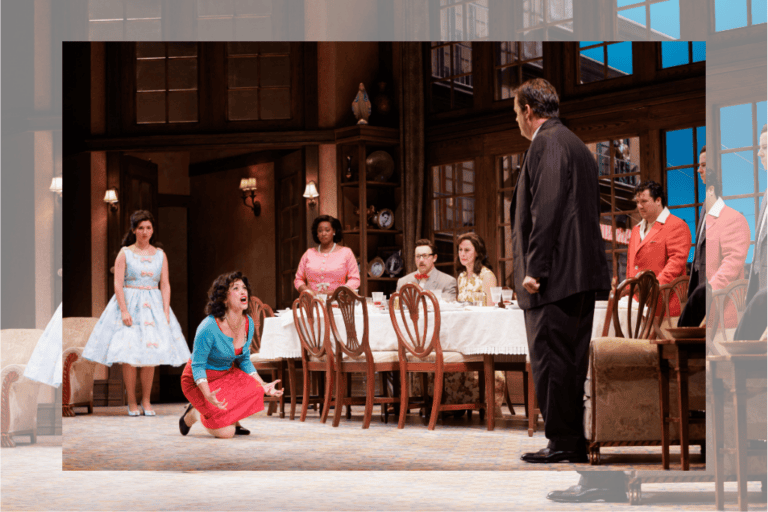 iPhoto caption: Rose Napoli as Rosa Priore (front left) and Graham Abbey as Giuseppe "Peppino" Priore (front right) with members of the company in 'Saturday, Sunday, Monday.' Stratford Festival 2026. Photo by David Hou.
REVIEW: Stratford’s Saturday, Sunday, Monday simmers into a rambunctious scenata napoletana
A pot of tomato sauce left unattended on the stove can only hold itself together for so long. So it is with the Priore family at the centre of Eduardo De Filippo's Saturday, Sunday, Monday. They bottle things up, turning every disappointment into a cordial grudge until resentment bubbles over in melodramatic eruptions.
 iPhoto caption: Photo by Jack Woolfe.
REVIEW: In Síofra at the Red Sandcastle, fairy lore curdles into communal dread
Spindle Collective’s unnerving Síofra takes us to 19th-century Ireland, where folklore gives a watchful community a language for the uncanny.
Comments