
REVIEW: What counts as indie, anyway? A look at Radiant Vermin, How to Defend Yourself, and Pippin
 iPhoto caption: Donnon Root and Paula Goldie in 'How to Defend Yourself.' Photo by Elana Emer.
When Intermission senior editor Liam Donovan asked me to review three shows in a single article, he warned: “It seems an impossible task.” And yet I took the challenge on! The productions I attended last week could hardly be more different in subject, style, and scale. What connects them is one increasingly slippery label: indie.
Forget the romantic image of Off-Off-Broadway, with its basement stages and the experimental ferment of the Wooster Group’s Performing Garage. My itinerary took me to Factory Theatre and The Theatre Centre, both established Toronto venues hosting independent companies. The third stop, the Red Sandcastle Theatre, came closest to that old underground ideal, with its 45 seats and a washroom tucked beside the stage. Yet its actors had Stratford Festival and Mirvish credits.
The plays have impressive pedigrees, too: Radiant Vermin is by Philip Ridley, a defining voice of Britain’s in-yer-face theatre; Liliana Padilla’s How to Defend Yourself won the Yale Drama Series Prize; and Pippin is, for heaven’s sake, a Broadway musical originally staged by Bob Fosse.
The protean nature of indie theatre is hardly a revelation. But in Toronto, the label seems stretched almost beyond recognition. So what kind of indie are we talking about? And what independence does each production claim? Let’s try a provisional, admittedly arbitrary taxonomy.
Subversion indie: Radiant Vermin (Red Sandcastle Theatre, November 12 to 22)
In director Sebastian Biasucci’s hands, no corner of the Red Sandcastle is off-limits. The action spills into the bathroom, up the steps dividing the audience, and even onto the metal railing running alongside the seats. And when Ridley’s script calls for car journeys? Biasucci’s solution is toy cars, of course. Parents-to-be Ollie (Ziye Hu) and Jill (Katherine Cappellacci) dash across the stage clutching miniature vehicles, like children at play. But don’t be fooled by the childlike antics: this whip-smart, 110-minute joyride has a deliciously dark streak.
In this Riot King production, Amelia Mielke-O’Grady crowds the stage with wooden planks evoking a house under construction. Windows and cupboards clutter the tiny stage, creating a maze of exits and hiding places for props. Ollie and Jill are scraping by in a miserable flat when Miss Dee (Lisa Horner), an almost angelic figure draped in white, offers them a free house. The catch? They must renovate it themselves.
Hu and Cappellacci radiate the relentless cheer of a picture-perfect family, narrating their story like upbeat YouTube vloggers. Even discovering they can remodel their home without paying a dime by murdering unhoused people barely dents their smiles. “We did it all for our child,” they insist, dressing self-interest as parental devotion. They make the grotesque easy to swallow. Almost.
Then, in the final scene, Miss Dee addresses us as prospective buyers, jolting us out of our comfortable passivity. Suddenly, we’re the butt of the joke. For all its manic inventiveness and theatrical flair, Radiant Vermin is no cosy crowd-pleaser. It’s a politically barbed gut punch.
Discovery indie: How to Defend Yourself (The Theatre Centre, November 12 to 28)
“Sometimes I don’t know what I want,” says Diana (Paula Goldie), flashing an impish grin during a heated debate about rough sex. It’s a complicated admission in a play set in motion by the rape of a college student named Susannah at a fraternity party. But playwright Liliana Padilla has little interest in easy moral answers.
After staging Dennis Kelly’s DNA and Polly Stenham’s Julie, Icarus Theatre continues introducing Toronto audiences to morally challenging contemporary drama. In How to Defend Yourself, Brandi (Kaeley Jade Wiebe) organizes self-defence workshops while her friend Susannah, who never appears onstage, recovers in hospital. With the audience seated on either side of the BMO Incubator, director and designer Emily Anne Corcoran bathes the action in washed-out pink. Interlocking blush exercise mats cover the floor but, scene by scene, the actors pull them away, dismantling the rosy reassurance Brandi is hell-bent on maintaining.
Padilla’s dialogue probes sex and desire with an unease reminiscent of Adolescence. The young cast’s unvarnished performances, though occasionally overwrought, suit the play’s emotional rawness. In a furious monologue, Eggo (Samel Sunil), until then the class clown, rails against his ex-girlfriend for complaining that he was too sweet and gentle to satisfy her sexually.
Twice, the script moves away from the workshop setting and slips back in time to childhood. The actors giggle through pliés in a ballet class. Later, they run freely at a birthday party. There’s something wonderfully carefree about these moments, a lightness at odds with the exhausting business of growing up and negotiating our relationships with others. What to say. How to stop someone. How to make ourselves understood. How to. How to. How to. In theory, the ethical dos and don’ts are clear. Putting them into practice is far messier.
Broadway indie: Pippin (Factory Theatre, November 15 to 21)
With a nine-piece onstage orchestra, a 12-member cast, and a two-and-a-half-hour running time, Bowtie Productions has gone all out. Fittingly, the Tony Award-winning Pippin is all about putting on a show, complete with jazz hands and theatrical ta-das.
Set in an outlandish reimagining of Charlemagne’s reign, the musical follows the emperor’s eldest son, Pippin (Anthony Palermo), on his quest for a meaningful life. With their feather-light tenor and faraway gaze, Palermo cuts the figure of a Prince Charming. Around them, the cast embraces the musical’s flamboyance with infectious abandon.
As Pippin’s irrepressible grandmother Berthe, Donna Garner gleefully flouts decorum, her legs planted wide in a glorious display of woman-spreading. Not to be outdone, Daniela Bauer’s scheming Fastrada flings herself about the stage, dancing and belting without losing a beat, while KC Martinez’s Leading Player unleashes Mariah Carey-worthy vocal runs. It’s a game of theatrical one-upmanship, each number more extravagant than the last.
There’s something endearingly cheeky about Bowtie taking on a musical of this scale, as though throwing down the gauntlet to Mirvish: Who says you’re the only ones who can do Broadway? Yet a little more polish wouldn’t hurt. Meredith Shedden’s Fosse-infused choreography looks rough around the edges, while Olivia Daniels’s frenetic direction sometimes lets spectacle overwhelm storytelling — a particular risk with Pippin, whose razzle-dazzle is both its chief attraction and the object of its satire. I’d be curious to see what Bowtie could accomplish on a smaller scale, with its considerable talent channelled into a more carefully crafted production.
***
There’s an old joke that Toronto loves world premieres so much it never gets around to second productions. Yet the three indie shows I saw offered a counterpoint: their producers had gone hunting for scripts that had already made sparks elsewhere but still had something to say. The question, then, was what their actors, directors, and designers could bring to those scripts. Perhaps it’s my background in Italy’s more director-driven theatre culture, but I found that emphasis particularly striking in a city so focused on new writing.
After three outings to the theatre, I still have no Oxford-worthy definition of indie theatre. In my defence, even Wikipedia hasn’t ventured a page of its own. But I can report that one evening, an older theatregoer spotted my snobbish critic’s notebook and shared what keeps her buying tickets to indie productions: “These smaller companies need our support,” she stressed. Even the Dora Awards’ classification of independent theatre rests largely on economic considerations. And indie is indeed a bold model of theatre-making, one in which small producers believe so fiercely in a project that they’re willing to gamble on it. I couldn’t respect that gamble more.
Intermission reviews are independent and unrelated to Intermission’s partnered content. Learn more about Intermission’s partnership model here.

Alessandro Stracuzzi
Alessandro Stracuzzi is a Toronto-based theatre critic and performance researcher from Italy. He holds an MA in Performance Studies from the University of Milan, and writes about contemporary theatre, performance, and experimental practices. His criticism has appeared in Stage Door, Our Theatre Voice, Stratagemmi, and Fermata Spettacolo.
LEARN MORE iPhoto caption: Members of the company of 'Rhinocéros.' Photo by Mathieu Taillardas.
REVIEW: TfT’s Rhinocéros soaks Ionesco’s existential malaise in broad farce
Performed in French with English surtitles, the production at times falls into a familiar trap of staging the so-called Theatre of the Absurd: trading existential anguish for comic eccentricity.
 iPhoto caption: The North American tour company of 'Operation Mincemeat.' Photo by Matthew Murphy.
REVIEW: Razor-sharp and whip-fast, Operation Mincemeat is a killer musical
This gloriously over-the-top frenzy is every bit as good as the hype. And it has teeth, too: it skewers the pompous men calling the shots in wartime.
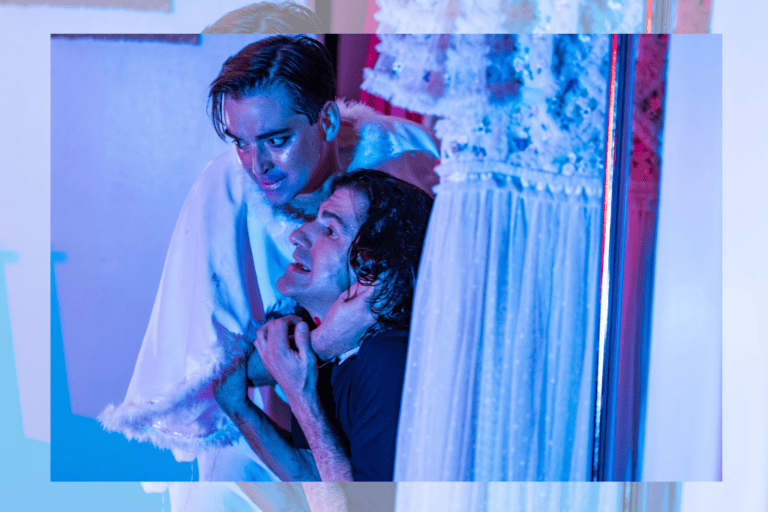 iPhoto caption: Billy Lake and Aidan de Salaiz in 'The Maids.' Photo by Dahlia Katz.
REVIEW: In Talk Is Free’s The Maids, reverence and rebellion share the same room
For all her impatience with the play, director Jillian Keiley chooses to stay rigorously within its terms, pushing its logic to an extreme and letting its contradictions show.
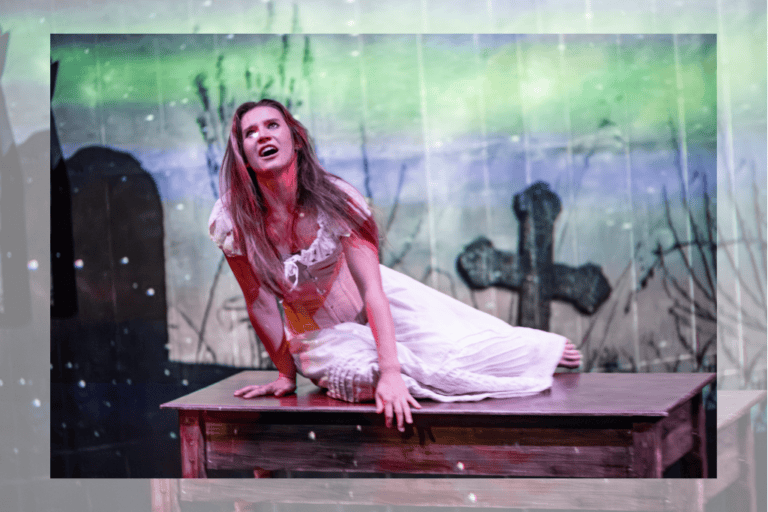 iPhoto caption: Juliana Monk in 'To a Flame.' Photo by Elana Emer.
REVIEW: To a Flame turns the deficit lens back on power
I left the theatre overstimulated, my attention stretched and my body still keyed up. For audiences willing to be swept up in that rush of sensation, that overload is part of the reward.
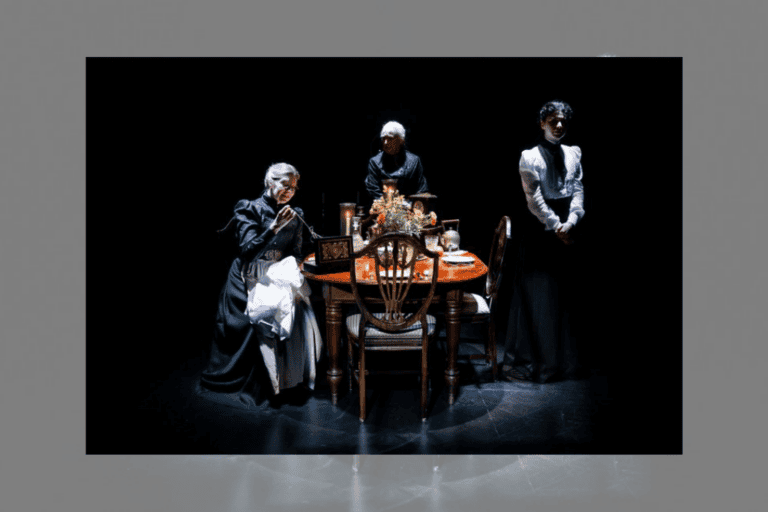 iPhoto caption: The cast of 'Suzannah.' Photo by Ann Baggley.
REVIEW: Jon Fosse’s Suzannah collapses temporal planes into an endless wait
Jon Fosse’s Suzannah fractures the life of Henrik Ibsen’s wife across three temporal planes, as fragments of biography, repetitions, memory, and grievance accumulate without ever coalescing into a stable portrait of Suzannah. The Here For Now Theatre production has closed, but this hypnotic, claustrophobic examination of a woman who struggles to imagine herself beyond her husband lingers.
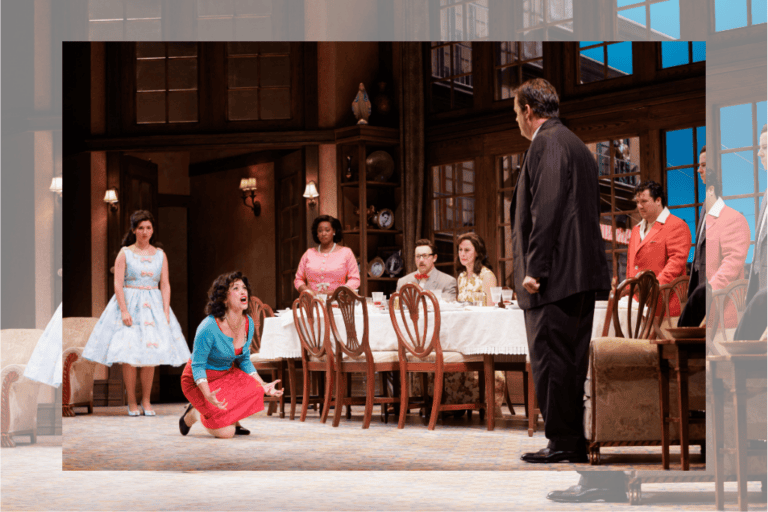 iPhoto caption: Rose Napoli as Rosa Priore (front left) and Graham Abbey as Giuseppe "Peppino" Priore (front right) with members of the company in 'Saturday, Sunday, Monday.' Stratford Festival 2026. Photo by David Hou.
REVIEW: Stratford’s Saturday, Sunday, Monday simmers into a rambunctious scenata napoletana
A pot of tomato sauce left unattended on the stove can only hold itself together for so long. So it is with the Priore family at the centre of Eduardo De Filippo's Saturday, Sunday, Monday. They bottle things up, turning every disappointment into a cordial grudge until resentment bubbles over in melodramatic eruptions.
Comments