
REVIEW: At Fall for Dance North’s festival opening, it all came back to Tessa Virtue
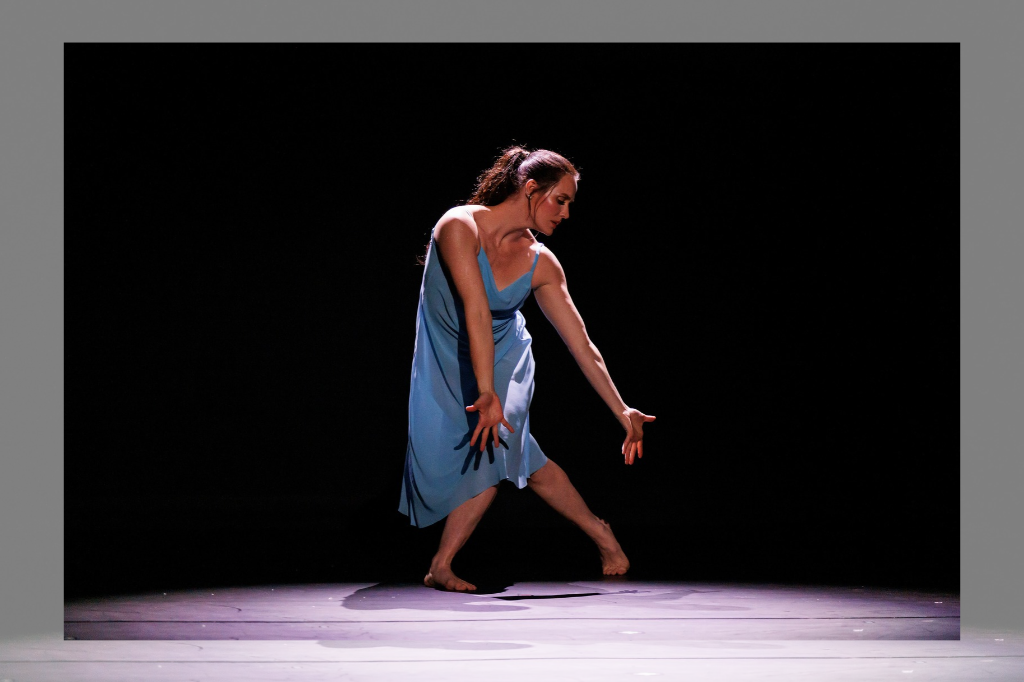 iPhoto caption: Tessa Virtue performs at Fall for Dance North. Photo by Bruce Zinger.
A mixed bill can be a tricky proposition. In trying to represent an array of aesthetics, dance festivals can end up offering a little something for every taste but not enough to chew on. But this year’s Fall for Dance North (FFDN) opening programme, Legends — five distinct dances, co-curated by Rob Binet and Alyssa Martin, each represented by artists typifying their genre — gives audiences a multi-course feast that’s delish all the way through. Well, almost.
With two years at FFDN’s helm as co-CEOs, Binet and Lily Sutherland are confidently settling into their second season, seeking out intriguing works and an expanding slate of community programming like free workshops and a matinee that offers childcare. Ticket prices have crept up since it began 22 years ago as a $5 offering in New York, but $25 for more than two hours of high-quality dancing remains a steal. The mission is wonderfully simple: make dance as affordable and fun as going to the movies.
On opening night, the Bluma Appel Theatre was packed with patrons eager to see Tessa Virtue, the most decorated Olympic ice dancer in history, perform her first dance sans skates — seven years after retiring and embarking on a new career as an executive advisor at Deloitte. I confess, I had my doubts. A retired athlete performing to Celine Dion’s power ballad “It’s All Coming Back to Me Now”? It sounded like a stunt purely to fill seats. But within seconds of Virtue taking the stage, I was delighted to be wrong. Virtue either regained or never lost her magnetic presence.
In an ice-blue slip dress under cyan lights, Virtue tosses herself right into Martin’s contemporary lyrical choreography in “The Unruly Heart.” Martin’s work is often pointedly quirky, sometimes to a fault, but here she wisely lets Virtue’s gifts speak for themselves. Virtue devours the stage, claiming a spotlight in every corner. It’s a skater’s instinct: accustomed to being surrounded rather than opposite to her audience, she gives each side of the audience a chance to feel like there’s a moment just for them. Without Scott Moir, without the ice, without scorecard-wielding judges, she seems unencumbered. She leaps in loose attitudes, pulls at the fabric around her heart, and stretches her arms wide as though trying to gather up the song. It’s dramatic and unabashedly emotional — it’s dessert. And the crowd went wild as, indeed, her former life as a mover came back to her.
Earlier, Claire Heggen, now 80, also performed a solo — though it’s hard to call it that despite Heggen being the only living person on stage in “Ma P’tite Dame.” Somewhere between performance art and dance, Heggen partners a life-sized puppet she created when she was 40 to resemble herself at 80. Back then, she danced with her imagined future; now she dances with her present. She seeks the puppet’s attention, pushes it away, fawns over it, collapses under it, and, in a fit of frustration, swings it around by its foot. It sounds grim, but Heggen’s gestures make the deeply human experience of having to endure oneself over a whole lifetime hilarious and touching. While Virtue’s performance grabs with ferocity, Heggen’s pokes with vulnerability — and that poke will be harder for me to forget.
Legends also features a trio from Chicago’s Hubbard Street Dance, who appear in rhinestone-encrusted, chocolate-brown bell-bottoms, button-downs, and cowboy hats arranged in an angular tableau to perform “Sweet Gwen Suite,” three 1960s made-for-TV variations originally credited to Bob Fosse, but now co-credited to their performer, and Fosse’s longtime partner, Gwen Verdon. Coolly, seductively, they saunter across the stage, striking flamingo-like poses, holding the audience’s gaze, punctuating every percussive beat with a hip thrust, a wrist flick, or a neck jut. It’s perfectly placed as the night’s opener, acting as the bright amuse-bouche to warm our appetites.
Canada’s Sampradaya Dance Creations and Sampradaya Dance Academy offer an energetic Bharatanatyam piece with intricate formations and sharply etched shapes. I found the facial expressions, traditionally so essential to the form, hard to discern from row L of the 800-plus-seat-theatre, but the ensemble’s precision is mesmerizing.
The disappointment of the night for me was “Distorted Familiarity” — a debut pas de deux choreographed by Ballet West principal dancer Katlyn Addison, performed by National Ballet of Canada principal dancers Svetlana Lunkina and Naoya Ebe. With a pianist and violinist on stage beside the angelically dressed couple, the penultimate piece seemed like it might aspire to the intimate romance of Jerome Robbins’ In the Night. But where Robbins finds drama and glamour in the smallest exchanges, Addison’s work has little to offer beyond gorgeous balletic technique. Its stiffness stood out in a program so full of personality.
But any down note vanished with the evening’s surprise ending. After the last roaring applause for Virtue ends, the curtain remains open and two shimmering golden pom-pom pop out from stage right. A young dancer in a short, gilded lame unitard looks around at the crowd gathering their things as if she’s snuck on stage. Soon the stage fills with over 20 dancers just like her, calling the Legends performers back on stage to “Everywhere” by Fleetwood Mac. The joy, youth, and sheer silliness in their jazzy high kicks and theatrical expressions reminds me how a celebration of all the weird and wonderful ways humans have found to shimmy, shake, and groove can be equally moving to the pursuit of profundity.
Fall for Dance North has two more signature programmes and three evening-length works still to come before it closes on October 25, including Martin’s anticipated 60-minute dance on parenting, Landslide. If the festival’s excellent opening is any indication, there’s plenty left to fall for.
Fall for Dance North runs until October 25. More information is available here.
Intermission reviews are independent and unrelated to Intermission’s partnered content. Learn more about Intermission’s partnership model here.

Lindsey King
Lindsey King is a Toronto-based freelance writer and editor with bylines in Toronto Life, Maclean's, Canadian Business, Intermission, and The Creative Independent.
LEARN MORE iPhoto caption: From left: Vivien Endicott-Douglas as Han, Rylan Wilkie as George Abbot (top left), Sara Topham as Cath (top right), Angel Lo as Anna and Liz Der as Roni in 'The King James Bible Play.' Stratford Festival 2026. Photo by David Hou.
REVIEW: The King James Bible Play both finds and fumbles profundity in translation
Corbeil-Coleman’s best-known plays, such as Guarded Girls and Scratch, centre contemporary young women circling grief, inheritance, and intergenerational trauma. It might seem like a surprise, then, that The King James Bible Play opens with five men centuries ago — but it turns out that the intergenerational trauma in this case stretches back about 417 years.
 iPhoto caption: Members of the company of 'Play Dead.' Photo by Alexander Galliez.
Play Dead trades death-defying circus tricks for bigger emotional risks
“The idea of consequences in [Play Dead] can make someone think the show is a little dreary, but we think of it more as a surreal celebration of all the little things that make up life,” says performer and People Watching co-artistic director Jérémi Lévesque.
 iPhoto caption: Melissa James and Patrick Heusinger in 'Paranormal Activity.' Photo by Johan Persson.
REVIEW: Mirvish’s Paranormal Activity summons real screams — but crashes into a cheap shock ending
It’s a spooky, cleverly staged hoot, but audiences might be distracted by one glaring narrative spectre that could use an exorcism.
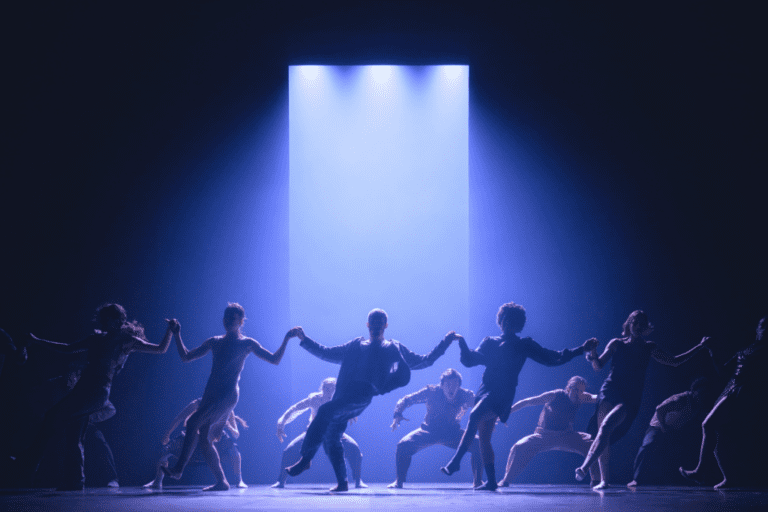 iPhoto caption: Members of the company of 'Theatre of Dreams.' Photo by Tom Visser.
It’s tough to tie Shechter’s style to any one dance lineage, but modern floorwork; commonplace gestures rendered sharp and frenzied; and loose, hip-circling movements often reserved for low-lit clubs evoke the woozy surreality of half-revealed consciousness.
 iPhoto caption: Amy Keating, Zorana Sadiq, Katherine Cullen, and Jean Yoon in 'Dance Nation.' Photo by Elana Emer.
REVIEW: Coal Mine Theatre’s Dance Nation vaults into the feral, ecstatic mess of girlhood
Played by a cast whose ages range widely, the characters exist in two tenses at once: present-day adolescence and retrospective memory, living these tender years shadowed by the adults they’ll become.
 iPhoto caption: Members of the company of 'Shucked.' Photo by Matthew Murphy and Evan Zimmerman.
REVIEW: Mirvish’s Shucked plants row after row of corny jokes
Shucked sits somewhere between a cartoon for adults and a wholesome farm musical.
Comments