
REVIEW: The Hooves Belonged to the Deer at Tarragon Theatre/Buddies in Bad Times Theatre
 iPhoto caption: Photo by Cylla von Tiedemann
Content warning: this review contains mention of sexual assault.
Oh, what a year for new playwriting.
This year’s blessed us with Claren Grosz’s I love the smell of gasoline, Matthew MacKenzie and Mariya Khomutova’s First Métis Man of Odesa, and Amy Lee Lavoie and Omari Newton’s Redbone Coonhound, to name just a few. At the centre of this year’s most compelling new plays seem to be riffs on the notion of identity, and the connectedness between the characters onstage and the playwrights holding the pen.
So it goes in Makram Ayache’s daring, complicated drama The Hooves Belonged to the Deer at Tarragon, in association with Buddies in Bad Times Theatre. While Ayache’s rooted-in-truth new play at times buckles under the weight of all it tries to achieve — which is quite a bit in just under two and a half hours — the moments of brilliance binding together the story’s multiple timelines and narrative threads quickly bring any overly ambitious aesthetics right back down to earth.
And those criss-crossed timelines are complex indeed. There’s the world of Aadam (Noor Hamdi), Eve (or Hawa as she’s called in Arabic, played by Bahareh Yaraghi), and Steve (Adrian Shepherd-Gawinski), pawns at the centre of a creation story warped by self-hatred and prejudice. And here in the modern day there’s Jake (also Shepherd-Gawinski), estranged son of Pastor Isaac (an unnervingly convincing Ryan Hollyman), unhoused and battling addiction as well as his own sexuality.
But blazing at the core of the play is Izzy, a young, queer, Muslim (actually Druze) boy living in rural Alberta. Izzy’s played by Ayache, an unsurprising choice on the part of both him and director Peter Hinton-Davis — the autobiography of the play is part of what makes it so fascinating — and Ayache plays him with such warmth and tenderness that the casting makes perfect sense. Izzy has a crush, Will (an endearing, standout Eric Wigston), but his Muslim parents are unlikely to support a homosexual son, so he keeps their blossoming relationship secret.
In the absence of parents, there’s Pastor Isaac, who’s Bible-thumping, charismatic, opportunistic, and, yes, truly well-meaning. In his eyes, he’s saving Izzy from the devil when he outs him to his parents, when he overloads him with scripture and heirloom Bibles. While Izzy’s own self-hatred is the prevailing antagonist of the play, it’s Pastor Isaac who most consistently coaxes that hatred out, tending to it like a child.
These stories all weave together, tightening around the maladjusted, neurotic, perennially lonely Izzy. When years of unresolved trauma finally catch up to him, it’s quickly — and to my eye, under-foreshadowed by content warnings — in the form of a fully staged oral rape and stabbing at the end of the play.
The Hooves Belonged to the Deer has much to say, and for the most part Ayache’s play communicates what it needs to without losing its train of thought. The Adam/Hawa/Steve creation story can feel frustratingly slow at times; the relationship between Izzy and Pastor Isaac is the most developed and compelling layer of the play, and more often than not I found myself itching to get back into that story whenever our attention was diverted elsewhere. As well, Izzy and the men in his world nurture rich inner lives with nuance and innumerable layers — the same is not always true for Hawa/Rebecca, whose stage time (and emotional development) is comparatively limited.
It’s aesthetically where The Hooves Belonged to the Deer at times bites off more than it can chew. Apples as symbolism for temptation begin to feel a little redundant by the play’s final breath, and a water mechanism which drenches Hawa feels unnecessarily showy for little dramaturgical payoff. Nevertheless, Anahita Dehbonehie’s set is striking and provocative, a stage covered in red dirt with a ladder, table, and benches to suggest the play’s many settings. Hinton-Davis uses those benches well, bringing slow, gentle motion to the background of scenes using whichever actors aren’t needed in a given scene (Corey Tazmania is the choreographer and intimacy director). Whittyn Jason’s lighting design, too, is excellent, using footlights to cast menacing shadows on Pastor Isaac’s face during sermons and disturbing pep talks.
The Hooves Belonged to the Deer is a major accomplishment for both Ayache and Tarragon, perhaps the most high-reaching and brave production of this remarkable season at Tarragon. And despite its occasional falters, Ayache’s play punches well above its weight in terms of tackling uncomfortable, deeply personal content through use of religious allegory.
The Hooves Belonged to the Deer runs at Tarragon March 28 through April 23, 2023.
Aisling Murphy
Aisling is Intermission's former senior editor and the theatre reporter for the Globe and Mail. She likes British playwright Sarah Kane, most songs by Taylor Swift, and her cats, Fig and June. She was a 2024 fellow at the National Critics Institute in Waterford, CT.
LEARN MORE iPhoto caption: Members of the company of 'Narnia.' Photo by Dahlia Katz.
REVIEW: Bad Hats’ Narnia is a joyful, heartwarming escape
The spirit of openness and the joy of discovery rule over this Narnia. Open the wardrobe and see.
 iPhoto caption: Members of the company of 'Robin Hood.' Photo by Dahlia Katz.
REVIEW: Canadian Stage’s Robin Hood panto is anti-capitalist fun for the whole family
Following Ross Petty’s legacy of scene-stealing, Damien Atkins as the evil Prince John is easily the greatest delight of the show.
 iPhoto caption: Lauren Gillis and Alaine Hutton in 'Public Consumption.' Photo by Eden Graham.
REVIEW: Lester Trips’ stylish Public Consumption captures the internet’s profound emptiness
Rather than directly representing online life, Public Consumption speculates — with virtuosity — about how the digital world affects our bodies. And the show's findings are by no means comfortable.
 iPhoto caption: Tony Ofori and Daren A. Herbert in 'Moonlight Schooner.' Photo by Dahlia Katz.
Kanika Ambrose’s Moonlight Schooner is animated and visually stunning, but its individual pieces don’t come together as neatly as I would've expected.
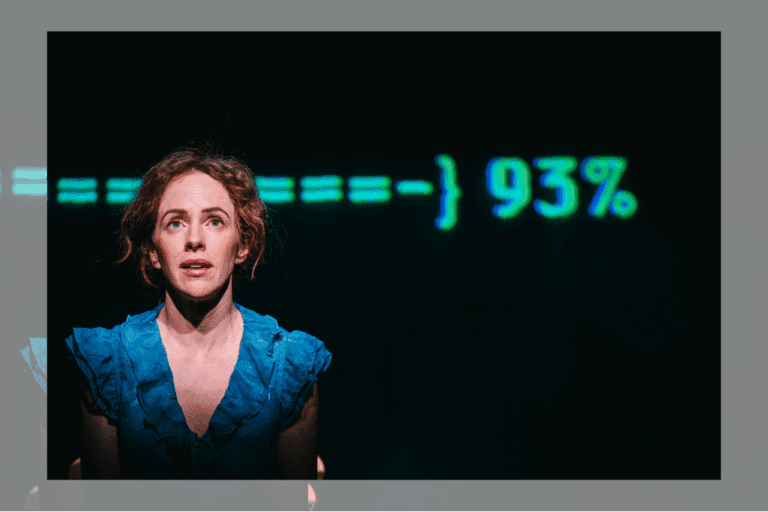 iPhoto caption: Fiona Mongillo in 'Reproduktion.' Photo by Ann Baggley.
REVIEW: Here For Now’s well-acted Reproduktion attempts to tackle too much
Amy Rutherford’s world premiere script is ambitious and the material it covers is complex — but the narrative feels disjointed.
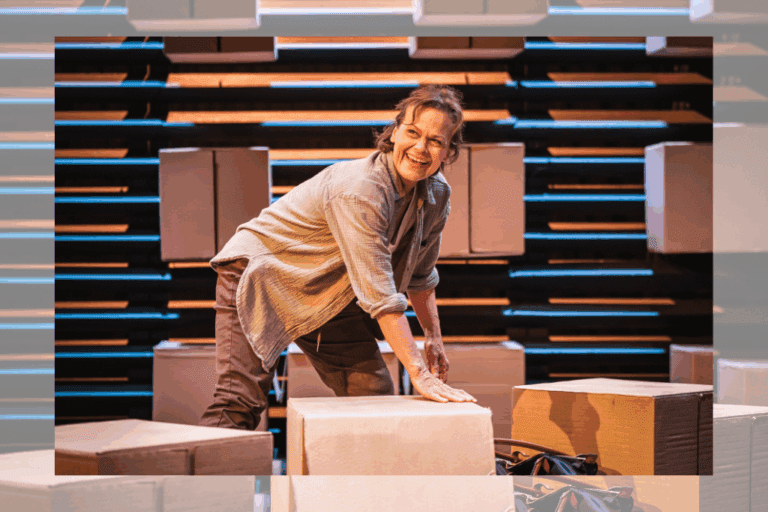 iPhoto caption: Kristen Thomson in 'Fulfillment Centre.' Photo by Elana Emer.
REVIEW: Coal Mine’s Fulfillment Centre asks how we end up alone, together
The production understands the play’s themes, yet feels limited by a script that delivers a package it never fully opens.
 iPhoto caption: Photo by Aisling Murphy.
In the darkest months of Yukon winter, it’s all about the Sun Room
I’m here for a week in January as a guest of Nakai Theatre, a hub for theatrical experimentation and outside-the-box programming in Canada’s westernmost territory.

Armchairs, tattoos, and an online theatre magazine
When I started at Intermission, my world was limited to the confines of an armchair. Arts journalism was a high it felt dangerously fruitless to chase. The life stretched ahead of me was amorphous and frightening, a chasm filled with hand sanitizer and immigration concerns. It was worth crying over a spilled kombucha and scrubbing at the stain.
 iPhoto caption: Liz Appel headshot courtesy of Liz Appel.
Five questions with Wights playwright Liz Appel
Intermission spoke with Appel over email for a brief Q&A about Wights, now playing at Crow’s Theatre until February 9.

Call for applications: Publishing and editorial assistant
Intermission Magazine is seeking a dynamic and collaborative individual to join our team.
 iPhoto caption: What Writing Can Do: The 2025 Musical Theatre Critics Lab
Announcing What Writing Can Do: The 2025 Musical Theatre Critics Lab
What Writing Can Do is timed to coincide with the Grand and Theatre Aquarius’ co-production of Waitress, which will serve as a jumping-off point for discussions throughout the Lab.
 iPhoto caption: A Christmas Story production still by Dahlia Katz.
REVIEW: A Christmas Story feels fresh at Theatre Aquarius
If you want to catch A Christmas Story before it closes, good luck — the show is close to sold out, and with the talent on that stage, it’s not hard to see why.
Comments