
REVIEW: The Surrogate cross-examines privilege and parenthood at Crow’s Theatre
 iPhoto caption: Antonette Rudder and Sarena Parmar in 'The Surrogate.' Photo by Kendra Epik.
As reproductive and queer rights face renewed scrutiny, The Surrogate enters the fray with a complicating twist.
Produced by Here For Now Theatre in association with Crow’s Theatre, House + Body, and b current Performing Arts, British novelist Mohsin Zaidi’s theatrical debut is a breakneck 95-minute drama that dissects the ethics of surrogacy, and interrogates how legal and medical systems can legitimize or limit the definition of family.
Zaidi’s play follows arrogant New York lawyer Sameer (Fuad Ahmed) and his aspiring-author husband Jake (Thom Nyhuus) as they pursue parenthood by entering into a paid surrogacy agreement with Marya, a working-class immigrant woman.
When Marya (Sarena Parmar) is hospitalized while visiting Louisiana, the couple flies down to check on her. They’re confronted with the fact that paid surrogacy is illegal in that state. They also learn that Marya is beginning to have doubts about relinquishing the child she’s carrying.
What’s initially presented as a legal complication quickly metastasizes into a high-stakes stakes ethical dilemma delivered through a medical drama, rife with caustic humour as well as a few emotional gut punches.
Zaidi sets the play over the course of one intense night in the hospital. Far upstage, a slanted mirror leans over a hospital bed, intentionally positioned to keep Parmar’s Marya visible even as she lies down. The production seats the audience in a “U” shape, and set designer Scott Panner utilizes a strip of cerulean flooring that evokes the forced calm of medical hallways. This simple layout choice brings the audience up close to the action — a proximity that director Christopher Manousos takes advantage of by having actors sit in the front row to quickly exit scenes.
Like Jonathan Spector’s Eureka Day (an American satire about mandatory vaccination at a private school, recently staged by Coal Mine Theatre), The Surrogate seeks to examine a contentious topic through the lives and motivations of five characters. To platform different perspectives, Zaidi has crafted characters that embody complex intersections of privilege and prejudice — and offer varying degrees of likeability.
With wealth affording him privilege, Sameer is exasperatingly callous and often antagonistic toward anyone who stands in the way of his ambitions. For audience members familiar with certain upper-class South Asian circles, Sameer feels instantly recognizable — an archetype seldom depicted on Toronto stages. His entitled attitude makes him immensely dislikeable. And yet, Ahmed’s nuanced performance invites flashes of empathy for Sameer, particularly when portraying his relentless need to earn his Muslim mother’s approval as a gay son.
Nyhuus brings levity and flippancy to Jake, portraying him as compassionate but occasionally self-involved to the point of naivety. Marya is a largely sympathetic character whose socioeconomic conditions provide a stark contrast to Sameer and Jake’s privilege, and Parmar skilfully balances her vulnerability with resolve, her gaze holding firm even as her voice betrays her nerves.
Siddharth Sharma plays Qasim — Marya’s 18-year-old son — with disarming earnestness and sincerity. His quiet conversations by Marya’s side are some of the softer, stiller moments where the play’s emotional weight sinks in.
Then there’s nurse Christina, compellingly portrayed by Antonette Rudder, who maintains a composed professional exterior even as flashes of homophobia surface — often couched in language about protecting women’s bodies and the sanctity of motherhood. Christina’s objections land as measured and procedural, a clear juxtaposition to Sameer’s sharper barbs and outright intimidation.
Does Sameer’s unlikability and litigious nature invalidate his legal right to surrogacy? Does Christina’s bigotry automatically discredit her concerns about the health risks of pregnancy and the exploitation of poor women by the wealthy?
Through these two characters, the play stages its fiercest debate on commercialized surrogacy, surfacing contradictions on every side. Sameer condemns the failures of the American healthcare system — fairly — while Christina counters that he’s simultaneously leveraging that very system to pursue his desire to have a child. Both statements are true.
And so the conflict deepens as the plot accelerates, additional interpersonal conflicts bubble up, and the overall dramatic stakes rise.
With taut precision, Manousos keeps the pacing fast and the tension at a steady simmer, pushing it toward moments that threaten to boil over. Lighting designer Chris Malkowski reinforces these efforts with a striking row of fluorescent tube lights that swiftly signal scene changes, rapidly move characters down hospital corridors, and pulsate to intensify key beats.
Though the script’s early jokes occasionally flirt with clichés, and there is an initial exposition-heavy phone call that feels a little contrived, Zaidi finds his footing as the story progresses, with rapid-fire dialogue that is thought-provoking, humorous, and occasionally vicious.
If the play sometimes reaches for one issue too many — religion, interracial relationships, infertility — it also underscores how interconnected these issues can be, and how identity and lived experience can colour perspectives on topics like surrogacy, family, and privilege.
The Surrogate doesn’t hand down a verdict. It ends on an emotionally charged note, leaving audiences to weigh the debate for themselves. Given its subject matter and structure, the play clearly aims to spark conversation — and the discussions spilling into the lobby after the show suggest that Zaidi has accomplished exactly that.
The Surrogate runs at Crow’s Theatre until March 29. More information is available here.
Sania Hameed wrote this review as part of Page Turn, a professional development network for emerging arts writers, funded by the Canada Council for the Arts and administered by Neworld Theatre.
Intermission reviews are independent and unrelated to Intermission’s partnered content. Learn more about Intermission’s partnership model here.

Sania Hameed
Sania Hameed (she/her) fell in love with the performing arts over a decade ago, and has been committed to her passion for live theatre ever since. Fringe is her favourite time of the year. While she primarily spends her days working in post-secondary education and attending shows, she still finds time to hone her birding skills in anticipation of her second favourite time of the year (spring migration).
LEARN MORE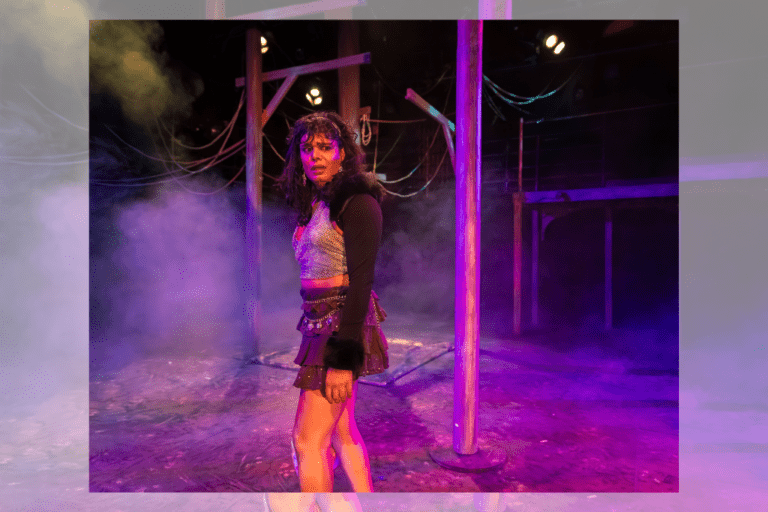 iPhoto caption: Zaiba Baig in 'The Begging Brown Bitch Plays.' Photo by Jeremy Mimnagh.
REVIEW: Truth and performance blur in Zaiba Baig’s The Begging Brown Bitch Plays at Buddies
It’s in the second half of Jhooti that Zaiba Baig’s performance is transcendent. She commands the stage, moving fluidly between humour and fury, bringing the audience through one emotional arc after another.
 iPhoto caption: Ben Porter in 'The Woman in Black.' Photo courtesy of Mirvish.
REVIEW: Mirvish’s The Woman in Black conjures chills in the shadows
If you’re willing to suspend your disbelief and let your imagination run loose, The Woman in Black will reward you with a genuine jolt or two.
 iPhoto caption: Scott Wentworth and Walter Borden in 'An Orchid and Other Such Lilies and Lies.' Photo by Seamus Easton.
Playing at the Red Sandcastle Theatre, Dandelion Theatre's An Orchid and Other Such Lilies and Lies is an existential rumination on life, death, and friendship — and for me, a gentle reminder to tell people you love them while you still can.
Comments