
REVIEW: Mirvish’s The Woman in Black conjures chills in the shadows
 iPhoto caption: Ben Porter in 'The Woman in Black.' Photo courtesy of Mirvish.
As a kid, I was drawn to horror stories. But as I got older, horror films became a little too much for me — too brutal and often too eager to show instead of suggest. Discovering the niche of horror theatre has offered a happy medium: most entries in the subgenre are tense enough to keep me on edge, while still leaving much to the imagination.
The Woman in Black, now haunting Mirvish’s CAA Theatre, leans into that tension and offers a slow-burning gothic tale built on stagecraft and suggestion — on what you can’t quite see, and what mere sound can unleash in your body.
It’s the 1950s and an old man, Arthur Kipps (David Acton), has recruited a young Actor (Ben Porter) to help him gain the confidence and skills to share the story that has been tormenting him for decades. Kipps takes us back to 1921, when he was a young solicitor sent to a remote rural town to settle the estate of a recently deceased client. This leads him to Eel Marsh House, a creepy and isolated manor that the locals avoid discussing, let alone visiting. It’s here that Kipps — and the audience — learn about the dreaded woman in black.
In adapting Susan Hill’s titular novel, Stephen Mallatrat reimagined the story through a meta-theatrical frame — a play within a play — to translate the ghost story from page to stage. The narrative starts disarmingly enough with gentle humour as the older Kipps quavers through reading his manuscript. To make his tale more compelling, the Actor volunteers to play young Kipps, and instead assigns the old man the task of performing every other character in the story. This clearly delineates the two timelines: Porter as the determined young Kipps in the past, Acton as the anxious older Kipps in the future.
Lighting designer Anshuman Bhatia facilitates the shifts between timelines — usually warm sepia for the past, and a starker white for the rehearsal room — while also cultivating unease through strategic dimness and pockets of shadow. There’s nothing quite as unnerving as the flash of something you’re not sure you actually saw, sending your imagination spinning.
Michael Holt has designed a simple set that also leaves ample room for the audience to fill in the details as the scenes change: a few chairs and a large wicker chest serve varying purposes, and a bleak grey curtain represents a non-descript wall. When backlit, the curtain reveals the silhouette of another room, slightly obscured by the fabric.
Sebastian Frost’s sound design is astonishingly unnerving. Even common sounds — a rocking chair, tinkling music — become eerie, stripped of comfort and rendered uncanny. The play underscores the importance of sound early on in the story, when the Actor explains to Kipps that audio recordings can paint the world more vividly than any elaborate description. Noticeably, after this is explained, scene transitions — which up until this point are simply a blackout and silence — start to be accompanied by sounds.
Under Robin Herford’s skilful direction, the two actors are confident and comfortable in their roles. Acton navigates an impressive range as he shifts from a timid gentleman to a colourful parade of characters from Kipps’s past. Porter’s young Kipps is equally compelling as he slowly begins to believe in the titular ghost. There’s a moment where he interacts with a barking dog in the middle of the night — surprisingly, with no sound cues, just sheer commitment from Porter — that highlights his skill in making the unseen feel utterly believable.
While the production’s 30-year run in London’s West End speaks to its ghostly appeal, the show also feels its age. There’s value in a slow burn, even now, but for a show built to thrill, the pacing occasionally drags. The intermission diffuses the tension, and some exposition-heavy stretches slow things further. A tighter runtime would give the story a sharper edge for contemporary audiences.
And structurally, the play-within-a-play conceit raises questions it doesn’t entirely answer: Why is Kipps so determined to relive his story in this manner? Yet this very same device also enables the show to end on a chilling note, hinting that some stories, once spoken aloud, refuse to stay contained.
Ultimately, it’s the visual and audio effects that elevate the production into something scary, more than the story itself. An ordinary door turns ominous under a single red beam, while a shadow projection of Eel Marsh House feels more foreboding than a physical set. A flashlight slicing through the darkness blinds the audience long enough to make the surrounding gloom feel unsettling. And the screams are unforgettable. These tricks are somewhat old-school, but they work.
If you’re willing to suspend your disbelief and let your imagination run loose, The Woman in Black will reward you with a genuine jolt or two. And once the first fright lands, you’re primed to wait for the next — with every patch of darkness a potential threat, and every flicker of unease signalling there may be something worse in the shadows.
The Woman in Black runs at the CAA Theatre until until January 4 . More information is available here.
Sania Hameed wrote this review as part of Page Turn, a professional development network for emerging arts writers, funded by the Canada Council for the Arts and administered by Neworld Theatre.
Intermission reviews are independent and unrelated to Intermission’s partnered content. Learn more about Intermission’s partnership model here.

Sania Hameed
Sania Hameed (she/her) fell in love with the performing arts over a decade ago, and has been committed to her passion for live theatre ever since. Fringe is her favourite time of the year. While she primarily spends her days working in post-secondary education and attending shows, she still finds time to hone her birding skills in anticipation of her second favourite time of the year (spring migration).
LEARN MORE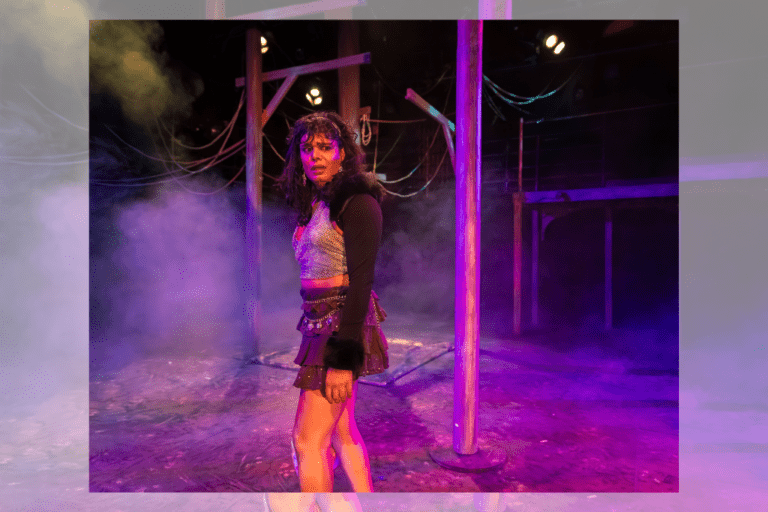 iPhoto caption: Zaiba Baig in 'The Begging Brown Bitch Plays.' Photo by Jeremy Mimnagh.
REVIEW: Truth and performance blur in Zaiba Baig’s The Begging Brown Bitch Plays at Buddies
It’s in the second half of Jhooti that Zaiba Baig’s performance is transcendent. She commands the stage, moving fluidly between humour and fury, bringing the audience through one emotional arc after another.
 iPhoto caption: Antonette Rudder and Sarena Parmar in 'The Surrogate.' Photo by Kendra Epik.
REVIEW: The Surrogate cross-examines privilege and parenthood at Crow’s Theatre
If the play sometimes reaches for one issue too many — religion, interracial relationships, infertility — it also underscores how interconnected these issues can be.
 iPhoto caption: Scott Wentworth and Walter Borden in 'An Orchid and Other Such Lilies and Lies.' Photo by Seamus Easton.
Playing at the Red Sandcastle Theatre, Dandelion Theatre's An Orchid and Other Such Lilies and Lies is an existential rumination on life, death, and friendship — and for me, a gentle reminder to tell people you love them while you still can.
Comments