
REVIEW: Against a bloody backdrop, Trident Moon pays homage to the power of resilience
 iPhoto caption: Photo by Dahlia Katz.
A band of warm light zig-zags through the dark — violent as an earthquake, jagged as a lightning bolt, arrogant as a border.
So opens the long-awaited Canadian premiere of Anusree Roy’s Trident Moon, produced by the National Arts Centre (NAC) and Crow’s Theatre at the latter’s Guloien Theatre (ahead of an April transfer to the NAC). Set during the British-instigated 1947 partition of India, which divided the country on religious grounds, the intense fictionalized drama offers a graceful depiction of several women’s high-stakes struggle to resist.
That aforementioned centre-stage line, lightly visible throughout the show, at first serves to divide. To the left of it kneel three Hindu characters: Alo (Roy), the forceful leader; Bani (Sehar Bhojani), her sister, nursing a recent gunshot wound; and Arun (Sahiba Arora), Bani’s 10-year-old daughter. When the play begins, the rest of Alo’s immediate family has just been massacred. The land they lived on is now part of Pakistan, meaning Hindus aren’t welcome.
In retribution, Alo and Bani have kidnapped Rabia (Imalia Perera) and Pari (Muhaddisah), whose shared husband was the murderer. Hands bound in the back of a speeding truck next to Pari’s six-year-old daughter Heera (Prerna Nehta), they’re on their way to the new India — where, as Muslims, all three will be in great danger. Alo even threatens to have Bani’s husband Kumar rape Rabia and Pari, after which she plans to scar their wrists with both the Hindu symbol of the trident and the Muslim symbol of the moon. To her, the women are guilty bystanders: “Where were you when your husband cut my family’s heads off one after another? You just stood there and listened to them scream.”
In NAC artistic director Nina Lee Aquino’s cohesive 90-minute production, the action unfolds in real time, with no scene transitions. The truck, driven by Kumar (who never appears on stage), stops thrice to let on new characters — played by Afroza Banu, Zorana Sadiq, Mirza Sarhan, and Michelle Mohammed — but otherwise pushes forward.
Trident Moon requires a tremendous amount from its 10-person ensemble. The action features death, sexual violence, and frequent screaming. These are, in turn, ultra-physical performances, pitched at mountainous levels of emotional intensity. The fact that the performers spend so much time on their knees adds to the atmosphere of desperation — even moving across the stage is a battle. (And, as per the instruction of Roy’s script, every character speaks with an accent.)
Stillness arrives like a balm. Several times, the tension eases, and the characters just sit, staring forward, unsure of where they’ll end up, taking solace in the simple act of being together; borders be damned. At such junctures, Aquino’s painterly eye for stage composition becomes apparent, with the onstage bodies combining to form richly layered images. While a couple of tense sequences mostly justify the decision to market Trident Moon as a thriller, these meditative interludes are what I found most impactful.
Sound designer Romeo Candido keeps an ambient score humming in the background. This generates forward momentum — but because its tempo is often a little slower than is comfortable, time blurs. As does place: even as the truck speeds toward the border, chants of rioters continue to ring out, the chaos seeming to take a similar form in every town.
Thick metal doors framed by sweeping curtains serve as the upstage wall of Jawon Kang’s set. From them, a raked trapezoidal platform widens out toward the audience. Michelle Ramsay’s crepuscular lighting design is subtle, morphing gradually, until the truck brakes or hits a speed bump and the side lights flash in sharp punctuation.
For audience members wondering if Trident Moon will be too visceral for them, I think director Andrew Kushnir’s 2023 Crow’s production of Natal’ya Vorozhbit’s Bad Roads is a solid benchmark. Set during the 2014 Russo-Ukrainian War, that show looked at a highly violent conflict with a similarly unsparing gaze, inviting the audience to confront something too wide-reaching for an isolated mind to comprehend.
Through performances of incredible vulnerability, Trident Moon lays itself bare. Gendered violence, colonialism, forced migration, genocide: These are ever-present forces, but they can be difficult to contemplate in any meaningful way. While Trident Moon doesn’t change that, it at least simplifies the first steps — just buy a ticket, sit down in the theatre, and breathe.
Trident Moon runs at Crow’s Theatre until March 30. Tickets are available here.
Intermission reviews are independent and unrelated to Intermission’s partnered content. Learn more about Intermission’s partnership model here.
Liam Donovan
Liam is Intermission’s senior editor. He lives in Toronto. His Substack newsletter is available at loamdonovan.substack.com.
LEARN MOREComments
Leave a Comment
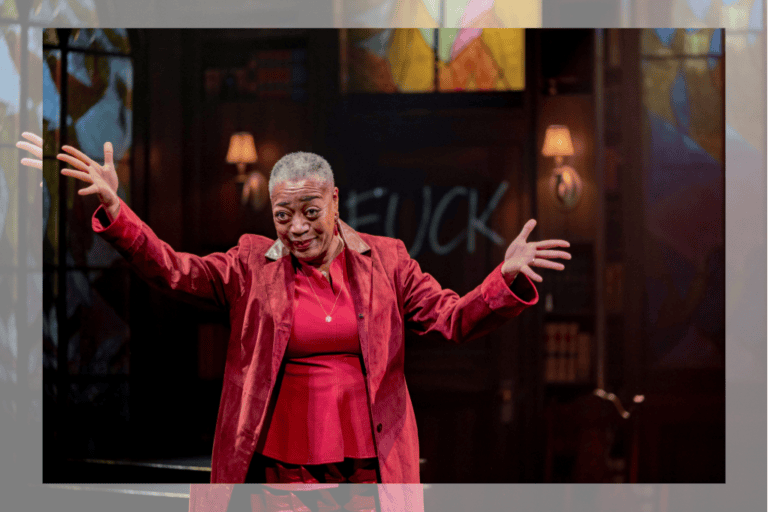 iPhoto caption: Karen Robinson in 'Prophetess.' Photo by Jae Yang.
REVIEW: In Tarragon’s outstanding Prophetess, language is both mighty and inadequate
Margaret’s facility with text helps her maneuver through an institution like York University, where words hold significant power. But the brilliant middle-aged scholar finds herself surprisingly unequipped to process the true sense of more elemental forces: love, grief, spiders.
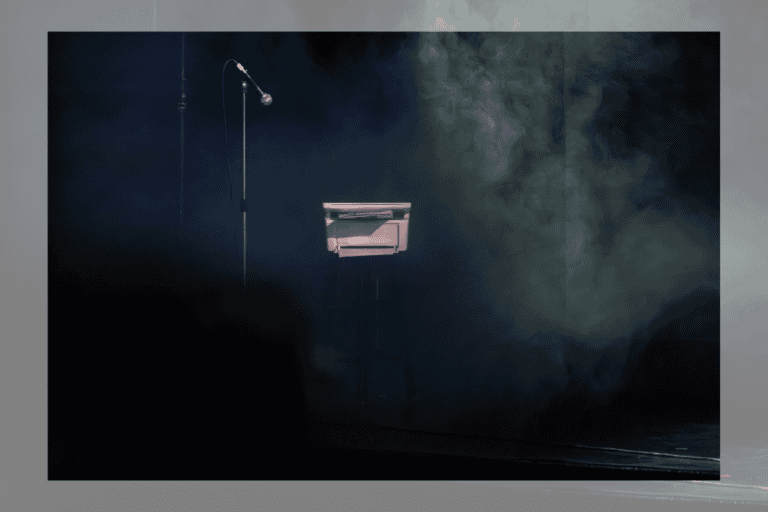 iPhoto caption: 'Documents Perform 3.' Photo by T Photo Factory.
Joining online from across the Americas, more than a dozen artists, artistic producers, cultural leaders, and policymakers add live suggestions to the document, together transforming stuffy bureaucratic language into a rowdy patchwork of compassionate imagining.
 iPhoto caption: Stratford's Tom Patterson Theatre. Photo by Ann Baggley.
2027 highlights include a new Canadian Jacob Two-Two musical and two of the Bard’s thornier plays: The Merchant of Venice and The Taming of the Shrew.
 iPhoto caption: Devon Michael Brown as Rusty Charlie with members of the 'Guys and Dolls' company.
“It's so exhausting, but it's really rewarding when you get to dance so full-out,” says Devon Michael Brown. “You get to use your technique and your training to the fullest extent.”
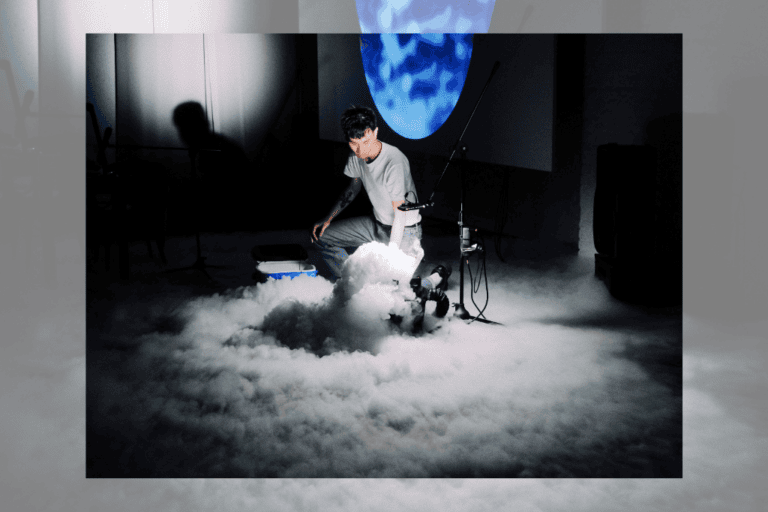 iPhoto caption: Ping-Hsiang Wang in 'Retina Maneuver.' Photo by Hang Su.
REVIEW: At this year’s SummerWorks Performance Festival, physical storytelling is central
From a dancer becoming a canine to a shy theatre director practicing his swordsmanship, the shows I’ve seen so far use performers’ bodies to dramatize defiance.
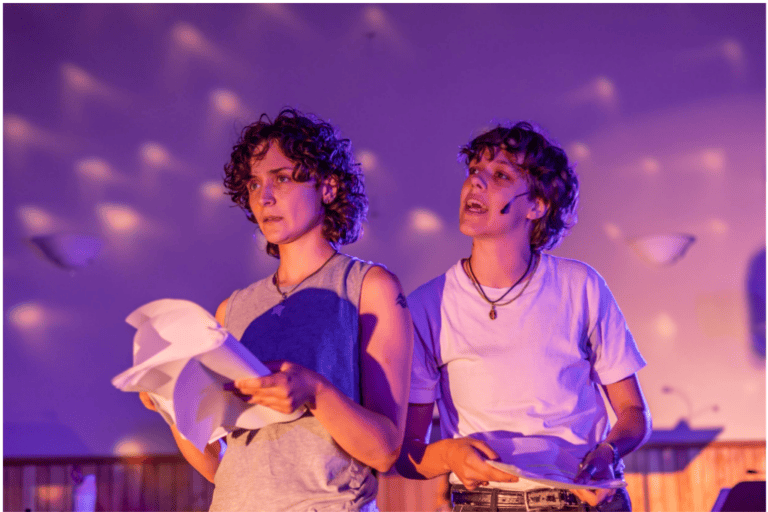 iPhoto caption: Anna Morreale and Luca McPhee perform in 'From Stardust' at the 2025 MADGEN Theatre Festival. Photo by Dave Klassen.
MADGEN Theatre Festival returns to the Danforth
Theatre of the Beat selected four producers under the age of 30 to receive paid mentorship from Toronto theatre-makers. From August 20 to 22, each member of the cohort mounts a new one-act Canadian play.
We were persons from India who have been here 30 years.
The play lacked proper actors.
The play had poor sound acoustics
Parts of script were repetitive
Too expensive