
REVIEW: Britta Johnson’s Life After shimmers in large-scale Mirvish transfer
 iPhoto caption: Pictured (L to R): Jake Epstein as Frank, Isabella Esler as Alice. Photo by Michael Cooper.
When listening to a song by Canadian composer-lyricist Britta Johnson, there’s often a point, toward the climax, where I think I know what’s next to come.
I’m always wrong.
Instead of taking the predictable path, Johnson will pivot into a refreshingly new harmonic realm, not making an unexpected turn so much as levitating off the ground completely.
This cliché-averse approach propels her complex musical Life After, which, over several runs, has evolved from a 2016 Toronto Fringe Festival production into a Yonge Street Theatricals-produced commercial engagement at Mirvish’s hulking CAA Ed Mirvish Theatre. Directed by frequent Dave Malloy collaborator Annie Tippe, with a cast that mixes American and Canadian talent, the show seems to be eyeing a Broadway run.
But let’s not worry about whether this idiosyncratic one-act would succeed in such an unforgiving market. What matters is that Tippe’s scaling-up of Life After is here now — and it shimmers. The show’s tender excavation of grief’s ambiguities hasn’t lost any power in its transfer to a bigger house; in fact, it’s clearer than ever.
Life After unfurls like a mystery, with GTA high-schooler Alice (Isabella Esler) in the central role of detective. The case under investigation is that of her father Frank (Jake Epstein), who recently died in a car crash in somewhat odd circumstances. The author of a self-help book popular with middle-aged women, he was set to leave for a conference in Winnipeg on a flight departing at 8:00 p.m.; 22 minutes later, his vehicle crashed in a suburb far from the airport.
While Alice’s sister Kate (Valeria Ceballos) and mother Beth (Mariand Torres) aren’t interested in the accident’s exact causes, Alice insatiably rifles through the sparse facts. The evidence includes a voicemail from Frank, in which he apologizes for fighting with Alice before leaving: “What a horrible way to say goodbye.”
A regional champion in prepared debating, Alice is logic-driven, a disposition that hasn’t prepared her for an occurrence so cruelly arbitrary. Her impassioned attempts to “make sense of the senseless” (as Frank puts it in a draft of his book) send memory, fantasy, and reality interweaving.
From the comfort of a bench, Frank croons the samba-inflected “Route 33,” about the street where he died, while an amusingly vapid Greek chorus — a metamorphic trio of Frank-obsessed women (Kaylee Harwood, Arinea Hermans, and Zoë O’Connor) called “Furies” in the program — attends a couple of events commemorating the author, appropriating the language of his voicemail: “What a beautiful way to say goodbye!” Amid this whirlwind, Alice finds a degree of solace in the company of her endlessly talkative friend Hannah (Julia Pulo).
When Life After played the Berkeley Street Theatre in 2017, director Robert McQueen established location primarily through tables and chairs (or so I remember). Tasked with filling the Ed Mirvish stage, Tippe and American scenic designer Todd Rosenthal take a more detailed approach. Seen in dollhouse view, Beth and Frank’s two-storey(-plus-attic) suburban home initially appears almost stereotypically conventional. But as the show begins to rove through Alice’s whirring mind, a turntable swaps out the ground floor living room for one verisimilar location after another, generating an ever-shifting sense of place that mirrors the unstable nature of grief.
Although Esler’s sensitive performance anchors Life After, much of what happens around Alice is rather funny. As the Furies transform from character to character, they dole out casseroles and hair flips with sarcastic flair. The sublime Pulo sprints from comic beat to comic beat, feasting on her many punchlines. Playing English teacher Ms. Hopkins, Chilina Kennedy channels a bit of Glee’s Sue Sylvester when she mutters that students disappointed about their marks should go home and “blog about it.” And Epstein makes for a far dorkier Frank than Dan Chameroy did in 2017.
Pile on a hefty dose of uptempo numbers (with jazzy choreography by Ann Yee) as well as peppy pacing, and you get a show that comes awfully close to fitting the definition of musical comedy. That’s an accessible — if commercial — approach to the subject of grief, but it has the side effect of keeping Kate and Beth oddly out of frame. While this sidelining parallels Alice’s own treatment of her family, I did at times lament not hearing a little more from them; when the show’s focus briefly returns to the family unit toward the end of the 90-minute runtime, it’s very welcome.
But Alice’s journey unfolds with remarkable sharpness, even though her experience isn’t at all neat — if anything, the character’s challenge is to embrace mess. To relinquish control. To debate on the fly. To be OK with in-betweenness. To welcome memory’s fuzziness. To become, in effect, an artist; and accept that, just before things climax, life will sometimes modulate to a volatile new key.
Life After runs at the CAA Ed Mirvish Theatre until May 10. Tickets are available here.
Intermission reviews are independent and unrelated to Intermission’s partnered content. Learn more about Intermission’s partnership model here.
Liam Donovan
Liam is Intermission’s senior editor. He lives in Toronto. His Substack newsletter is available at loamdonovan.substack.com.
LEARN MOREComments
Leave a Comment
 iPhoto caption: Steven Sutcliffe and company in 'Twelfth Night.' Photo by Dahlia Katz.
REVIEW: High Park Twelfth Night pays tribute to the crazy things we do for love
As the play’s events ping-pong between seriousness and frivolity, Caroline Toal’s Viola appears constantly aware of the dangerous contradictions in the air, remaining guarded against the chaos' pull — and yet never entirely abandoning the possibility of enchantment.
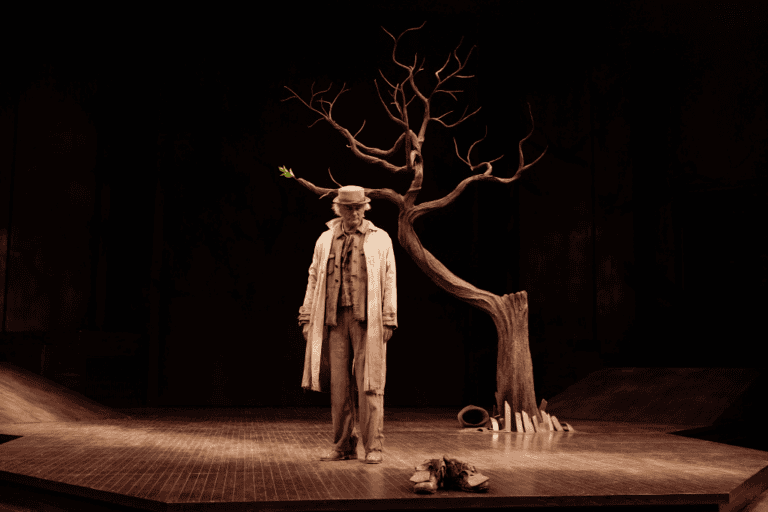 iPhoto caption: Paul Gross in 'Waiting for Godot.' Photo by David Hou.
Why Paul Gross thinks Waiting for Godot is ‘one of the great achievements of human creativity’
“The audience is with you. You bring them in. There isn't a big division between the stage and the audience,” says Gross, currently playing Vladimir in Waiting for Godot at the Stratford Festival. “They’re the final piece of the storytelling. We need them to complete the circle.”
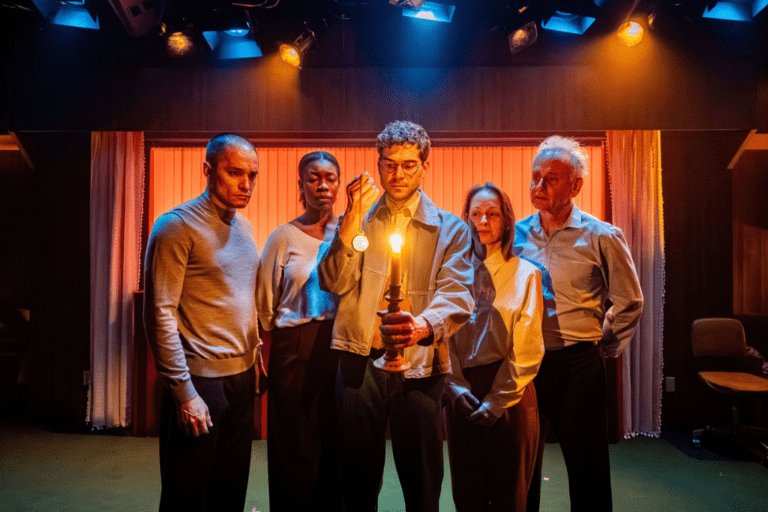 iPhoto caption: Karl Ang, Ivy Charles, Daniel Maslany, Mariya Khomutova, and Alon Nashman in 'The Division.' Photo by Dahlia Katz.
Productions at Crow’s and Theatre Passe Muraille win top honours at the 2026 Dora Awards
This evening at Meridian Hall, the Toronto Alliance for the Performing Arts (TAPA) announced the recipients of the 46th annual Dora Awards, celebrating local theatre, dance, and opera.
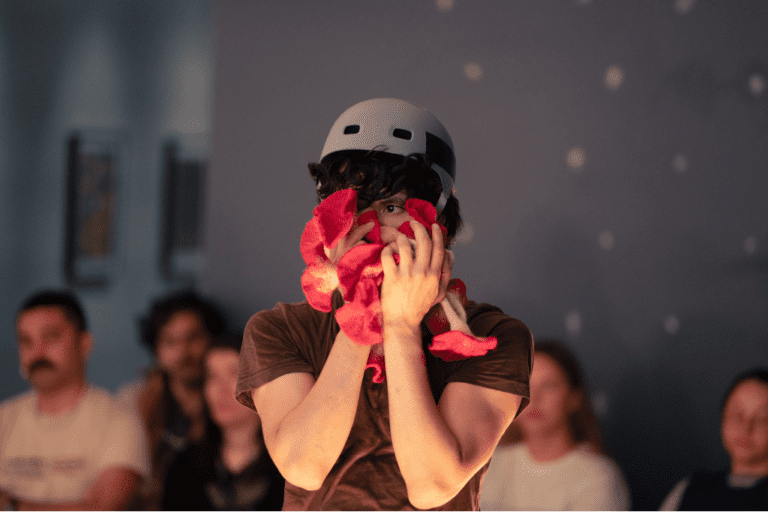 iPhoto caption: 'Golden Rez Dog.' Photo by Philippe Latour.
Creations from Denmark, Hong Kong, Iran, Mexico, and beyond feature in this year’s SummerWorks Performance Festival programming.
 iPhoto caption: Photo by Drew Berry.
REVIEW: An homage to Richard Foreman commands us to change our lives — and our theatre
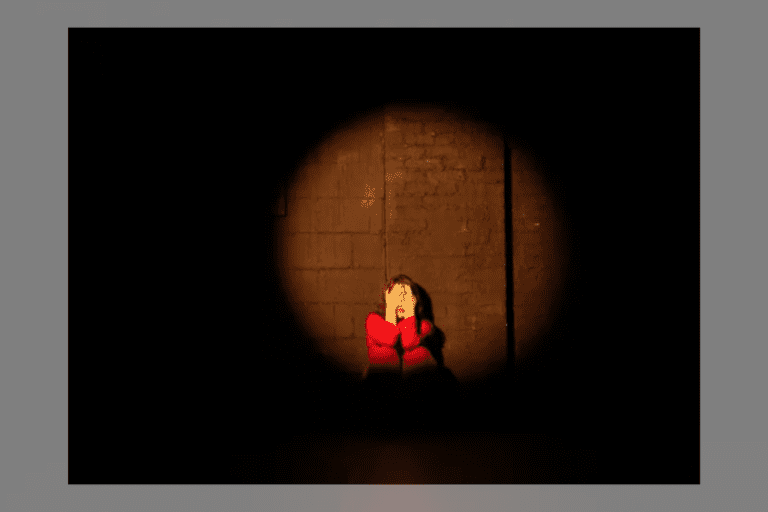
Richard Foreman's plays usually drew on his personal journals and clocked in around 70 minutes; when he passed away last year at the age of 87, he left behind an invitation for directors to create royalty-free work from those journals. With the recently closed You Must Change Your Life at Toronto’s Alumnae Theatre, creator-director Ilana Khanin took up that offer to ludic, collage-like effect.
 iPhoto caption: Danny O’Mahony and Emily Kilkenny Roddy in 'Bellow.' Photo by Ste Murray.
REVIEW: This year’s Bealtaine Theatre Festival featured accordions, ketamine, and James Joyce
The festival serves up a curated program of contemporary theatre from Ireland — appreciated, in a city that punches below its weight in terms of international performing arts offerings from countries it doesn’t border.
I saw this on Saturday. I walked in blind. I didn’t know what it was about and had never listened to the score. At first, I was moderately amused. The furies made me laugh out loud. They were funny. Over the top! I thought, “How could this be about grief? I thought this was supposed to be a sad show.” I even brought extra Kleenex for the 90-minute show.. I had been laughing so much I forgot where the Kleenex was.
And then, at some point, I found myself holding back sobs. I was crying. My body was shaking. I had to fight hard not to let my grief become public. This show moved me. It moved me a lot. I felt Alice’s pain. I felt her mom’s pain. I felt her sister’s pain. I even felt her friend Hannah’s pain.
This sadness in this show isn’t in your face like in Les Misérables. It is always there, just below the surface, and then it bubbles up like a geyser. It is a lot like how we deal with grief in our lives. We try to ignore it. Or find excuses for it.
This show will sit with me for a long time. I