
As he plays Leontes at the Stratford Festival, Graham Abbey reflects on his deep bond with The Winter’s Tale
 iPhoto caption: The company of 'The Comedy of Errors.' Photo by JVL Photography.
Describing his immense connection to The Winter’s Tale, actor Graham Abbey invokes an idea from Douglas Campbell, who in 1958 directed the Stratford Festival’s first take on the genre-bending play.
“Campbell used to talk about an ectoplasm in the theatre: an invisible thing that connects actors to audiences,” Abbey told me over Zoom. “This is a play where I’ve felt that ectoplasm more powerful[ly] than ever, anytime I touch it.”
Staged at the Tom Patterson Theatre by artistic director Antoni Cimolino, Stratford’s current production stars Abbey as Leontes, the fictional king of Sicilia (played by Christopher Plummer in the Campbell version). Minutes into the play, the character spirals into an abyss of jealousy and paranoia. In violent but richly poetic monologues, he accuses his wife Hermione (Sara Topham) of sleeping with his dear friend Polixenes (André Sills). Though from the audience her innocence seems obvious, Leontes’ convictions are immovable.
He then disappears until the play’s final scenes, as Shakespeare pivots from first-half tragedy to second-half pastoral. The changeability of this fragmented, late-period work sometimes deters producers: While Stratford has done A Midsummer Night’s Dream 14 times, this is only its sixth Winter’s Tale. But Abbey has returned to the text repeatedly, at the festival and beyond.
In Stratford’s 1998 production, he played the young prince Florizel under the direction of Brian Bedford, himself Leontes at Stratford in 1978. (The company’s Shakespearean mandate inevitably produces such connections to the ghosts of productions past, filling the air with another sort of ectoplasm.) 18 years later, it was the first play produced by Abbey’s company Groundling Theatre; staged at the Coal Mine Theatre, the production marked Abbey’s directorial debut, and won the Dora Award for outstanding production in the indie division. That staging transferred to the Winter Garden Theatre the next year. Most recently, in 2020, he directed another version, at the University of Toronto.

“It’s got to be my favourite [Shakespeare play] at this point,” he reflected. “I don’t understand why it’s so rarely done. It’s listed as a ‘problem play,’ and I see that, but I have had such beautiful experiences with it throughout my life… I think it has the ability to unite audience and cast in a deeply human event.”
Abbey had to consider Leontes thoroughly when Tom McCamus played the part for Groundling (in Cimolino’s production, McCamus is the sagacious Old Shepherd), but stepping into the role is different. In particular, he’s come to think of the text’s health-related imagery as key to understanding Leontes’ erratic behaviour.
“Seeing it from the inside, I really feel the trajectory of mental illness,” said Abbey. “Very early on, the first thing Leontes notices is that his heart [is vibrating with what he calls] ‘tremor cordis,’ so he’s able to see that something physically is happening to him… And there’s all sorts of references to infection through the play, right up till the end, when he apologizes to Polixenes and Hermione, and he says: ‘both your pardons / That e’er I put between your holy looks / My ill suspicion.’
“And really, when we talk about the possibility for redemption of… tyrannical behavior, for me the path through that is the ability to forgive someone who was sick, who was addicted, who had a disease. What is our capacity to forgive that, and work towards resolution?”
The topic of redemption came up throughout our conversation (forgiveness, it seems, is an important theme at the Tom Patterson right now). After 16 years of regretting what he put Hermione through, Leontes emerges a softer, more sensitive man, and Shakespeare rewards him with a dose of salvation.
While it’s easy to draw links between Leontes’ abuse of power and the actions of various contemporary authoritarian governments, Abbey thinks the character’s redeemability sets him apart. “Certainly, there are parallels to a tyrannical dictator. We’ve got a bunch of those, unfortunately, in the world,” he said. “But in this case, at least, I’m happy that we have the redemption, and I’m happy to embody a man who has the capacity to look at his actions and be deeply sorry… I’m proud that the back-end [of the play] examines a deeper soul, someone who can see what’s right and wrong. Because when I look at our world right now, there’s a whole bunch of people who can’t make that separation.”

In a further divergence from reality, the play’s iconic final scene contains a divine act — a resurrection, of sorts. But looking back at his time working on the Bedford production, Abbey wonders if this, too, can serve as a blueprint for our world. “I remember Brian said to us: ‘What if, in fact, we are witnessing a miracle?’ And it’s always stuck with me, because it’s such a beautiful idea for theatre in general: ‘What if these things are real?’
“It sounds silly, because it’s what we do for a living, but I always think of that in that moment, and I think of the energy of everyone in the house, and the possibility that for each of us, somebody we loved and cared for… could come back into that room. What would that do to our psyche, and our heart, and our soul?”
The Winter’s Tale runs at the Stratford Festival’s Tom Patterson Theatre until September 27. Tickets are available here.
The Stratford Festival is an Intermission partner. Learn more about Intermission’s partnership model here.
Liam Donovan
Liam is Intermission’s senior editor. He lives in Toronto. His Substack newsletter is available at loamdonovan.substack.com.
LEARN MORE iPhoto caption: Devon Michael Brown as Rusty Charlie with members of the 'Guys and Dolls' company. Stratford Festival 2026. Photo by Ann Baggley.
“It's so exhausting, but it's really rewarding when you get to dance so full-out,” says Devon Michael Brown. “You get to use your technique and your training to the fullest extent.”
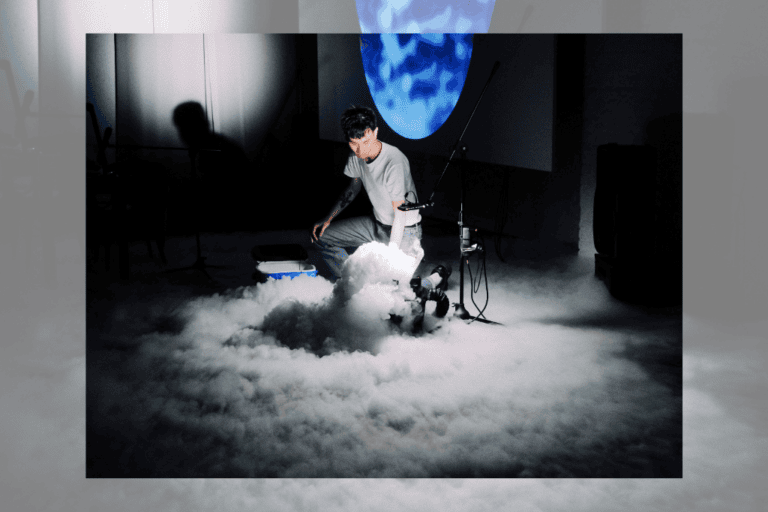 iPhoto caption: Ping-Hsiang Wang in 'Retina Maneuver.' Photo by Hang Su.
REVIEW: At this year’s SummerWorks Performance Festival, physical storytelling is central
From a dancer becoming a canine to a shy theatre director practicing his swordsmanship, the shows I’ve seen so far use performers’ bodies to dramatize defiance.
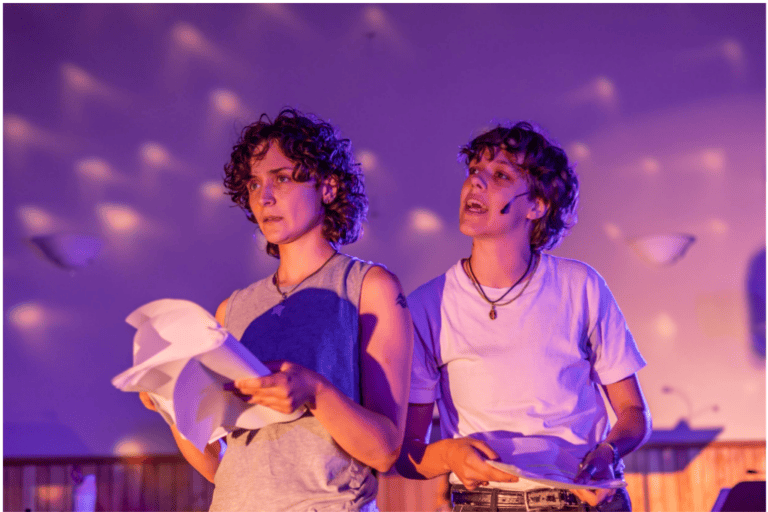 iPhoto caption: Anna Morreale and Luca McPhee perform in 'From Stardust' at the 2025 MADGEN Theatre Festival. Photo by Dave Klassen.
MADGEN Theatre Festival returns to the Danforth
Theatre of the Beat selected four producers under the age of 30 to receive paid mentorship from Toronto theatre-makers. From August 20 to 22, each member of the cohort mounts a new one-act Canadian play.
 iPhoto caption: Steven Sutcliffe and company in 'Twelfth Night.' Photo by Dahlia Katz.
REVIEW: High Park Twelfth Night pays tribute to the crazy things we do for love
As the play’s events ping-pong between seriousness and frivolity, Caroline Toal’s Viola appears constantly aware of the dangerous contradictions in the air, remaining guarded against the chaos' pull — and yet never entirely abandoning the possibility of enchantment.
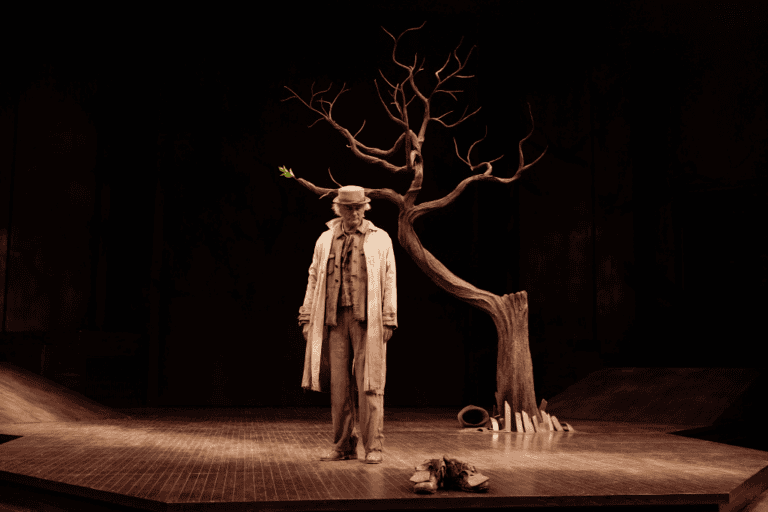 iPhoto caption: Paul Gross in 'Waiting for Godot.' Photo by David Hou.
Why Paul Gross thinks Waiting for Godot is ‘one of the great achievements of human creativity’
“The audience is with you. You bring them in. There isn't a big division between the stage and the audience,” says Gross, currently playing Vladimir in Waiting for Godot at the Stratford Festival. “They’re the final piece of the storytelling. We need them to complete the circle.”
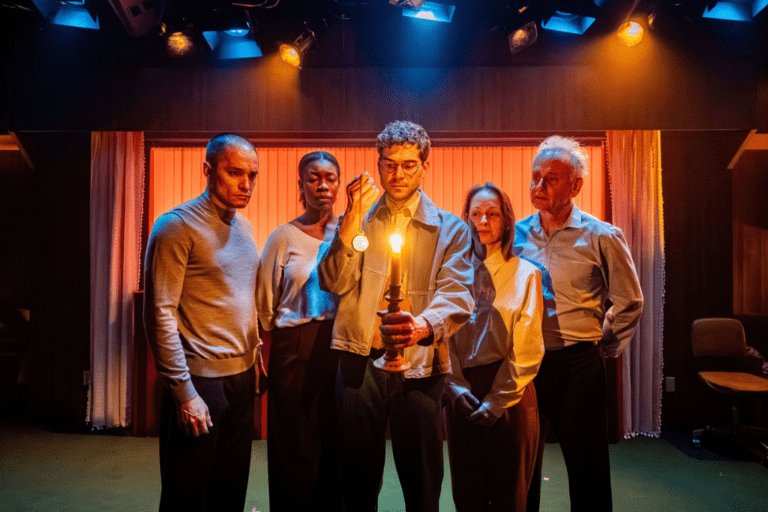 iPhoto caption: Karl Ang, Ivy Charles, Daniel Maslany, Mariya Khomutova, and Alon Nashman in 'The Division.' Photo by Dahlia Katz.
Productions at Crow’s and Theatre Passe Muraille win top honours at the 2026 Dora Awards
This evening at Meridian Hall, the Toronto Alliance for the Performing Arts (TAPA) announced the recipients of the 46th annual Dora Awards, celebrating local theatre, dance, and opera.
Comments