
Anita Rochon, director of A Doll’s House at Theatre Calgary, knows a good play has your back
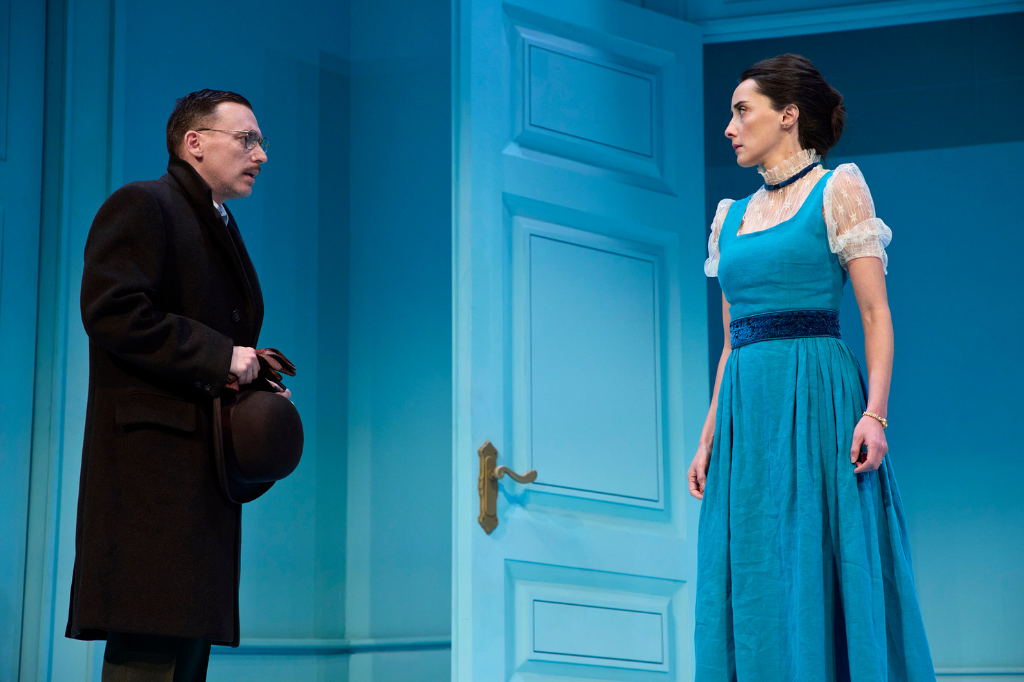 iPhoto caption: (L to R) Ron Pederson (Nils) and Alexandra Lainfiesta (Nora) in 'A Doll's House.' Photo by HarderLee.
Ibsen’s A Doll’s House is one of the best-known plays in the Western theatre canon, but Anita Rochon wants to preserve the mysteries at its core.
The Vancouver-based director is staging Theatre Calgary’s current production, which uses a 2023 translation by American playwright Amy Herzog. Produced in partnership with the Arts Club Theatre Company, this Doll’s House first ran in Vancouver last fall. In a conversation by phone during technical rehearsals, Rochon spoke about her excitement at this chance to collaborate across provinces.
“The Calgary theatre community is well-regarded across the whole country,” she said. “The Vancouver portion of the team are really enjoying being here, and working alongside everyone from the artists, to the technicians, to the administrators. Working in Calgary, this time and previously, there’s this feeling that people are committed to excellence, and to kindness.”
Rochon said that this co-production is a chance to further nuance the production, which retains most of the same cast and creative team from the Vancouver run.
“With a script as complex and rich as A Doll’s House, it felt like we got to a really great sketch of what the play is,” said Rochon of the opening in Vancouver. “Throughout that run, the actors continued to fill in the details. As we enter tech in Calgary, I’m seeing this deeper understanding of the piece in their bones.”

Herzog’s work was in Rochon’s bones before rehearsals started. In 2019, Rochon directed the playwright’s 4000 Miles — about a young man and his grandmother trying to bridge their generational divide — at the Belfry Theatre in Victoria.
“[I know] the rhythms and aspects of humanity that she’s interested in exploring,” Rochon said. “I’m always attracted to the complex, troubled, imperfect human. Ibsen and Herzog invite in complexity.”
Herzog’s translation of A Doll’s House, which Canadian Stage also recently staged, is by and large a faithful rendering of Ibsen’s play. Set in 1879 at Christmastime, it follows a young woman called Nora — played by Alexandra Lainfiesta in this production — as she awakens to the hollowness of her marriage, and the stifling nature of her society’s middle-class morality. Where Herzog’s version differs most is its approach to language, which cuts to the core of Nora’s journey.
“Herzog makes A Doll’s House feel like it’s happening right now,” Rochon described. “The language is immediate and contemporary, without changing the period setting. The translation strips away formality so that the emotional stakes land harder.”
Rochon said that Herzog’s stage directions, in particular, set this translation apart. “There’s no staff in the house, versus in the original, in which a maid answers the doors and brings people in,” she explained. “[Instead], Herzog’s written these shifts into the play. It just says ‘shift’ on the page, and then [a new character] is in front of [Nora]. One interpretation is that you jump forward in time a little bit. I think you could go with the interpretation that we are very much inside Nora’s reality.
“It invites you into being creative,” she added. “I’m so curious how others have interpreted it.”
It’s important to Rochon that the audience — not just the creative team — has plenty of room to interpret this Doll’s House.
“All the characters are imperfect, and a little bit mysterious,” she said. “I know in interviews with Amy Herzog, she’s spoken about wanting to highlight how Nora is complicit in some of the games she plays, and the ways she maneuvers through her world. The story is not just happening to her. She’s not a victim.”
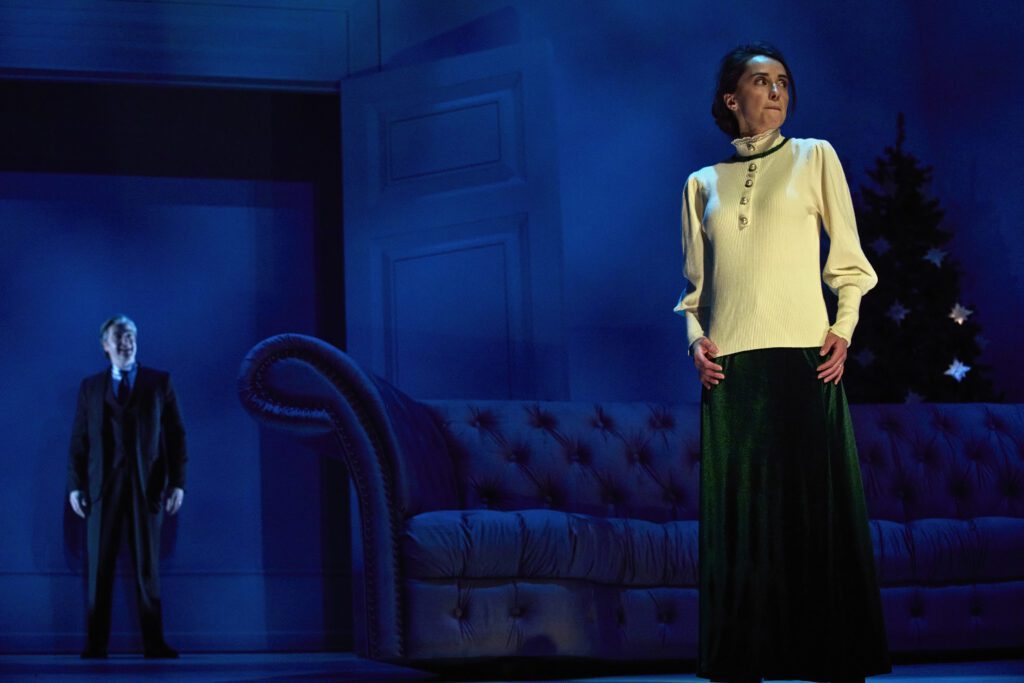
How complicit Nora’s been in keeping up appearances — and how permanent her decision to leave her family may be — Rochon leaves up to the audience.
“At the end of the play, questions are left unanswered,” she said. “For me, those are the best kinds of plays: the ones where, on the bus ride or the drive home, you and your friends can pick things apart and discuss what these characters were motivated by. ‘Do you think [Nora and her husband] will stay separated, or do you think they’ll come back together?’
“We’re trying to honour the intelligence of the characters and the audience,” she continued.
Thankfully, this particular doll’s house was made by two master builders.
“Sometimes, if a script is not as strong, you’re having to act your way through the gaps,” explained Rochon. “Or a director might try to create dynamics that aren’t inherently there. Whereas in a strong script like this, the tension mounts in a way that’s deeply connected to its structure.
“A good play has your back,” she said. “You just have to meet it, match it, and embody it.”
A Doll’s House begins previews April 7 and runs until May 3, in the Max Bell Theatre at Werklund Centre. Tickets are available here.
Theatre Calgary is an Intermission partner. Learn more about Intermission’s partnership model here.

Nathaniel Hanula-James
Nathaniel Hanula-James is a multidisciplinary theatre artist who has worked across Canada as a dramaturg, playwright, performer, and administrator.
LEARN MORE iPhoto caption: Dance Macabre cast. In photo: Keira Marie Forde (front). Back: [L to R] Uche Ama, King Cosmos, Theresa Gomes and Thomas Fournier. Photo by Tiku Romello Fisher (TRF Media).
At the 2026 Toronto Fringe, Caribbean artists stage collisions of identity, power, and desire
In separate video conversations, the lead artists behind Danse Macabre, Ex-Change of Words, and Momme Domme spoke about approaching themes of Blackness, diaspora, power, and desire.
 iPhoto caption: Marissa Orjalo as Ariel with members of the company in 'The Tempest.' Stratford Festival 2026. Photo by Ann Baggley.
For Marissa Orjalo, this season at Stratford is such stuff as dreams are made on
“Every day feels like a new adventure,” says Orjalo. “I always look to the people who've come before me, and they're always very generous. I'm on this journey of learning, and I hope to learn for the rest of my life.”
 iPhoto caption: Ordena Stephens-Thompson and Tony Nappo in 'The Neighbours' at Tarragon Theatre. Photo by Jae Yang.
As PlayME’s season concludes, its creators reflect on the changing world of Canadian audio drama
Chris Tolley remembers CBC's Studio 212 with a sense of awe. “It felt like you were on the Starship Enterprise holodeck,” he said. “There was this big, long table with all these different computers and servers underneath. The studio had these different staircases made out of wood and metal, and strips of concrete and wood floor, so that you could run on them and record [different sound effects].”
 iPhoto caption: 'Chicken.' Photo by Hildegard Ryan.
This piece of contemporary Irish theatre stars a talking fowl with a ketamine habit. Its creators are anything but chicken.
 iPhoto caption: Members of the company of 'Katma.' Photo by Anna Kucera.
At the 2026 Luminato Festival, performance gets up close and personal
“It would be so weird for people to be sitting two feet away, watching other people have a good time,” says Katma creator Azzam Mohamed. “In the party environment, there’s nothing between me and you. You’re so close to me that I can’t fake it."
 iPhoto caption: Headshots of Signy Lynch, Martin Julien, Anita Majumdar, Donna-Michelle St. Bernard, and Derrick Chua.
Five theatre professionals champion Canadian plays that deserve more life
Across the country, second productions are rare, especially for shows that premiered pre-pandemic. With this in mind, I spoke to five theatre folks about the Canadian play that each of them thinks deserves another live production.
Comments