
Interdependent (And Published!) Magic: In Conversation with Jessica Watkin
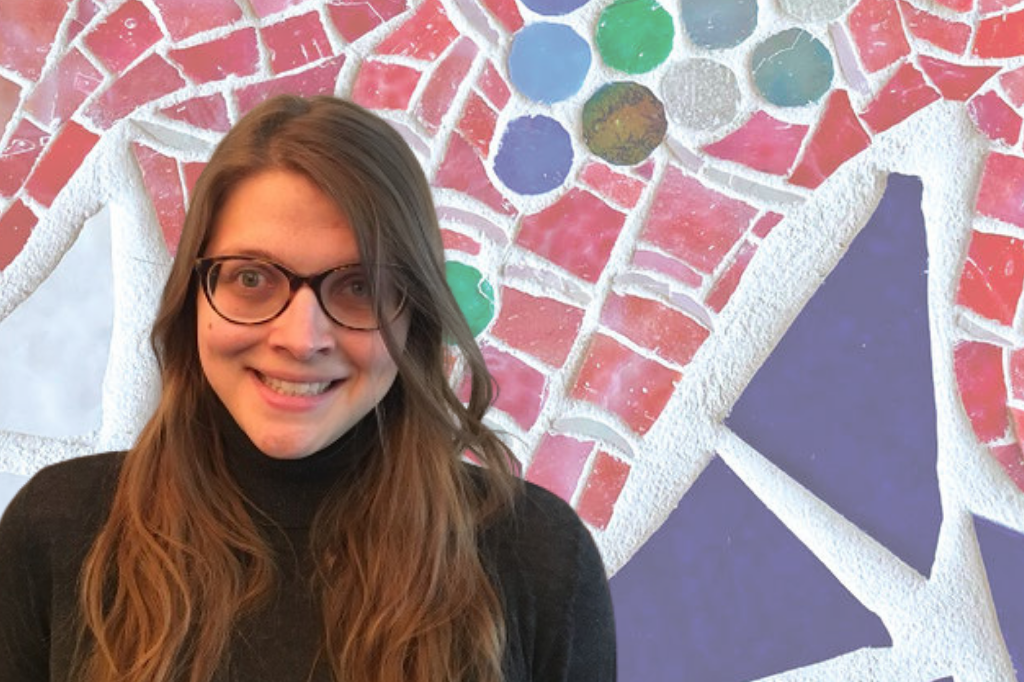
Playwrights Canada Press’ first anthology of disability performance in Canada is long overdue.
But after a pandemic, a paper shortage, and innumerable conversations on what it means to publish a printed record of ephemeral, physically diverse performances, it’s finally happening.
Curated by Blind performance scholar, artist, designer, and educator Jessica Watkin, Interdependent Magic: Disability Performance in Canada brings together four plays: Smudge by Alex Bulmer, Access Me by the Boys in Chairs Collective, Antarctica by Syrus Marcus Ware, and Deafy by Chris Dodd. The collection is purposely wide in scope, offering readers an intersectional peek into the vast world that is Canadian disability performance.
“I’m a creative problem solver,” says Watkin when we meet over Zoom. Blind since the beginning of her post-secondary education, Watkin has a complicated relationship with script-based practice — she’s a tactile artist and learner, but uses script-based texts solely because it’s what she calls “normal.”
“I dream of a day where we can use sound-based or tactile-based text,” she says. “But that’ll take an increase in non-visual practice in the field.”
I’m a creative problem solver.
Watkin’s first anthology for Playwrights Canada Press marks a major milestone in Canadian dramatic publishing: it’s the first edited collection of its kind, and it’s not just being marketed to academic communities.
“My goal with this book is to reach the disability community and the arts community,” says Watkin. “It’s not just for academics.”
“There’s value in a conversational tone in academic writing — it makes it more accessible. It’s so interesting to see how the tone you use can open up or demystify these concepts. The introduction to this anthology is the best example of that: I want to take these concepts that are really complicated and make them understandable.”
This book is not just for academics.
We dig into the book itself, leaning into the curatorial prowess needed to select just four plays which represent disability performance across Canada.
“I’m a scholar. It was part of my research to meet with these artists and study their work closely. When this opportunity at Playwrights Canada Press arose, it was a chance to give back to these artists who’d shaped my own practice — so I gave them a publication deal.”
It’s personal reasoning for a collection of deeply personal plays. Smudge by Alex Bulmer, in particular, hits close to home for Watkin.
“When it comes to Bulmer’s play Smudge — that was the first Blind play I’d ever read in my life. I mean — Alex lost her vision at the same time I did. There’s a section from the play I’ll be reading aloud at the book launch this week, and every single time it makes me cry. The whole thing touches me, but the last monologue is the love letter to her sight — it rocks my bones every single time. Smudge is in the anthology for a lot of reasons, but it really shows the medical models of disability — the interaction in diagnosis. And it’s so fucking funny. There’s humour in there.”
The book is a labour of love and a long time coming.
The conversation flows smoothly from one play to the next: Watkin’s evidently passionate about the book. It’s a labour of love and a long time coming.
“Access Me by the Boys in Chairs Collective is so clearly about queerness and gayness and sexuality in Toronto. It opens up discussion on the intersection between queerness and disability. Then Antarctica builds on that idea, too: there’s a close relationship between queerness and disability. And there’s a scholarly framework for that, where both queerness and disability serve as disruptive modes, tools for world-building and future-building.”
Antarctica by Syrus Marcus Ware is a particularly layered piece, speaking not only to overlapping disability and queerness but to anti-Black racism and climate change, as well — and it accomplishes that discourse in just twenty-five pages.
Chris Dodd’s Deafy, too, is a unique entry in the book, just one instance of Deaf performance within a “vibrant and beautiful community,” says Watkin. She describes American Sign Language, or ASL, as a performance-based language — it’s a vital component of Deafy, the first Deaf play to be published in Canada.
“In the context of what we typically see on theatre stages, it’s so radical,” says Watkin.
These are contextual, situational pieces. It’s not Hamlet, and it’s not George F. Walker.
We move into the heart of our discussion on curation.
“I think the hardest thing for me — and I hate to say it — is filling the quota,” says Watkin.
“And that’s a big responsibility when you’re making the first anthology of disability plays in Canada. I want to hit every disability — there are thousands of them. I want to hit every race, every ethnicity, every culture — there’s no way to realistically do that. Making those decisions and curating was partly quota-filling, and partly thinking about what publishing means for a play,” she says.
“This isn’t necessarily an anthology you can bring into a classroom to read together. You’re not going to go and put on Smudge without a Blind actor. It’s about getting the work out there, and not necessarily handing people a blueprint to go and put on the show themselves. No one’s going to pick up Antarctica and perform it. It’s not Hamlet, it’s not George F. Walker. These are contextual, situational pieces. We need to frame things carefully — publishing a script is not, in this case, an invitation to perform it.”
“It’s about balance.”
Watkin’s anthology builds on larger conversations in dramatic publishing in Canada: what, truly, does it mean to publish a script? Canadian drama’s populated by a lot of deeply personal, autobiographical solo shows: their publishing (by Playwrights Canada Press and otherwise) doesn’t necessarily indicate an uptick in their productions by artists who didn’t write the work themselves. To publish a play is to offer to the world a written archive as much as it is to posit a blueprint for future performance: it’s situational.
It’s about balance.
There’s also the whole idea of script-publishing as a whole — what it means, and what it excludes.
“I had to choose these plays specifically because they had scripts. There are incredible disability performances I wanted to include: dance pieces with no script, for instance. What’s come up through the curation of this is wrapped up in colonization and ableism and the patriarchy: there’s a systemic dedication and devotion to text. If there’s no text, there’s no evidence of the performance, and it can’t be published — it’s unpublishable.”
Dreams for radical changes in the publishing industry at large aside, Interdependent Magic: Disability Performance in Canada signals an exciting, bold first step in representation for a wide gamut of differently abled folks in Canadian theatre and performance. The book, at Watkin’s behest, is available in paperback, PDF, EPUB, and audiobook forms: as in any play worth its dramaturgical salt, the medium here has been stretched to accommodate its timely, resonant message.
Interdependent Magic: Disability Performance in Canada is available for purchase from Playwrights Canada Press here.
Aisling Murphy
Aisling is Intermission's former senior editor and the theatre reporter for the Globe and Mail. She likes British playwright Sarah Kane, most songs by Taylor Swift, and her cats, Fig and June. She was a 2024 fellow at the National Critics Institute in Waterford, CT.
LEARN MORE iPhoto caption: Photo by Fabian Hammerl.
In A a | a B : B E N D, choreographer Aszure Barton aims to rebuild dance from the inside out
“It’s so easy to over-intellectualize dance in general, but B E N D is about hearing and moving to cool-ass music together,” says Barton ahead of the show's run at the Bluma Appel Theatre.
 iPhoto caption: Elinor Holt and Ellen Close in 'How Patty and Joanne Won High Gold at the Grand Christmas Cup Winter Dance Competition.' Photo by Benjamin Laird.
“We’re living in a world right now where failure is not an option,” says actor Elinor Holt. “And a lot of times people would rather not try anything at all, rather than try something and risk failing at it.”
 iPhoto caption: Jane Spidell as Bettye, Kevin Bundy as Jim, and Noah Beemer as Steve in 'Twelve Dinners.' Photo by Dahlia Katz.
With TIFT’s Twelve Dinners, actor Steve Ross makes the leap to playwright-director
"I love sitting with the actors before rehearsals and discussing, especially when they ask questions,” says Ross. “I love the blocking and staging. I love directing my own work, but find it challenging."
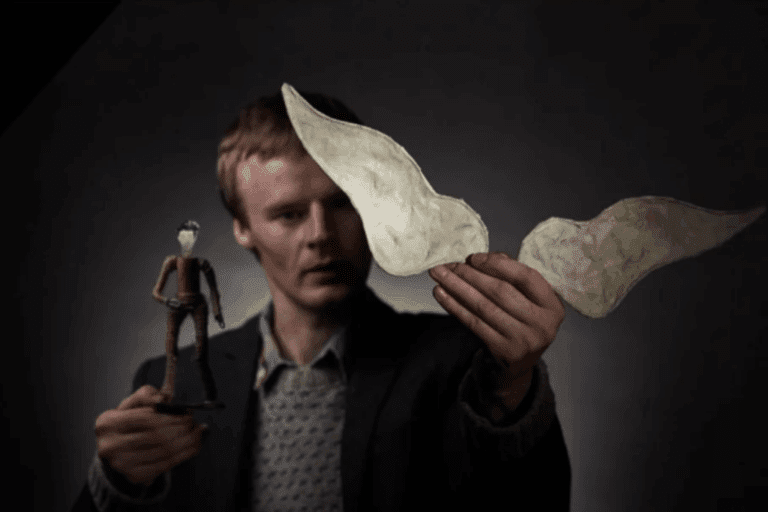 iPhoto caption: Manus Halligan in Dan Colley's adaptation of 'A Very Old Man with Enormous Wings'. Photo by Ste Murray.
A contemporary Gabriel García Márquez adaptation touches down in Toronto
A Very Old Man with Enormous Wings has toured internationally since 2022, with a shifting cast of performers. Halligan and Beaman, the original actors and co-adaptors, will reprise their roles for the Toronto premiere.
 iPhoto caption: 'Narnia' in rehearsal. Photo by Dahlia Katz.
"What emerged for us was this idea of life cycles,” reflects Narnia adaptor-director Fiona Sauder. “‘What happens when you get stuck in one season [of life], and what happens when that season comes to an end? [What things] have to die and fall away in order for new things to grow?’”
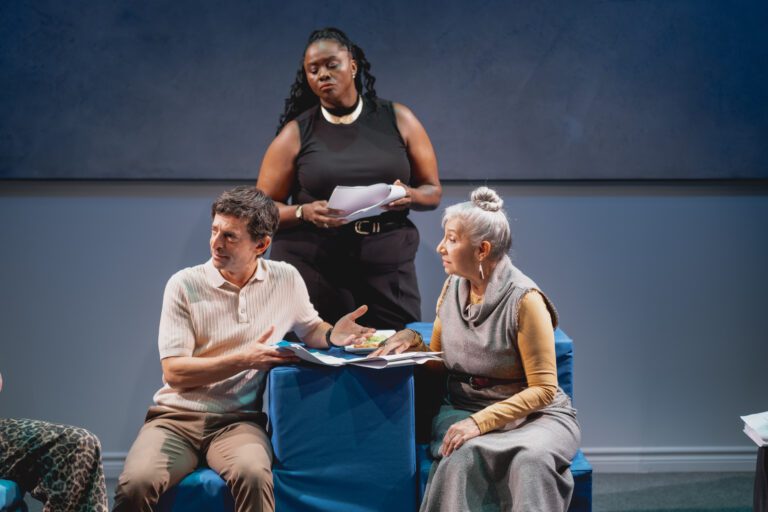 iPhoto caption: Jordan Pettle, Janelle Cooper, and Monique Mojica in CHILD-ish. Photo by Jae Yang.
Tarragon’s upcoming show gives audiences a verbatim taste of children’s wisdom, wit, and weirdness
The first inklings of CHILD-ish came to Drake in 2017. “I got to an age where I started having a lot more kids in my life,” he said. That “got me curious about what adults can learn from kids: playing with and flipping that power dynamic of who’s the learner and who’s the teacher.”
 iPhoto caption: Photo by Aisling Murphy.
In the darkest months of Yukon winter, it’s all about the Sun Room
I’m here for a week in January as a guest of Nakai Theatre, a hub for theatrical experimentation and outside-the-box programming in Canada’s westernmost territory.

Armchairs, tattoos, and an online theatre magazine
When I started at Intermission, my world was limited to the confines of an armchair. Arts journalism was a high it felt dangerously fruitless to chase. The life stretched ahead of me was amorphous and frightening, a chasm filled with hand sanitizer and immigration concerns. It was worth crying over a spilled kombucha and scrubbing at the stain.
 iPhoto caption: Liz Appel headshot courtesy of Liz Appel.
Five questions with Wights playwright Liz Appel
Intermission spoke with Appel over email for a brief Q&A about Wights, now playing at Crow’s Theatre until February 9.

Call for applications: Publishing and editorial assistant
Intermission Magazine is seeking a dynamic and collaborative individual to join our team.
 iPhoto caption: What Writing Can Do: The 2025 Musical Theatre Critics Lab
Announcing What Writing Can Do: The 2025 Musical Theatre Critics Lab
What Writing Can Do is timed to coincide with the Grand and Theatre Aquarius’ co-production of Waitress, which will serve as a jumping-off point for discussions throughout the Lab.
 iPhoto caption: A Christmas Story production still by Dahlia Katz.
REVIEW: A Christmas Story feels fresh at Theatre Aquarius
If you want to catch A Christmas Story before it closes, good luck — the show is close to sold out, and with the talent on that stage, it’s not hard to see why.
Comments