
Tarragon’s upcoming show gives audiences a verbatim taste of children’s wisdom, wit, and weirdness
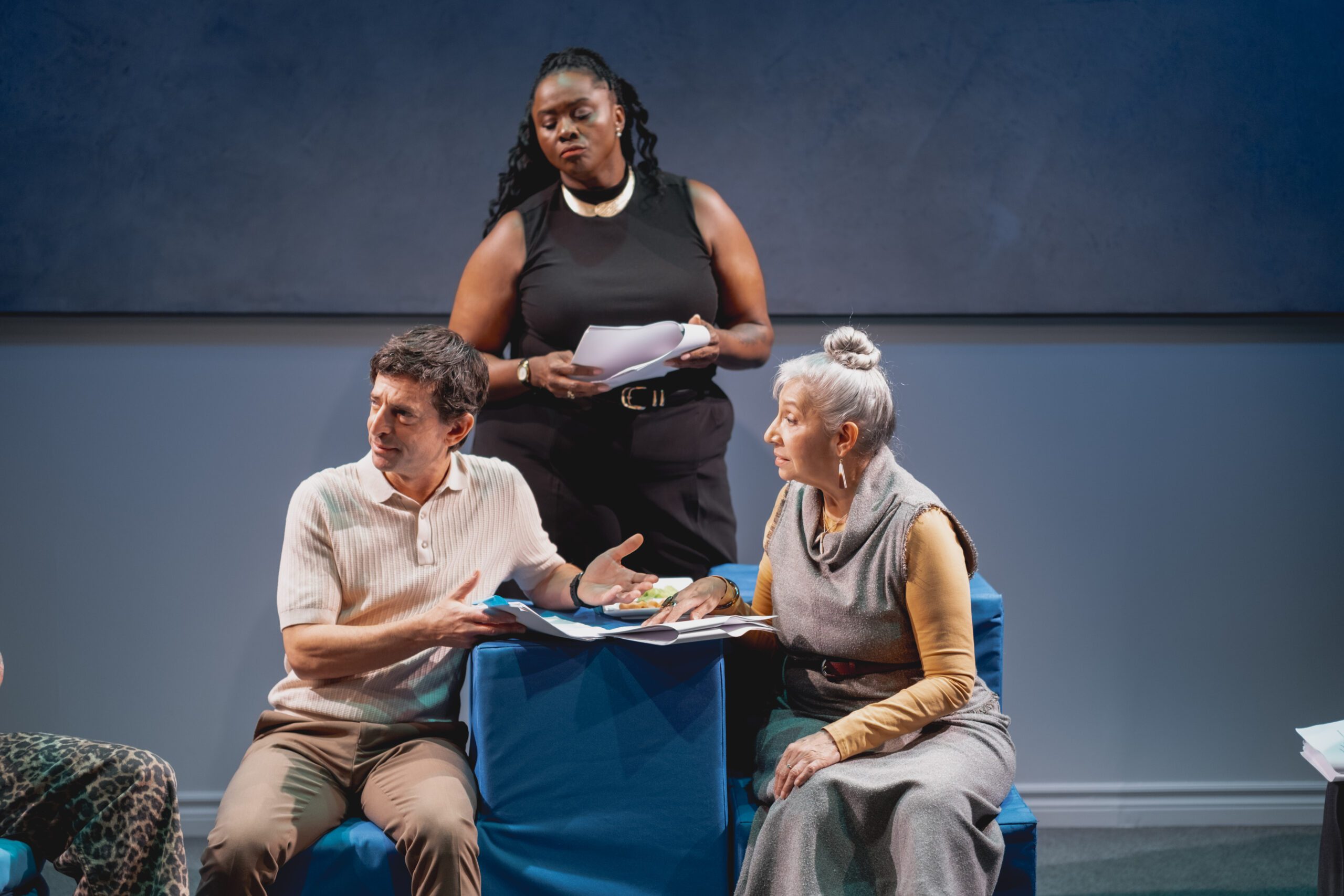 iPhoto caption: Jordan Pettle, Janelle Cooper, and Monique Mojica in CHILD-ish. Photo by Jae Yang.
Sometimes, theatre is hard. Other times, it’s literal child’s play.
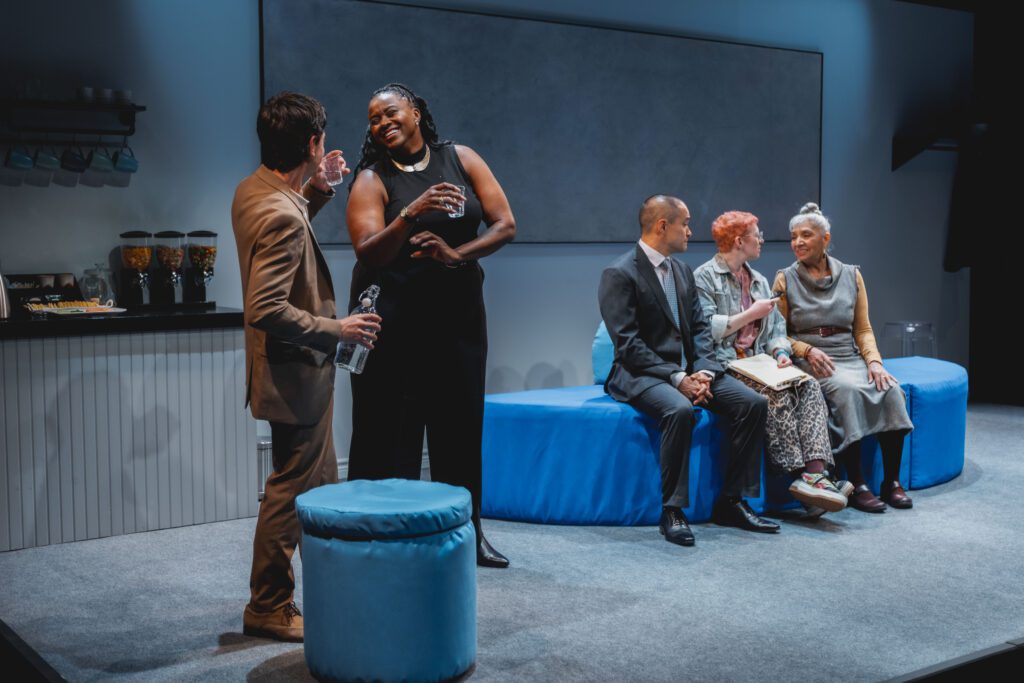
In CHILD-ish, a verbatim play created by Sunny Drake, four actors give voice to over 40 children’s thoughts on everything from love and relationships, to war, to unicorns. The Toronto premiere, directed by Andrea Donaldson and produced by Tarragon Theatre in association with the CHILD-ish Collective, began previews October 21. Actors Karl Ang, Janelle Cooper, Monique Mojica, and Jordan Pettle speak the verbatim words of children, while Asher Rose plays an interviewer on their own journey of discovery.
Crucially, the actors in this production do not imitate kids. Instead, they speak children’s words while retaining their own voices and physicalities. “My obsession creatively is always how to get the form and style of a piece to drive the content,” said Drake in a Zoom interview. Through CHILD-ish, he’s testing how grown-ups might “listen differently” to kids’ experiences — too often easy “to just write off,” Drake said — when they’re spoken by other adults, as adults.
“CHILD-ish is a celebration of the voices of the next generation,” said Tarragon’s artistic director Mike Payette in a written statement. “It is a call to listening and response, as adults, to help navigate some of the things we are collectively grappling with. The piece highlights the spirit of intergenerational conversation that is connected within our incredible audience, and how we — through theatre’s unique power — can come together and share stories that affect us all.”
The first inklings of CHILD-ish came to Drake in 2017. “I got to an age where I started having a lot more kids in my life,” he said. That “got me curious about what adults can learn from kids: playing with and flipping that power dynamic of who’s the learner and who’s the teacher.”
One interaction in particular sparked his imagination. “I went to look after a friend’s seven-year-old. I arrive, and this child is absolutely beside herself, bawling her eyes out.” When Drake asked what was wrong, the child told him “this very epic story” of how she had unsuccessfully proposed to a boy at school. At first, Drake didn’t take her anguish seriously.
“Then I started actually feeling worried,’ he remembered. “She [was] super crushed.”
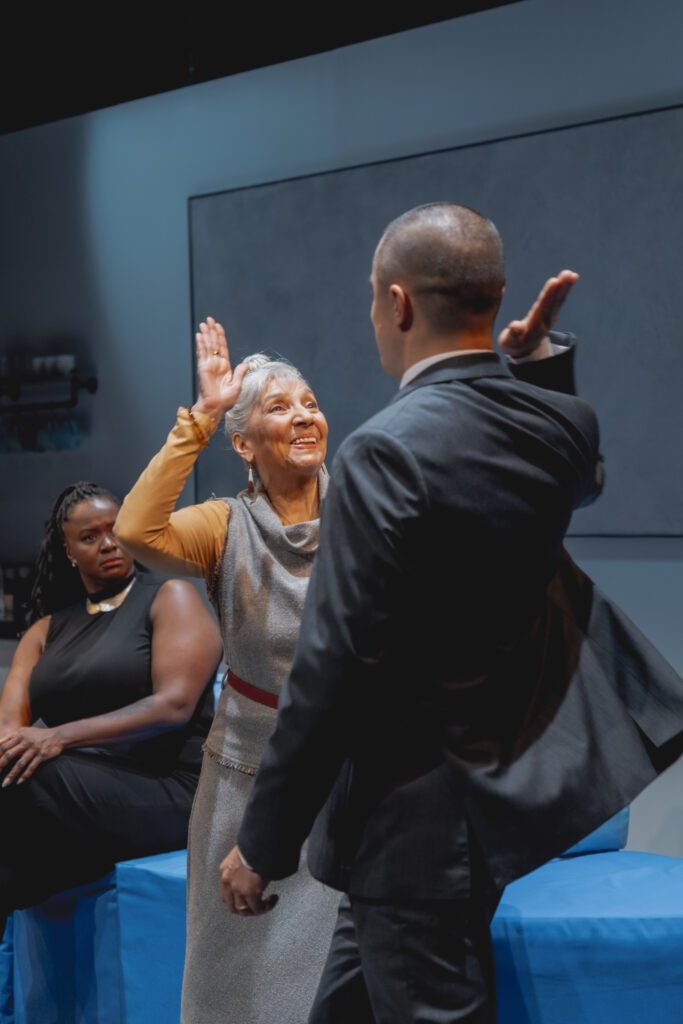
That is, until the child went “from sobbing [to] doing somersaults on the couch while recounting the story. I reckon it probably took two minutes for her to go from devastation to – boom! – moved on.”
The quick switch left Drake wondering: “What are the tools and skills and knowledge and perspectives that [kids have], that I’ve completely forgotten?” The idea for a verbatim theatre piece, woven from interviews with children ages six to 12, began to coalesce.
Drake reached out to Brian Quirt, artistic director of the company Nightswimming, for dramaturgical support; as well as Jessica Greenberg, an artist-educator and a longtime friend and colleague. Greenberg became the project’s director of child engagement. “Right from day one,” Drake explained, the team “built an age-appropriate consent process.”
“Consent is essential and complicated for people of all ages,” said Greenberg in a separate Zoom interview, “but especially with young people. We’re always doing as much as we can… to let kids know that it’s not about appeasing or impressing or performing for us, or their parents.”
The goal is to “make space for every child and all of their experience,” she continued. To craft CHILD-ish’s consent protocols, she and Drake looked to other companies that had a history of co-creating with youth, such as Mammalian Diving Reflex. Founded by Darren O’Donnell in 1993, Mammalian has won acclaim for works like Haircuts by Children, in which youngsters offer free chops to grownups; and Eat the Street, a project that trains children as restaurant critics. Drake and Greenberg also drew from the United Nations Convention on the Rights of the Child.
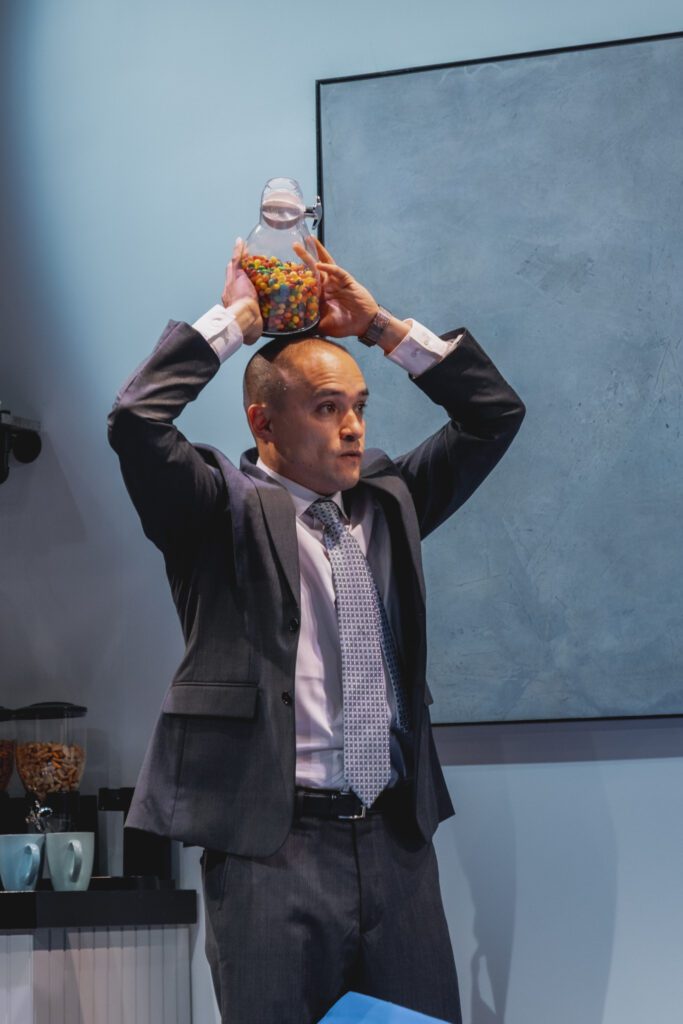
One non-negotiable element in the CHILD-ish process: “We always have snacks,” said Greenberg.
If CHILD-ish was itself a child, it would have just begun third grade this fall. In theatre years, that translates to a long and rich development period. The collective first shared a work-in-progress at the SummerWorks Festival in 2019, to sold-out houses. In 2021, during the COVID-19 pandemic, the team reimagined the project as a web series. The live show finally premiered in 2024 at Pacific Theatre in Vancouver.
The years of development beg the question: What happens when a child interviewee no longer fits within the project’s age bracket?
“ Sunny and I agreed that part of our ethos is that nobody ages out of the CHILD-ish process or community, if they don’t want to,” said Greenberg.
Drake described realizing how, from the very beginning, “kids were asking such smart questions about the creative [framework]”. He and Greenberg decided to give participants “agency, not just as interviewees, but on the creative team itself.” Seven of the original 40 children have remained with the project as young collaborators and dramaturgs. Four of those seven are involved with the Tarragon production, with two new teenage collaborators joining.
One of those original interviewees is actor and musician Eponine Lee. She became one of the project’s first young dramaturgs in 2018.
“I remember, in the SummerWorks productions, there was a whole part of the show [where I realized], ‘A lot of this is from me!’” she said, speaking alongside Greenberg. “It was quite touching… seeing how that affected people in the audience.” Now age 18, ““I’ve gotten to see the project from all angles.”
For the Tarragon production, Lee, who lives in Ottawa, has written the program note. Other young collaborators have created social media posts, contributed artwork, shadowed creative team members, and even co-designed a lobby display about the show’s process. Some have also mentored a new generation of 14 local kids, who helped shape a small part of the script for this version.
In their interviews, all three artists touched on how this rich, multi-generational process has transformed them, and how they hope it might do the same for audiences.
“My relationship with animals has completely changed,” Drake reflected. “A lot of kids have a really different relationship to animals” than grownups do: “this absolute curiosity and awe.”
“Young people are rarely asked about what they think… and rarely listened to,” said Greenberg. “I believe deeply that we all need to do more of that.”
Lee hoped that CHILD-ish “can somehow bridge those two worlds of the adult and the child.” In doing so, she added, it might “create something even more beautiful and joyous and free.”
CHILD-ish began previews at Tarragon Theatre on October 21 and runs until November 16. Tickets are available here.
Tarragon Theatre is an Intermission partner. Learn more about Intermission’s partnership model here.
Nathaniel Hanula-James
Nathaniel Hanula-James is a multidisciplinary theatre artist who has worked across Canada as a dramaturg, playwright, performer, and administrator.
LEARN MORE iPhoto caption: 'C'est la vida!' production photo by Julie Cherki.
C’est la vida! uses mime, dance, and electro beats to remix classic rom-com tropes
“Having endless talks with David about love, and our respective relationships, while creating and touring this show has definitely helped me grow,” says dancer Liesbeth Kiebooms. “It’s given me a more subtle understanding of love.”
 iPhoto caption: Headshots of Sophie Gee, Ray Hogg, Margot Greve, Leora Morris, and Jessica Carmichael.
Five theatre directors offer advice to the next generation — and the programs training it
The artists on this call were candid and vulnerable. They spoke openly about their professional frustrations and challenges — and they weren’t shy about pinpointing the ways that mainstream anglophone Canadian theatre practices fail directors and artists more broadly. That said, I didn’t leave our chat feeling hopeless or cynical.
 iPhoto caption: Ann-Marie MacDonald in 'Goodnight Desdemona (Good Morning Juliet).' Photo by Elana Emer.
“Sexism kept me out of hockey as a kid,” says Ann-Marie MacDonald. “But sexism also shut me out of Shakespeare."
 iPhoto caption: Headshots of Sophie Gee, Ray Hogg, Margot Greve, Leora Morris, and Jessica Carmichael.
How can theatre directors forge a sustainable career in Canada?
It’s increasingly unlikely that directors will hone their craft through formal training. Relatively few post-secondary programs devoted to directing exist, and it seems to me that directing-specific mentorship programs are less common than similar initiatives for actors or playwrights. To convene a roundtable about director training, I reached out to five very different artists on a continuum of early- to mid-career.
 iPhoto caption: Portrait of Eric Woolfe. Photo by Dahlia Katz.
Eric Woolfe’s inventive horror theatre is a monster mash of artistic influences
For the past 26 years, Eldritch Theatre’s director of the uncanny has given ghoulies, ghosties, and long-legged beasties of all kinds a spot in the limelight, in productions that serve up puppets, magic, and a crumbling castle’s-worth of uncanny influences, including schlock-horror B-movies, Shakespeare at his bloodiest, and the fiction of H.P. Lovecraft.
 iPhoto caption: Nate Yaffe in 'Rot Hat.' Photo by Kinga Michalska.
This year’s SummerWorks Performance Festival strives to make accessibility intrinsic
The curated festival’s 36th edition features a range of works by Disabled and neurodivergent artists where the medium is very much the message.
Comments