
The new season of PlayME promises five wholehearted Canadian radio dramas about fitting into a weird world
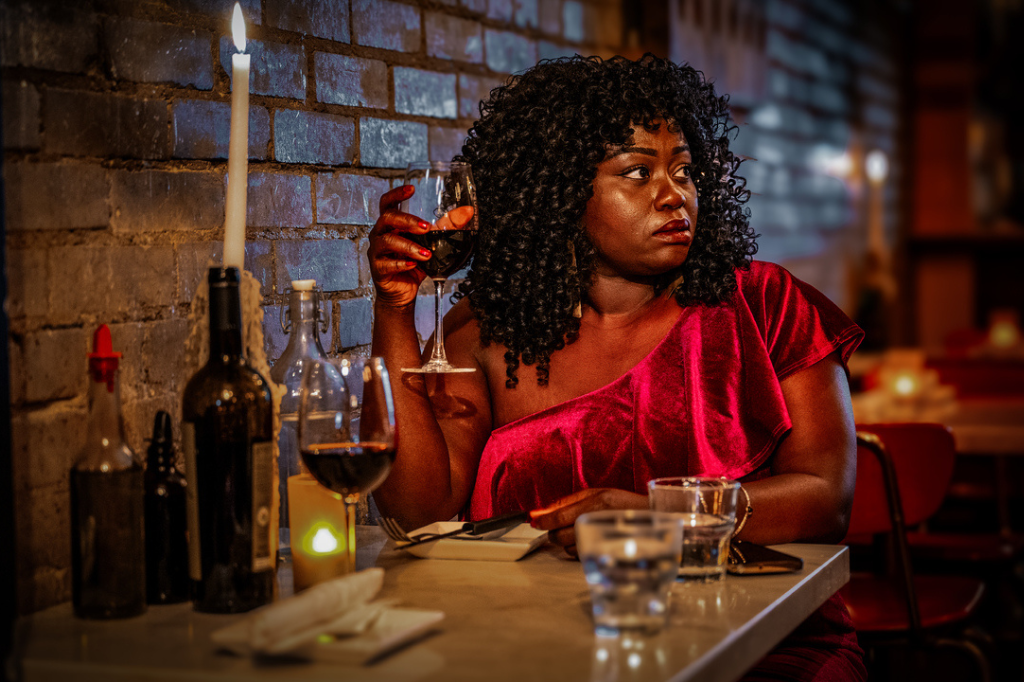 iPhoto caption: Akosua Amo-Adem in a promo photo for 'Table for Two' ahead of the show's 2025 premiere, a co-production between Soulpepper Theatre and Obsidian Theatre. Photo by Dahlia Katz.
After nearly a decade on the air, the CBC radio-drama podcast PlayME hardly needs an introduction — but it deserves a fresh one. What began in 2016 as Laura Mullin and Chris Tolley’s experimental radio translations of Canada’s most compelling contemporary plays has since ballooned. With offshoots like their writing-workshop series PlayPEN and more than 80 recorded plays, PlayME has grown into a living archive of Canadian dramaturgy.
PlayME’s appeal is obvious. Skip the commute and get a free, front-row-seat show performed in one of the best venues in town: the theatre of your mind. The latest season — five plays released monthly, each followed by a talkback interview — launched January 14. This year centres big, forceful protagonists locating themselves in a weird world.
“Many of the shows this year are about fitting in — being a fish out of water,” said Tolley over a video call. “You can see that explicitly in new immigrant stories, but also in dating stories [about] searching for connection, or even in a piece about a young actor from Toronto trying to assimilate into life on a rural farm.”

The season opens with the cheerful door chime of Kim’s Convenience, Ins Choi’s iconic Korean-Canadian portrait of a family navigating generational and cultural change in Toronto. Written by and starring Choi, the story returns to its roots after both a blockbuster television adaptation and a wider North American remount of the play. “It started as a huge play, then became an even bigger TV series,” said Mullin. “It’s really nice to go back to the [source again] and remember where it came from.” Similar to the play’s run at Soulpepper Theatre last year, Choi voices the father character, Appa, though in the original Toronto Fringe Festival and Soulpepper productions he had played his son Jung. “He started writing the play before he had kids, with the goal to one day play the dad — his ultimate role.”
Mullin told me that because PlayME’s sound design feels so natural, listeners often assume it’s plucked straight from stage productions. But in reality it’s all Tolley’s auricular magic — he’s the sound designer who transforms set, props, costume, and gesture into the show’s signature audio playhouse.
During one of many final Kim’s Convenience safety listens, Choi suggested that Tolley remove a sound effect entirely. There’s a moment where two characters kiss, and Choi suggested Tolley leave it silent.
“At first I wondered how the listener would know what was happening, but every time I listened to the show afterward I could see [the scene] differently and the silence made space for my imagination,” said Tolley. “[Choi’s] instincts for the show are spot on — you can tell he’s lived the show for 15 years.”
Later this spring, the season continues with Pamela Mala Sinha’s New, a 1970s-set story of a bride from Bengal meeting her husband for the first time; Nicolas Billion’s The Neighbours, a taut moral three-hander premiering next month at Tarragon Theatre; and Michael Healey’s modern classic The Drawer Boy, an intimate rendering of two farmers seen through the eyes of a young actor.
Waiting in the wings for February is Akosua Amo-Adem’s Table for Two. Perfect for Valentine’s Day, the sharp and tender comedy follows Abby, a self-proclaimed hopeless romantic navigating single life amid social and familial pressure. The play premiered at Soulpepper almost exactly a year ago, and since 2012 it’s gone through numerous iterations — first as a theatre-training exercise, then an improv character, then a monologue-slam winner — before becoming a full-length work. Radio marks another incarnation.
“I call the play my love letter to the perpetually single woman,” Amo-Adem told me over a video call. “Abby’s journey is one of trying to figure out what actually makes her happy. Is being in a relationship one of [those things], or is that pushed on women?
“So many people are redefining what it means to be single — that it doesn’t have to be lonely or desperate,” she continued, “and sometimes you just really need your best friend to remind you of that, to tell you it’s going to be okay. Table for Two is that friend.”
As with any translation, the move from stage to radio doesn’t tend to follow a straight line, and that often produces the best surprises. “I love plays that break the fourth wall — I’m not interested in my audience having a passive experience,” said Amo-Adem. “Onstage, the audience chooses what dress Abby wears to the date. In the audio, I still call on the listener… but I rely more on description. You start to get a sense of how gestures can live entirely in your voice.”
When it comes to how and where to listen, Amo-Adem recommends pressing play right before a date. “You can listen to it on the treadmill, or when you’re grocery shopping — but if you’re wondering whether or not to go on a date, you should definitely listen to Abby’s story.”
And Mullin and Tolley suggest tuning to this season of PlayME anywhere you can let the show offer you an immersive experience. “Wherever people are, whether they’re folding laundry or on a long walk, we just hope they can listen with earbuds (and preferably not in front of a screen), so they can get lost in all of Chris’ nuanced details,” said Mullin.
In the end, PlayME taps into one of radio’s greatest gifts, conjuring a kind of guided dream that washes over you. As Tolley put it: “[Listening is] a way to juice your imagination. It will send pictures running through your mind and give you a chance to see incredible and unseen worlds.”
PlayME is available wherever you get your podcasts. Learn more here.
PlayME is an Intermission partner. Learn more about Intermission’s partnership model here.

Lindsey King
Lindsey King is a Toronto-based freelance writer and editor with bylines in Toronto Life, Maclean's, Canadian Business, Intermission, and The Creative Independent.
LEARN MORE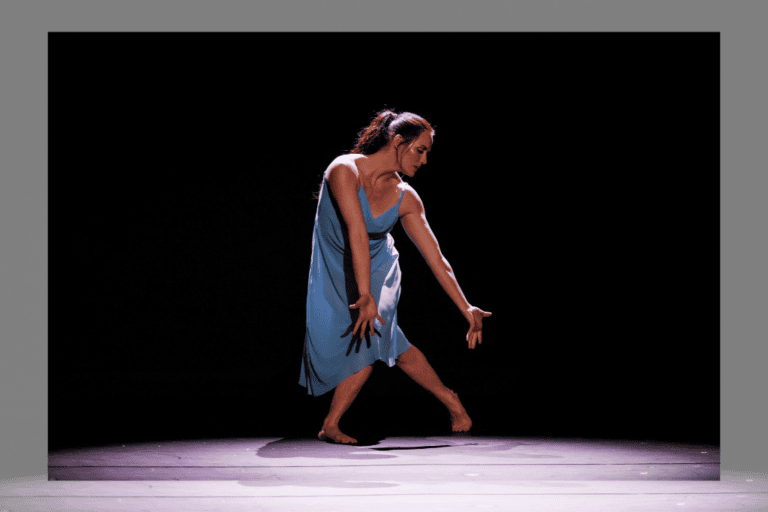 iPhoto caption: Tessa Virtue performs at Fall for Dance North. Photo by Bruce Zinger.
REVIEW: At Fall for Dance North’s festival opening, it all came back to Tessa Virtue
This year’s Fall for Dance North opening programme gave audiences a multi-course feast that’s delish all the way through. Well, almost.
 iPhoto caption: From left: Vivien Endicott-Douglas as Han, Rylan Wilkie as George Abbot (top left), Sara Topham as Cath (top right), Angel Lo as Anna and Liz Der as Roni in 'The King James Bible Play.' Stratford Festival 2026. Photo by David Hou.
REVIEW: The King James Bible Play both finds and fumbles profundity in translation
Corbeil-Coleman’s best-known plays, such as Guarded Girls and Scratch, centre contemporary young women circling grief, inheritance, and intergenerational trauma. It might seem like a surprise, then, that The King James Bible Play opens with five men centuries ago — but it turns out that the intergenerational trauma in this case stretches back about 417 years.
 iPhoto caption: Members of the company of 'Play Dead.' Photo by Alexander Galliez.
Play Dead trades death-defying circus tricks for bigger emotional risks
“The idea of consequences in [Play Dead] can make someone think the show is a little dreary, but we think of it more as a surreal celebration of all the little things that make up life,” says performer and People Watching co-artistic director Jérémi Lévesque.
 iPhoto caption: Melissa James and Patrick Heusinger in 'Paranormal Activity.' Photo by Johan Persson.
REVIEW: Mirvish’s Paranormal Activity summons real screams — but crashes into a cheap shock ending
It’s a spooky, cleverly staged hoot, but audiences might be distracted by one glaring narrative spectre that could use an exorcism.
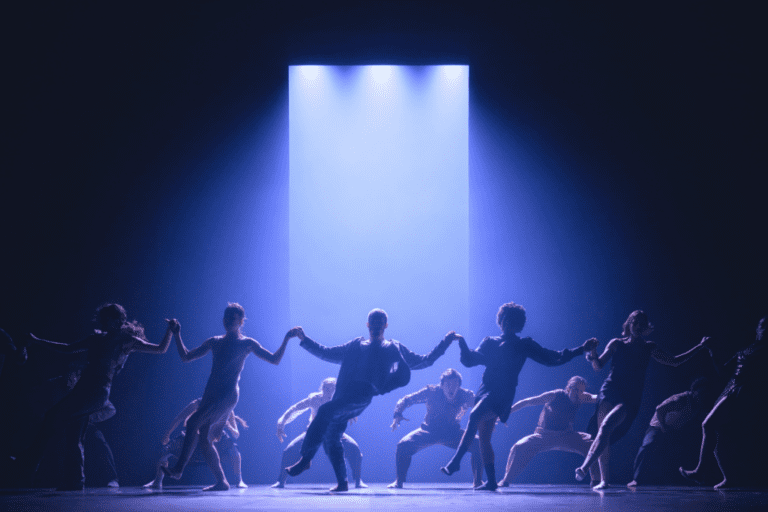 iPhoto caption: Members of the company of 'Theatre of Dreams.' Photo by Tom Visser.
It’s tough to tie Shechter’s style to any one dance lineage, but modern floorwork; commonplace gestures rendered sharp and frenzied; and loose, hip-circling movements often reserved for low-lit clubs evoke the woozy surreality of half-revealed consciousness.
 iPhoto caption: Amy Keating, Zorana Sadiq, Katherine Cullen, and Jean Yoon in 'Dance Nation.' Photo by Elana Emer.
REVIEW: Coal Mine Theatre’s Dance Nation vaults into the feral, ecstatic mess of girlhood
Played by a cast whose ages range widely, the characters exist in two tenses at once: present-day adolescence and retrospective memory, living these tender years shadowed by the adults they’ll become.
Comments