
REVIEW: Cockroach at Tarragon Theatre
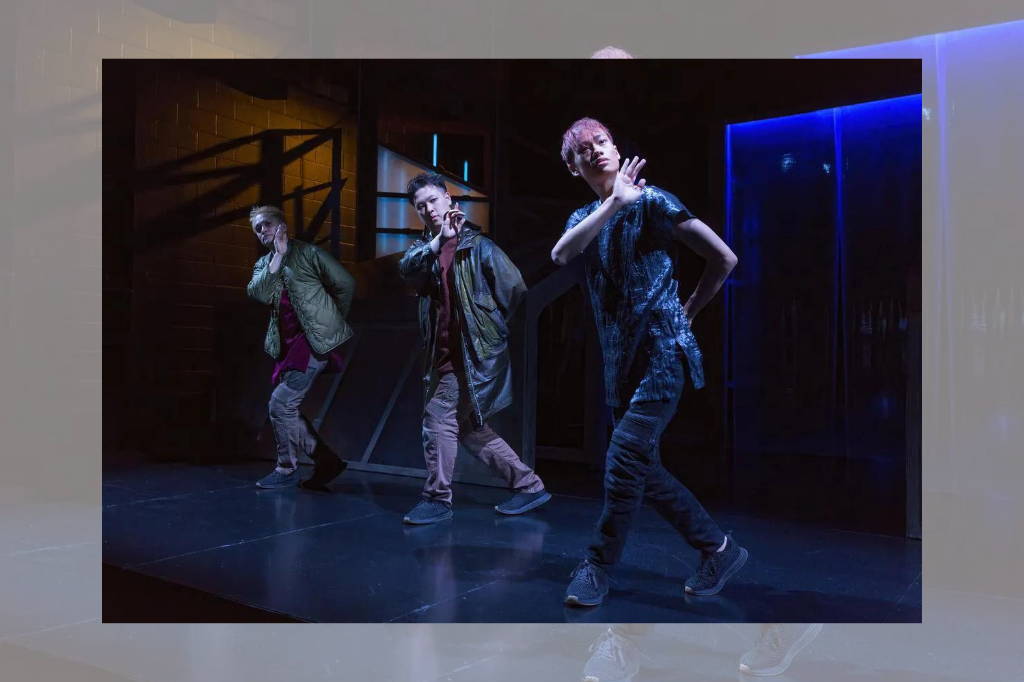
Something’s scuttled into the Tarragon Mainspace.
Gilded in slick design and bright, venomous language, scampering from moment to moment as if its very life depends on it, Ho Ka Kei (Jeff Ho)’s Cockroach grabs the audience by the throat and does not let go for its eighty-minute run.
Aesthetically sharp and dramaturgically potent, Cockroach demonstrates loudly the overwhelming competence of Ho as playwright, Tarragon AD Mike Payette as director, and Hanna Kiel as choreographer: the three’s artistic synergy is otherworldly compared to what else is currently on Toronto stages, the naturalistic Vanyas and the corporate-styled Lears and so on. Within that abstraction rests a grimy sort of transcendence: in the mouth of one highly choreographed cockroach lies the truth of a diaspora.
郝邦宇 Steven Hao as the title character introduces us to the world of the play — the life of a cockroach. Snidely, callously, he informs us of his close bearings and sour encounters with humans in a lengthy monologue, as two as-of-yet-unnamed figures maneuver tall blocks behind him. (Often throughout the play, one figure takes centre stage while the other two engage in complex movement sequences behind: when those movement sequences crescendo into dance, they’re unfathomably beautiful.) When Cockroach meets a lobster (his close cousin) and falls in love with them, he must then watch the humans eat them. It’s a cruel, unspeakably sad moment for our narrator, and Hao’s a very good one — despite his jadedness and resentment, we feel for Cockroach, embedded into a futuristic and vacuous playing space.
And then there’s Karl Ang as the Bard — yes, that one — spiralling into himself and his ownership of English idioms. Ang’s Shakespeare feels the acute weight of his impending legacy, the magnifying glass hovering over his words in the hands of future writers. The Bard, too, is tired and angry — like the lobster, the Bard is perhaps a close cousin of the Cockroach — and Ang’s despair is razor-sharp as the line between human genius and insect futility becomes thinner and thinner.
Anton Ling as the Boy completes the embittered trio, a queer young Asian man in Canada (at times Montreal, at others Toronto), tired and traumatized, wrestling with words and their weight and their capacity to harm. The Boy bookends the play, and during his extended monologue details an illicit sexual encounter gone sour, a distinctly human experience, more existentially complex than the Cockroach can comprehend and so visceral the Bard can’t appropriately verbalize it. Ling is magnetic to watch, and their inward collapse, amplified by the Roach’s and Bard’s negging, is heartbreaking.
Cockroach bites hardest when the trio interacts — when the Bard’s playwriting eclipses the Boy’s, when the Boy clambours over the Cockroach, when the Roach watches the missteps of humans with hollow reproach. At times, Cockroach feels like a 4.48 Psychosis for 2022 — a three-handed requiem for a long-gone self, fractured in structure and seeped in dour cultural commentary. As Joshua Chong thoughtfully pointed out in his own Cockroach review, the effect here is one of choreopoem — and it’s superb. Payette’s direction is smart and intentional, with gleaming moments of lucidity mined from a text which demands careful handling, loaded with slurs and combative, emotional pacing. Kiel’s choreography is equally thoughtful, complementing Payette’s overarching treatment of the text, and Christine Ting-Huan Urquhart’s set and costumes, Arun Srinivasan’s lighting, and Deanna H. Choi’s sound fully flesh out the physical world of a play which tends towards the cerebral.
Cockroach tackles questions of immigration and racism with a personal, intimate flair — the slurs hurled at the audience are all the more painful on the breath of actors who could themselves be harmed by such language. As well, Ho’s creation of anthropomorphic animals with uniquely human feelings and scenarios is beyond skillful, and the intrusion of Shakespeare’s ghost further amplifies Ho’s explorations of inadequacy.
Cockroach is a difficult watch, and given its denseness, it certainly feels all its eighty minutes. But Cockroach is also a vibrant, often-funny examination of what it means to be an immigrant, a playwright, and even a human: as far as I’m concerned, it should be mandatory viewing for Toronto audiences, a play unlike any other this year.
Cockroach runs at Tarragon September 13 through October 9, 2022.
Aisling Murphy
Aisling is Intermission's former senior editor and the theatre reporter for the Globe and Mail. She likes British playwright Sarah Kane, most songs by Taylor Swift, and her cats, Fig and June. She was a 2024 fellow at the National Critics Institute in Waterford, CT.
LEARN MORE iPhoto caption: Photo by Aisling Murphy.
In the darkest months of Yukon winter, it’s all about the Sun Room
I’m here for a week in January as a guest of Nakai Theatre, a hub for theatrical experimentation and outside-the-box programming in Canada’s westernmost territory.

Armchairs, tattoos, and an online theatre magazine
When I started at Intermission, my world was limited to the confines of an armchair. Arts journalism was a high it felt dangerously fruitless to chase. The life stretched ahead of me was amorphous and frightening, a chasm filled with hand sanitizer and immigration concerns. It was worth crying over a spilled kombucha and scrubbing at the stain.
 iPhoto caption: Liz Appel headshot courtesy of Liz Appel.
Five questions with Wights playwright Liz Appel
Intermission spoke with Appel over email for a brief Q&A about Wights, now playing at Crow’s Theatre until February 9.

Call for applications: Publishing and editorial assistant
Intermission Magazine is seeking a dynamic and collaborative individual to join our team.
 iPhoto caption: What Writing Can Do: The 2025 Musical Theatre Critics Lab
Announcing What Writing Can Do: The 2025 Musical Theatre Critics Lab
What Writing Can Do is timed to coincide with the Grand and Theatre Aquarius’ co-production of Waitress, which will serve as a jumping-off point for discussions throughout the Lab.
 iPhoto caption: A Christmas Story production still by Dahlia Katz.
REVIEW: A Christmas Story feels fresh at Theatre Aquarius
If you want to catch A Christmas Story before it closes, good luck — the show is close to sold out, and with the talent on that stage, it’s not hard to see why.
Comments