
REVIEW: Immersive Macbeth at the Tower brings Shakespeare to the banks of the St. Lawrence River
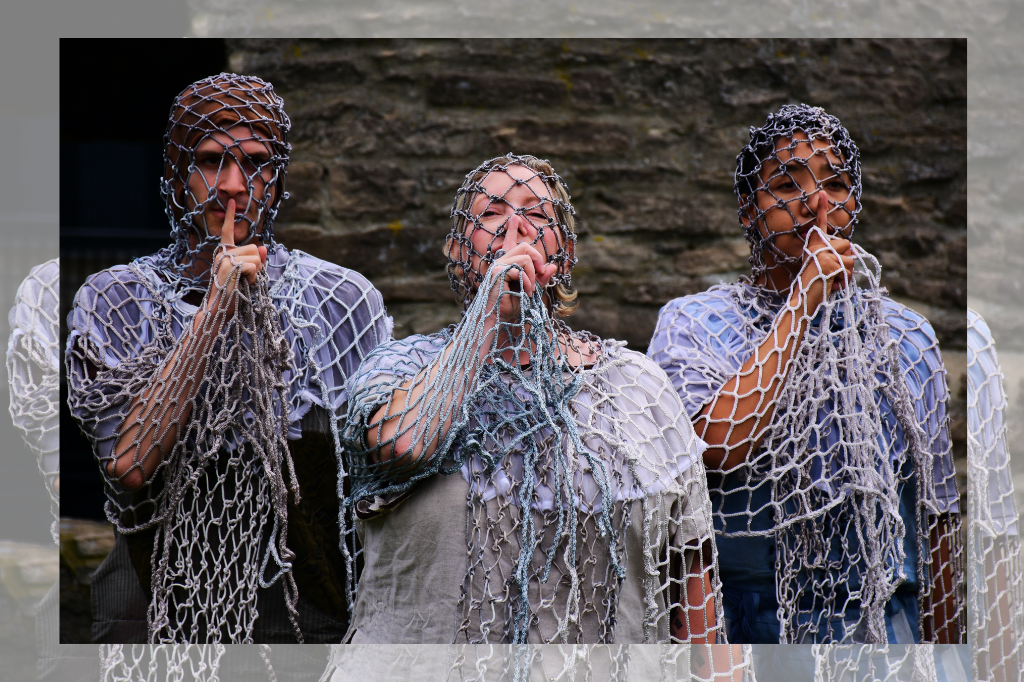 iPhoto caption: Nick Dolan, Cara Pantalone, and Jillian Mitsuko Cooper in 'Macbeth at the Tower.' Photo by Deanna Clark.
As Ontarians trudge through a summer marked with filthy air and foreboding announcements from the powers that be, St. Lawrence Shakespeare Festival’s Macbeth at the Tower brings the turbulent energy of the present to a time-tested historical tragedy. Taking medieval Scotland on a Thousand Islands detour, this immersive repertory production directed by James Wallis balances emotionally grounded performances with delightful jumpscares, all while showcasing the imposing figure of Maitland Tower, an hour south of Ottawa on the edge of the St. Lawrence River.
Judicious cuts and savvy rearrangements of Shakespeare’s script keep the cast to six and the runtime to a breezy 75 minutes, punctuated by four mini-intermissions as the audience moves through the tower grounds from set to set. The short treks between sites take just enough time to shake off any early-modern-English blues while touring the scenic surroundings.
The opening sequence, set outside the tower, establishes an easy rapport between Macbeth (Andrew Iles) and Banquo (Richard Lam). Hannah Ferguson’s costume design deftly blurs reality and fantasy, offering a satisfying blend of medieval motley and camping-core — Banquo’s earth-toned tunic made from a raincoat sewn to a work shirt is particularly fun, and why shouldn’t a thane wear gaiters if he’s out in the mud? The Witches (Jillian Mitsuko Cooper, Nick Dolan, and Cara Pantalone) wear silvery netted shrouds, which create an eerie, almost fishlike effect.
Each set presents a unique acoustic environment, and Matt Nish-Lapidus’ sound design has its corresponding ups and downs — while the speakers serve up captivatingly creepy effects later in the play, it sometimes feels like the theatrical sound is fighting against the natural soundscape of the riverside, especially during outdoor scenes. Blustering winds and nighttime noises pumped through a PA system are hard-pressed to cast a spell when the birds and the river sing irrepressibly of a lush summer sunset.
Over in the chart house, the high ceiling and stone walls of the long room make a stately castle chamber and banquet hall. Here, the warmth between Macbeth and Lady Macbeth (Hilary Adams) builds to a rolling boil as the couple become paranoid co-conspirators, taking turns needing and giving comfort, alternating between raging and paling at one another’s greed-driven schemes. Adams’ line delivery is lyrical, her rich, alto timbre animating the text beautifully. Iles is shifty-eyed and charming, and quick on his feet — when an audience member dropped their phone on opening night and it echoed through the room, he came back with a killer ad lib that made me keen to see him as Mercutio in R&J and Joni.
During the banquet, we’re treated to a sensational ghost shtick that also serves as a clever way for Lam to switch roles. Despite only subtle costume changes, Lam’s portrayals of the cautious everyman Banquo and the dramatic Macduff read as distinct. Even so, the lingering memory of Lam as Banquo makes Macduff’s face-off with Macbeth in the fifth act feel doubly satisfying — but I’m getting ahead of myself.
In the titular tower — a 90-foot-tall, 200-year-old stone windmill with wide window ledges home to birds’ nests and an open skylight — the audience sits around a giant cauldron, where the Witches perform their much-anticipated prophecy. Nish-Lapidus’ unsettling audio additions give the scene haunted house flair; on opening night, smoke effects and loud noises ruffled some feathers among the pigeons perched above like gawking groundlings. Then down to the riverbed by a lofty willow tree, where Lady Macbeth’s guilt eats at her until her hand-washing ritual becomes an Ophelian descent.
Around the corner in the outdoor grotto, the final act barrels to its conclusion, the multiple ground levels well-suited to the distant approach of the Birnam Wood ambush. As Macbeth’s fate wears on his fragile spirit, Iles’ vocal control is truly impressive, speaking perfectly audibly in a quiet, broken tone. Though Macbeth’s reign of terror comes to an end, the play ends on an eerie note. Is dethroning one tyrant enough to stop corruption? Is it enough to avenge the innocent when the damage is already done?
Leaving Maitland at the brink of dusk with the windows rolled down — the air quality index, which I had pored over like a grimoire that afternoon, said “Fair” — I bade goodbye to the birds, the trees, the water, and wondered how many tomorrows we might all live to see. Macbeth is a play preoccupied with legacies and future generations, and Macbeth at the Tower gives a front row seat to the more-than-human relatives who stand to lose as much as we do when greed outweighs governance.
Macbeth at the Tower runs at the Maitland Tower until August 14. More information is available here.
Intermission reviews are independent and unrelated to Intermission’s partnered content. Learn more about Intermission’s partnership model here.

Haley Sarfeld
Haley Sarfeld (she/they) has reviewed theatre for the Kingston Theatre Alliance, Kingston Whig-Standard, and Intermission Magazine. Her coverage of Theatre Kingston's Fringe Festival in 2024 was recognized with a Nathan Cohen Award for Excellence in Critical Writing (Outstanding Emerging Critic). As a playwright and composer-lyricist, her work has been featured in the Shortwave Theatre Festival, Watershed Music Theatre Festival, and Kick & Push Festival. Haley loves word games and is a regular crossword puzzle contributor for The Skeleton Press.
LEARN MORE iPhoto caption: Photo by Lin Yu Huan.
REVIEW: The Storyville Mosquito buzzes brilliantly at NAC English Theatre
Although The Storyville Mosquito is about being happy with what you’ve got, I left the theatre itching to see it again.
 iPhoto caption: Found Fest 2021. Photo by Mat Simpson.
Although Walker conceived and workshopped This Is the Story of the Child Ruled by Fear just prior to COVID-19 lockdown, it’s perhaps best understood and appreciated as a pandemic project. Its festival appearances began in 2021, at which time the “I’m alone in the world”-ness of it all must have felt cathartic, and reciting lines together in person would have been nothing short of a spiritual experience.
 iPhoto caption: Poster courtesy of Theatre Kingston and Kick & Push Festival.
REVIEW: This summer, Kingston’s TK Fringe is eclectic as ever
The first weekend of TK Fringe has come and gone, and as heat waves and thunderstorms wage a battle over southeastern Ontario, there’s never been a better time to seek solace in a cool, dry theatre. Popping between the festival’s three venues with a pen and mini notebook, I took in an eclectic series of performances by local theatre-makers.
 iPhoto caption: Logo courtesy of TK Fringe.
REVIEW: TK Fringe brings a strong mélange of summer shows to Kingston
This year’s lineup includes a mix of touring and local productions, and of the made-in-Kingston variety, there’s a good blend of student, amateur, and professional work.
 iPhoto caption: Image by Haley Sarfeld.
Every play is fantastic: A small-city theatre critic’s manifesto
My top priority as a critic will be to furnish every marketing team with as many easily quotable compliments as possible. I'll do this dutifully and without ambivalence.
Comments