
REVIEW: A Grimm Night at TranscenDance
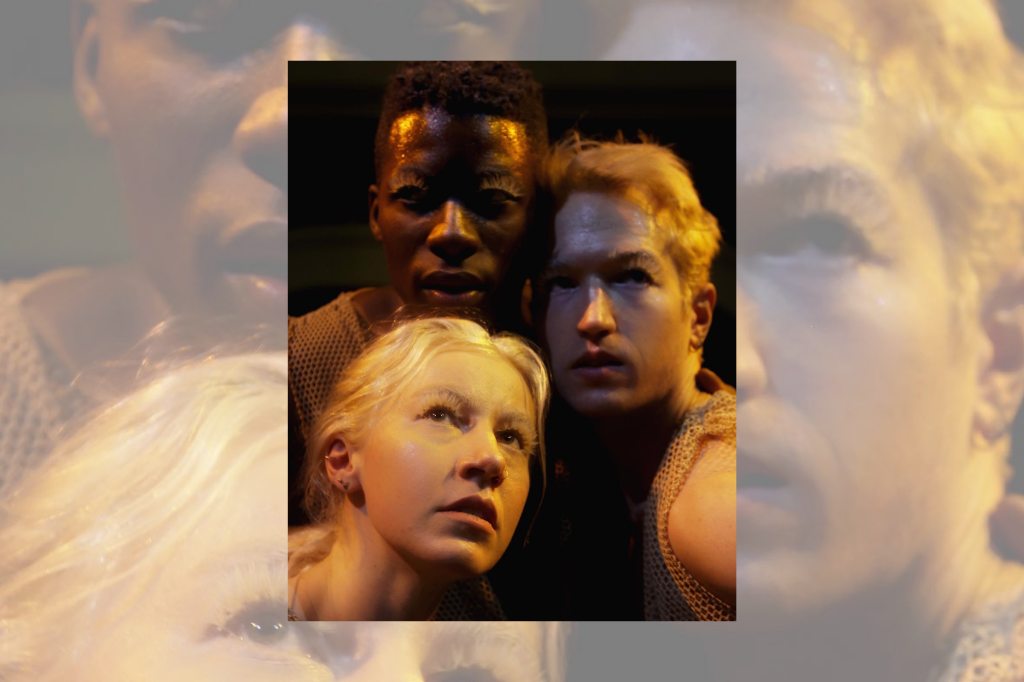
Once upon a time on Queen Street West, there was an immersive dance experience presented by the TranscenDance Project. A truly impressive crowd of Toronto townsfolk descended upon the venue, a lavish banquet hall clearly tailored to weddings. Champagne flowed. An episode of Euphoria’s worth of glitter donned the faces and limbs of a corps of modern dancers. Music boomed. And they all lived happily ever after.
Well. Sort of.
In the works since well before the pandemic, TranscenDance has offered an appealing project: an immersive dance performance inspired by two Grimm fairy tales, Sleeping Beauty and Cinderella. As far as I can tell, it’s the first of its kind in Toronto: a Punchdrunk-style experience in which audience members follow dancers from room to room, observing the action from close up. I was only able to attend closing night — Toronto theatre’s come back booming, and there have been quite a few conflicting performance schedules these past few weeks — and in terms of the concept and choreography by Julia Cratchley, I was thoroughly impressed. The space, Toronto’s Great Hall (which overlooks bustling Queen Street and a Pizza Pizza, which amusingly looms over Cinderella’s bedroom), was used superbly — there can’t possibly be a better venue for fairy tales in the city than this one, clad with ornate crown moulding, elegant balconies, and sprawling staircases. Owen Belton’s original music was atmospheric and deeply suspenseful: if ever it looped, I couldn’t tell.
The performances from the billed “2022 cast” (was there a 2020 cast lost to the pandemic?) were exquisite: a pas de trois between Martha Hart, Julia Cosentino, and Tyler Gledhill as the stepsisters and prince was truly stunning, bringing together the grace of ballet and the corporeality of modern dance. Kudos too to the three faeries, Tyler Angell, Dana MacDonald, and Sam Darius. As the impish aides to a lovely Sleeping Beauty (or Rose, in Grimm’s telling), danced gorgeously by Sarah MacDonald, they sparkled, both literally and metaphorically, through stunning makeup, evident strength, and masterful technique. The entire cast kept up admirable energy for the full one hundred minutes of non-stop performance: audience members could wander the space freely, and whenever I chose to move to the observatory (and Pizza Pizza lookout) or enchanted garden (a basement space), characters would flit past me, on the move, fully engrossed in their roles. As far as I could tell, there was no time for any character, particularly Rose or Cinderella (the knockout Kelly Shaw) to so much as catch their breath, let alone take a sip of water.
And there’s my concern. A Grimm Night is an ambitious (and clearly rather costly) project: stretching across four main performance spots plus the hallways in between, the performance uses almost every corner of this coveted downtown event space, meaning this production can’t have been cheap. On top of rental costs, the performance features a cast of thirteen, and audience members are greeted with masquerade-style masks and hand-written, wax-sealed letters which they get to keep. Costumes, too, though simply enchanting (and designed by Yulia Kinshakova), clearly had an associated cost to them.
How to offset an expensive production that’s been postponed for two years?
Cram in as many performances as possible — six performances in one weekend, at $73 per ticket (or $103 for the VIP experience, which lets you skip the line and grab a free glass of champagne at the bar).
I attended the 7pm showing on Saturday, and I was more than a little uncomfortable at the fact that the dancers who’d been performing at such high energy and with such intensity would have to do the entire thing again just over an hour later: TranscenDance programmed “late night” 10pm performances twice during the run, leaving little time for performers to recuperate between showings. Dark bruises on legs and knees, too, were concerning — why weren’t knee pads worn throughout the cast? A Grimm Night has a wonderful concept, and there’s clearly been much effort made to make the evening a pleasant, even magical experience for the audience: but there is no experience worth the danger of the well-being of artists. Swan Lake might be three hours long, but those dancers get an intermission and at least a scene or two offstage: A Grimm Night doesn’t offer that luxury, and given its immersive nature, any fatigue will be evident to an audience just steps away.
I’d be surprised if A Grimm Night doesn’t come back in some capacity — the audience seemed to be clinging to every duet, every gravity-defying jeté — but if it does, something needs to change. Perhaps a double, alternating cast, or a longer run with fewer performances per day. If it comes back, too, care needs to be taken with regards to accessibility for audiences: the masquerade masks are a fun immersive element, but if you’re a glasses-wearer (as was my seatmate), you’ll have to choose between wearing your mask and being able to see. The tickets, too, advised comfortable shoes for the performance: something of an understatement, given the Great Hall’s stair-heavy architecture, an expectation of standing for the full performance, and constant travel between spaces. TranscenDance’s A Grimm Night is on the cusp of being incredible — with further workshopping, I could see it as a permanent installation somewhere less splashy — but in its current iteration, I fear what has been lost in favour of recouping sunk costs, and that just isn’t the fairy tale ending this cast deserves.
You can find out more about TranscenDance here.

Aisling Murphy
Aisling is Intermission's former senior editor and the theatre reporter for the Globe and Mail. She likes British playwright Sarah Kane, most songs by Taylor Swift, and her cats, Fig and June. She was a 2024 fellow at the National Critics Institute in Waterford, CT.
LEARN MORE iPhoto caption: Photo by Aisling Murphy.
In the darkest months of Yukon winter, it’s all about the Sun Room
I’m here for a week in January as a guest of Nakai Theatre, a hub for theatrical experimentation and outside-the-box programming in Canada’s westernmost territory.

Armchairs, tattoos, and an online theatre magazine
When I started at Intermission, my world was limited to the confines of an armchair. Arts journalism was a high it felt dangerously fruitless to chase. The life stretched ahead of me was amorphous and frightening, a chasm filled with hand sanitizer and immigration concerns. It was worth crying over a spilled kombucha and scrubbing at the stain.
 iPhoto caption: Liz Appel headshot courtesy of Liz Appel.
Five questions with Wights playwright Liz Appel
Intermission spoke with Appel over email for a brief Q&A about Wights, now playing at Crow’s Theatre until February 9.

Call for applications: Publishing and editorial assistant
Intermission Magazine is seeking a dynamic and collaborative individual to join our team.
 iPhoto caption: What Writing Can Do: The 2025 Musical Theatre Critics Lab
Announcing What Writing Can Do: The 2025 Musical Theatre Critics Lab
What Writing Can Do is timed to coincide with the Grand and Theatre Aquarius’ co-production of Waitress, which will serve as a jumping-off point for discussions throughout the Lab.
 iPhoto caption: A Christmas Story production still by Dahlia Katz.
REVIEW: A Christmas Story feels fresh at Theatre Aquarius
If you want to catch A Christmas Story before it closes, good luck — the show is close to sold out, and with the talent on that stage, it’s not hard to see why.
Comments