
REVIEW: Maggie at Theatre Aquarius
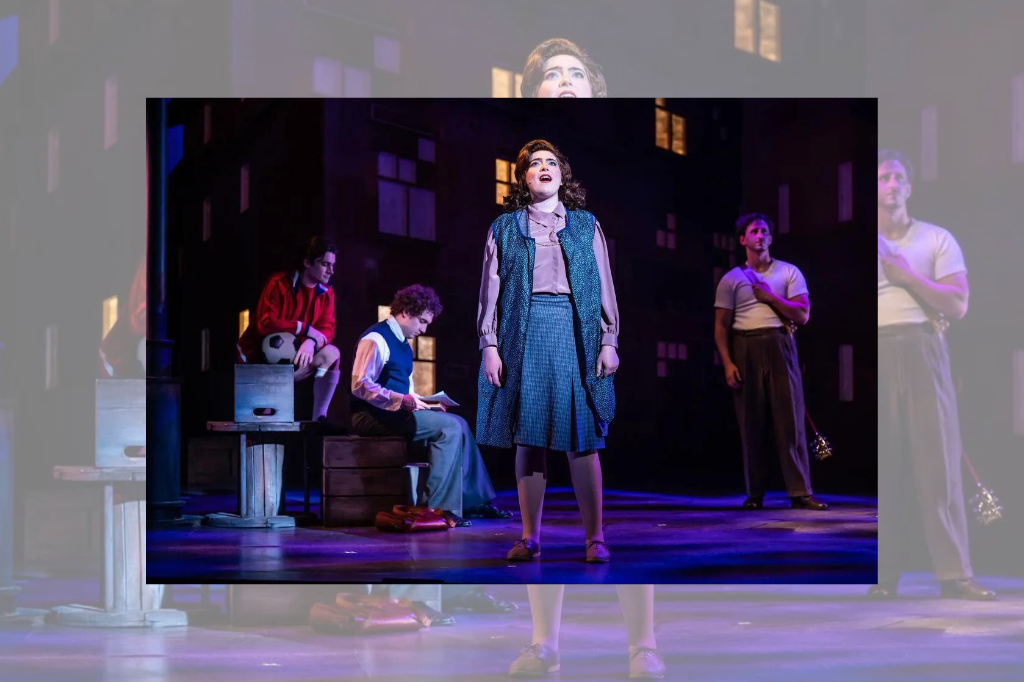 iPhoto caption: Photo by Dahlia Katz
I’ve often wondered what it was like to see the earliest draft of Come From Away — what was the energy in the room? How has the blockbuster musical evolved since that first outing? Did that audience know how special that piece of theatre would become?
Someday, I think critics and historians might wonder the same about Maggie, now playing in its world premiere at Theatre Aquarius in Hamilton.
With music, book, lyrics, and real-life inspiration from country singer Johnny Reid (with help from Matt Murray and Bob Foster), Maggie is a love letter to working-class Scotland, a tribute to Reid’s grandmother, and a wrenching tale of perseverance and love. Though set in Lanark, a small, industrial town between Glasgow and Edinburgh, the musical speaks to a much larger geography, asking sharp questions about what happens when people migrate from their hometowns, as well as what happens when they stay there. As a product of Sheridan College’s late mamented Canadian Music Theatre Project, you can be sure there’s a Canadian reference or two in there, as well.
It’s 1954 in Lanark, and our heroine Maggie (a wickedly talented Dharma Bizier) is pregnant and in love with her husband. That’s more than most of the women of Lanark can say — at best they seem to tolerate the men in their lives — but immediately it’s clear Maggie has a strong community of lasses ready to support her through her journey into motherhood.
She’ll need that support, it turns out. We meet her husband for only a moment, and he never gets to parent his three boys: Shug, Tommy, and Jimmy (the well cast, highly compelling Lawrence Libor, William Lincoln, and Aidan Burke, respectively).
A wee time-jump later, it’s 1968, and the boys are nearly grown, exploring different interests and wondering what their futures might look like. The world around them is suffocatingly small, and they all have dreams far larger than Lanark, but they also understand the life-and-death stakes of the divide between Catholics and Protestants. That schism, in fact, dominates their everyday lives: one can hardly buy a drink or play a game of football without the religious and cultural looming over their heads.
So goes Maggie. As the matriarch ages, so do her sons, and so does the splintering, hotly political world around them. As time goes on, Maggie suffers unimaginable loss, having to reckon with just how far a mother’s love can stretch — both emotionally and geographically. Throughout it all, though, Maggie has that rock-solid community of women around her, mothers and friends who put the kettle on for her when she needs it most. Sadie (a funny and strongly voiced Jamie McRoberts) leads the chorus of women as they come to grips with themselves and their place in the world, rallying around Maggie, yes, but equally coming together to ensure a more equitable future for their small town.
The Theatre Aquarius run is a first outing for Maggie. It shows. There’s much to be wowed by in the production — an ensemble of actors who have nailed a tricky accent, and Mary Francis Moore’s sensible, well paced direction — but there are structural bumps to iron out before Maggie heads off to Prince Edward Island this summer (and perhaps down Mirvish Way after that; it’s a fair guess, given the musical’s feel-good glow). Maggie is ably sung and often smartly composed, but the rhythm of the book stumbles a few times. Our lovely, commanding protagonist has a few confessional songs, one of which appears oddly early on in the show. While “Unbreakable” is a tight, powerful ballad, it’s also unearned so early in the narrative thrust of the story — we’ve not yet learned that Maggie is unbreakable, so it seems the song might be better placed later on, once we’ve had the chance to see that strength for ourselves. It seems “Unbreakable” was a late addition, sometime after the creation of the show’s cast recording — there’s time yet to find a more impactful place for it in the show.
Generally, as well, Reid’s uptempo songs are more memorable than the ballads and the musical connective tissue between them. “Friday Night In Lanark” and “Queen For a Day” are very, very good, the former as captivating an opening number as Come From Away’s “Welcome to the Rock.” As well, Maggie’s emotional songs tend to pack more of a punch than those written for her sons. There’s room, too, for more underscoring between musical numbers, making for a more cohesive, less stop-and-start show.
Technically, Maggie’s in tip-top shape, from Ken MacDonald’s inventive set, which perfectly captures the rowhomes of working-class Scotland, to Samantha McCue’s bang-on costumes, which suggest time and place so well one wonders if a few of the time-stamping references in the book might not be necessary. Kimberly Purtell’s lights, too, are original and effective, drawing focus to imagined places onstage without distracting from MacDonald’s set.
With a few tweaks, Maggie could be well on its way to becoming Canada’s next musical theatre phenomenon. It’s got the cast, it’s got the aesthetics, and it’s got the heart — already I can confidently say it’s the show in the GTA you should take your mom to if you can. With just a few snips, additions, and rearrangements in the book, Maggie will be a real force to reckon with once it hits bigger stages in bigger cities — and Bizier might just be seeing herself on a Broadway marquee in a few years’ time.
Maggie runs at Theatre Aquarius until May 6. Tickets are available here.

Aisling Murphy
Aisling is Intermission's former senior editor and the theatre reporter for the Globe and Mail. She likes British playwright Sarah Kane, most songs by Taylor Swift, and her cats, Fig and June. She was a 2024 fellow at the National Critics Institute in Waterford, CT.
LEARN MORE iPhoto caption: Photo by Aisling Murphy.
In the darkest months of Yukon winter, it’s all about the Sun Room
I’m here for a week in January as a guest of Nakai Theatre, a hub for theatrical experimentation and outside-the-box programming in Canada’s westernmost territory.

Armchairs, tattoos, and an online theatre magazine
When I started at Intermission, my world was limited to the confines of an armchair. Arts journalism was a high it felt dangerously fruitless to chase. The life stretched ahead of me was amorphous and frightening, a chasm filled with hand sanitizer and immigration concerns. It was worth crying over a spilled kombucha and scrubbing at the stain.
 iPhoto caption: Liz Appel headshot courtesy of Liz Appel.
Five questions with Wights playwright Liz Appel
Intermission spoke with Appel over email for a brief Q&A about Wights, now playing at Crow’s Theatre until February 9.

Call for applications: Publishing and editorial assistant
Intermission Magazine is seeking a dynamic and collaborative individual to join our team.
 iPhoto caption: What Writing Can Do: The 2025 Musical Theatre Critics Lab
Announcing What Writing Can Do: The 2025 Musical Theatre Critics Lab
What Writing Can Do is timed to coincide with the Grand and Theatre Aquarius’ co-production of Waitress, which will serve as a jumping-off point for discussions throughout the Lab.
 iPhoto caption: A Christmas Story production still by Dahlia Katz.
REVIEW: A Christmas Story feels fresh at Theatre Aquarius
If you want to catch A Christmas Story before it closes, good luck — the show is close to sold out, and with the talent on that stage, it’s not hard to see why.
Comments