
REVIEW: This year’s SummerWorks Performance Festival embraced danger — in more ways than one
 iPhoto caption: Production photos courtesy of SummerWorks. Shows, from left to right, top to bottom: Girl's Notes III, SUBJECT TO خضوع, The Movements, Warm up.
A bundle of lit candles teeters on the neck of a shirtless dancer as he struggles to his feet. Dripping wax streaks his spine as tension smogs the room — can he make it upright without scorching his skin and igniting the sheet of artificial grass below?
That visceral question defines the drawn-out, wince-inducing peak of Mehdi Dahkan’s tactile contemporary dance solo SUBJECT TO خضوع, one of more than 40 artistic offerings presented at this August’s SummerWorks Performance Festival, which took “survival mode” as its anchoring curatorial theme. (I can only assume the Minecraft reference was unintentional.)
By placing its performer in a degree of physical danger, SUBJECT TO خضوع stages a literal fight for survival — one of an elemental, instinctual nature. But many of this year’s productions aimed more directly at our present moment’s evils: Targets included corporate speaking gigs, rent payments, climate change, global wealth inequality, and the ostracization of horse girls.
Like SUBJECT TO خضوع, Adam Lazarus’ solo show Versus gets bodily, with a climactic sequence involving several seconds of the writer-performer-co-creator vomiting fake blood. The freewheeling 90-minute production (directed by co-creators Guillermo Verdecchia and Ann-Marie Kerr) sketches a mid-life crisis of operatic proportions. Confronted by an ostensibly normal work day, burnt-out father Gerald Bloom finds himself suddenly unable to cope. He jitters around the stage in manic circles, barking erratic orders at his family and the audience before falling into a kind of surreal, existential wormhole.
On opening night, I found myself embroiled in a battle for survival. Gerald picked me out of the crowd at random with the request that I walk his invisible dog, and after a bizarre chain of events I ended up on my knees brushing sand into a dustpan while another spectator concocted a smoothie out of real fruit. Although this kind of intense audience participation isn’t out of the ordinary for a clown-inspired show, such productions often embrace a makeshift aesthetic. But Versus counterpoints its chaotic happenings with precise lighting and sound/projection design (by co-creators Michelle Ramsey and David Mesiha respectively); after a dose of audience banter smashes the production’s momentum like a teapot, a meticulously composed image will swoop in from the shadows, gluing the shards back together.
Despite seeming to take place over a single day, Versus’ scope is wide — at one point, Gerald even finds himself atop Mount Everest. But the solo shows Girl’s Notes III and It’s a Shame zoom in tighter, depicting women alone in domestic spaces.
In the exceptional former — a wordless, 45-minute performance art piece co-presented by Why Not Theatre — Taiwanese movement artist Su Pin-Wen explores how they move their body when out of the public gaze. While Canadian theatre often (over)telegraphs characters’ motivations, the highly personal Girl’s Notes luxuriates in the act of withholding. As Su prepares a meal involving veggies and rice, they ignore the audience, spending most of their time bopping to music in headphones. They then remove all their clothes before hunching above their rice cooker and caressing its shoots of steam until they scream. The reason for this odd set of actions? That’s not for anyone but Su to know. Toward the show’s end, they even chill on an unlit portion of the stage for a couple minutes, further underlining their refreshing lack of interest in catering to the audience.
Girl’s Notes’ total detachment from the public sphere reads as almost utopian; It’s a Shame conjures a tone significantly more pessimistic. Co-created by director Lucy Coren and performer Nevaeh May, the play’s main action unfolds on an OnlyFans livestream (although instead of attending from home, SummerWorks audiences made use of devices scattered around the Theatre Passe Muraille Backspace).
May’s character, a sex worker and doula, spends a few minutes addressing her small but rowdy group of viewers before signing off to go about her day. Or so she believes — in reality, she’s still streaming, offering an unintentional peek into her private life, where stressors are converging: She has to film an exclusive video for her OnlyFans, argue with a photographer about her right to access sexual images of herself, pay the deposit on a new apartment, and soothe a pregnant client who just went into labour, all while her livestream chat gossips. Part of the Lab programming stream, the half-hour piece is still in development — but its nightmarish vision of sex work’s precarity, as well as its exploration of a uniquely contemporary form of voyeurism, made it a canny antithesis to the serenity of Girl’s Notes.
And while that pair of productions demonstrates that disregarding the audience can be a useful move for a solo show, Warm up, by Québécois creator-performer Mykalle Bielinski, pedals far in the other direction. Out of props lugged from backstage, Bielinski builds a playing space. A spinning bike connected to a battery moors the resulting apparatus; pedalling it generates electricity, allowing Bielinski to share her ethereal original songs through a microphone and speakers. Although this first section of Warm up abounds in ambiguity, I found myself interpreting it as a meditation on how capitalism pinches artists: If Bielinski wants to sing, she first has to work.
But it eventually emerges that the play’s primary interest is climate change, especially in the context of Quebec’s high levels of energy consumption. A recorded voice-over details sobering statistics as Bielinski disassembles her bike and transforms it into a fragile sculpture. She then burns incense and invites us to look at the structure’s shadow while contemplating sustainability. This series of actions feels oddly detached from the pedalling that preceded it, but Bielinski’s insistence on making warm eye contact with the audience at every opportunity helps gel the production — dramaturgy by way of community.
Writer-director Alex McLean’s The Movements, a dance-theatre piece about wealth inequality, also uses exhaustion as a theatrical device. A quartet of treadmills backs designer Gillian Gallow’s set, buttressing the show’s central conceit: That a single second of running equals 37 million dollars. To represent Taylor Swift’s net worth of 1.3 billion, for example, one of the four actors (Ursula Calder, composer Stewart Legere, Faly Mevamanana, and choreographer Liliona Quarmyne) would treadmill for 35 seconds. Calder starts jogging the value of Jeff Bezos early on, and it soon becomes clear that this will take the rest of the show’s 90-minute runtime; the barrage of statistics continues all the while.
Created by Halifax-based company Zuppa, The Movements resembles a sung-through musical in that the cast seems to have little control over the production’s rhythm (a fact sometimes detrimental — when things get out of sync, or a bit of dead air arises, they’re left treading water). As Legere’s electronic score troops steadily forward, projection designer Christian Ludwig Hansen flashes visual representations of the discussed data. And Quarmyne’s aerobic choreography, inspired by 1980s workout videos, coats the gloomy facts with a glaze of optimism that feels ironic until it suddenly doesn’t. The show’s straightforward advice: Get rich, or dance not trying.
While these six very interesting productions are each rather different, they share a commitment to exploring clearly defined theatrical questions; ones relating not to plot, character, or theme, but performance — whether that involves a smoothie, a live stream, a rice cooker, a battery, $190 billion worth of jogging, or a mass of flaming candles. From specific starting points, they launch themselves into the unknown, where survival still electrifies. In a Canadian theatre scene big on polished, heavily workshopped scripts, this tendency to embrace danger makes SummerWorks stand out. I’m already hyped for next year.
This year’s SummerWorks Performance Festival ran from August 1 to 11. More information is available here.
Intermission reviews are independent and unrelated to Intermission’s partnered content. Learn more about Intermission’s partnership model here.
Liam Donovan
Liam is Intermission’s senior editor. He lives in Toronto. His Substack newsletter is available at loamdonovan.substack.com.
LEARN MORE iPhoto caption: Stratford's Tom Patterson Theatre. Photo by Ann Baggley.
2027 highlights include a new Canadian Jacob Two-Two musical and two of the Bard’s thornier plays: The Merchant of Venice and The Taming of the Shrew.
 iPhoto caption: Devon Michael Brown as Rusty Charlie with members of the 'Guys and Dolls' company.
“It's so exhausting, but it's really rewarding when you get to dance so full-out,” says Devon Michael Brown. “You get to use your technique and your training to the fullest extent.”
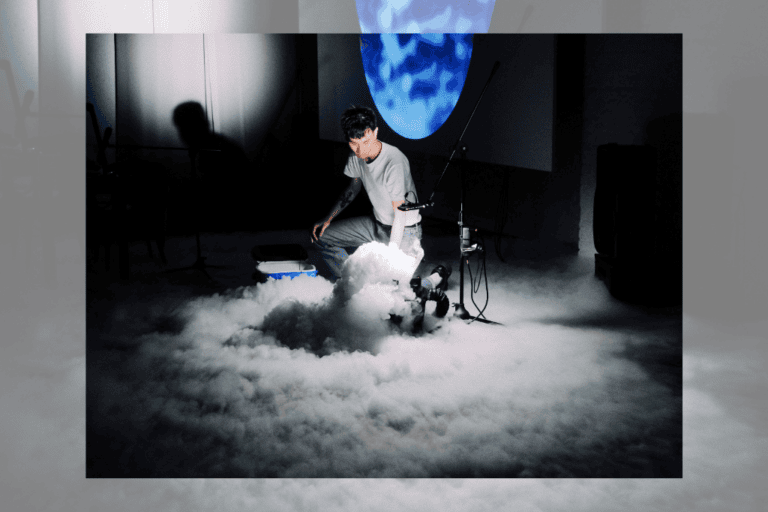 iPhoto caption: Ping-Hsiang Wang in 'Retina Maneuver.' Photo by Hang Su.
REVIEW: At this year’s SummerWorks Performance Festival, physical storytelling is central
From a dancer becoming a canine to a shy theatre director practicing his swordsmanship, the shows I’ve seen so far use performers’ bodies to dramatize defiance.
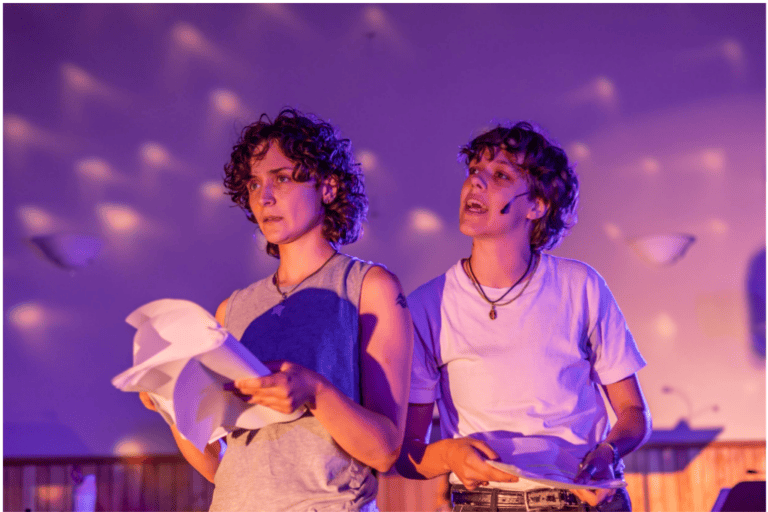 iPhoto caption: Anna Morreale and Luca McPhee perform in 'From Stardust' at the 2025 MADGEN Theatre Festival. Photo by Dave Klassen.
MADGEN Theatre Festival returns to the Danforth
Theatre of the Beat selected four producers under the age of 30 to receive paid mentorship from Toronto theatre-makers. From August 20 to 22, each member of the cohort mounts a new one-act Canadian play.
 iPhoto caption: Steven Sutcliffe and company in 'Twelfth Night.' Photo by Dahlia Katz.
REVIEW: High Park Twelfth Night pays tribute to the crazy things we do for love
As the play’s events ping-pong between seriousness and frivolity, Caroline Toal’s Viola appears constantly aware of the dangerous contradictions in the air, remaining guarded against the chaos' pull — and yet never entirely abandoning the possibility of enchantment.
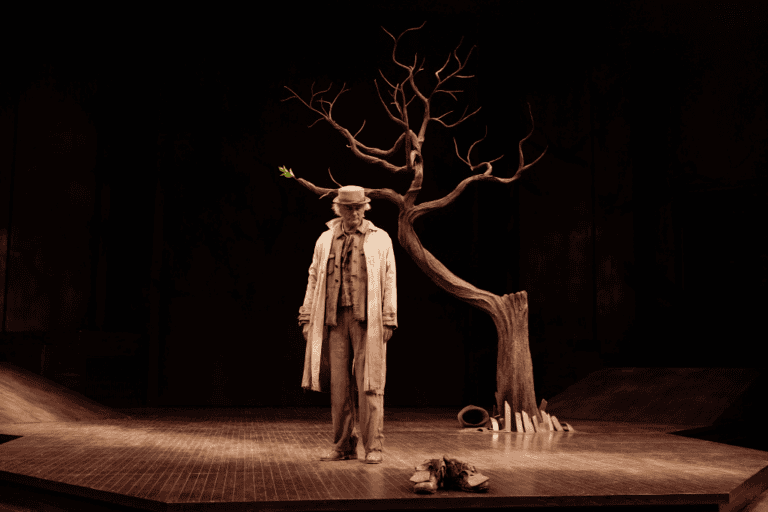 iPhoto caption: Paul Gross in 'Waiting for Godot.' Photo by David Hou.
Why Paul Gross thinks Waiting for Godot is ‘one of the great achievements of human creativity’
“The audience is with you. You bring them in. There isn't a big division between the stage and the audience,” says Gross, currently playing Vladimir in Waiting for Godot at the Stratford Festival. “They’re the final piece of the storytelling. We need them to complete the circle.”
Comments