
REVIEW: Andrew Kushnir’s The Division confronts the impossibility of fully knowing the past
 iPhoto caption: Daniel Maslany and Karl Ang in 'The Division.' Photo by Dahlia Katz.
In 2023, a scandal erupted when members of Canada’s federal government gave a standing ovation to a “freedom fighter” who others called a war criminal. Against the backdrop of Russia’s invasion of Ukraine, 98-year-old Yaroslav Hunka received praise for his service to Ukrainian independence during the Second World War.
Suddenly, the questions started coming: Didn’t Ukraine partner with Axis powers to exterminate its Jewish and Polish neighbours? Were we so focused on today’s definitions of geopolitical heroes and villains that we’d forgotten the past? Did this lend any credence to Vladimir Putin’s claims that Russia was simply trying to “de-Nazify” Ukraine?
Andrew Kushnir, writer and director of the layered and haunting new documentary play The Division, from Project: Humanity and Pyretic Productions in association with Crow’s Theatre, spent years grappling with these questions on a more personal scale. In 2019, after publishing a loving remembrance of his larger-than-life grandfather, a watchmaker who told endless stories but had never spoken to Andrew about his war service, he received a comment questioning the man’s part in the “Division.” The First Division of the Ukrainian National Army, by another name, was the Waffen-SS Galicia Division, which voluntarily fought under Nazi command.
Had Kushnir’s grandfather secretly been a Nazi all these years? Or was he, at the time, just a misguided teen with few options? Already overwhelmed with grief over the destruction in his family’s homeland, Kushnir traveled to Europe in search of the truth. The result is a thorny, intimate work of theatre that examines inherited guilt, the relentlessness of eye-for-an-eye justice, and the seductive promise of being able to clearly define and banish evil forever, if only you could choose and label the correct side.
Like the finely tuned watch that Kushnir (portrayed by Daniel Maslany) reverently holds and photographs throughout his journey to Ukraine, Poland, the U.K., and beyond, the play ticks along precisely through time (and place), anchored by date-bearing slides, catalogued interviews, and a cast that brings Kushnir’s multitude of audio recordings to life. Kushnir frames the show both as a future letter to his young nephew Lev — intended to explain his family’s complicated past — and as a time capsule that he hopes, 15 years from now, won’t be the only thing left of Ukraine.
Maslany capably cycles through Kushnir’s mix of love, anger, joy, fear, and horror, his face dancing with conflicted emotion as he peppers family game night with questions, rings the village church bells his ancestors donated, watches a Simon Wiesenthal Centre lecture, dines at an aggressively patriotic Ukrainian restaurant-cum-museum, and takes an uncomfortably rushed tour of Auschwitz. He often sits in the audience while recording the interviews with his phone and observing, letting audience members in the centre seats essentially see through his eyes as he watches his own journey, and dramatizing the moments the recordings took place while breaking the fourth wall to share their archived catalogue numbers.
Sim Suzer and Niloufar Ziaee’s set turns the Crow’s Studio Theatre into a cosy midcentury living room with dark brown wood paneling, while Thomas Ryder Payne’s sound design adds depth through backdrops of ticking clocks, breaking news reports, and the muffled thumping of a Robyn anthem in a Polish gay bar. As director, Kushnir uses similarly impressive visual techniques to ones in his powerful 2023 production of Bad Roads, reusing props in creative ways to promote a sense of fluidity. In both plays, characters ride careening vehicles comprised of household objects; here, the car taking Kushnir to his next interview is made from table-lamp headlights and a plate steering wheel.
The cast also slips gracefully into multiple roles. Karl Ang is equally believable as a patriotic young poet-soldier who prophesied his own death and an aging historian whose delight in playing fetch with his dog in the present distracts him from his lecture about the past. Alon Nashman’s portrayal of Putin, bolstered by a simple but clever visual effect, nearly stopped the show with laughter; clearly, Kushnir’s not getting off the list of Canadians banned from Russia any time soon. Ivy Charles’ horologist reminds us that people can be capable of causing great pain while creating exquisitely beautiful things. And Mariya Khomutova’s Chernobyl reporter provides a flattering account of Kushnir’s Ukraine trip that contrasts sharply with his more self-critical portrayal of his actions.
A delicate, quiet scene near the end of the play featuring Nashman and Khomutova is the emotional jewel in this theatrical watch mechanism. It’s both a catharsis and anti-catharsis for Kushnir, as he shares a shining moment of connection between historical enemies, but also recognizes that the past can’t be fully fixed or completely explained.
Kushnir quips that his duty as a gay uncle is to “collect things we don’t have room for” — not just watches or vases, but layers of the past that can seismically shift our sense of self, burying us if we’re not careful. However, in passing them down to the next generation, we can also rejoice in the potential for new life these children represent.
“We survived,” he says.
That directive may be the imperative of the moment — but examining how we did so is the work of a lifetime.
The Division runs at Crow’s Theatre until May 17. More information is available here.
Intermission reviews are independent and unrelated to Intermission’s partnered content. Learn more about Intermission’s partnership model here.

Ilana Lucas
Ilana Lucas is a professor of English in Centennial College’s School of Advancement. She is the President of the Canadian Theatre Critics Association. She holds a BA in English and Theatre from Princeton University, an MFA in Dramaturgy and Script Development from Columbia University, and serves as Princeton’s Alumni Schools Committee Chair for Western Ontario. She has written for Brit+Co, Mooney on Theatre, and BroadwayWorld Toronto. Her most recent play, Let’s Talk, won the 2019 Toronto Fringe Festival’s 24-Hour Playwriting Contest. She has a deep and abiding love of musical theatre, and considers her year working for the estate of Tony winners Phyllis Newman and Adolph Green one of her most treasured memories.
LEARN MORE iPhoto caption: André Sills and Krystin Pellerin in 'Othello.' Photo by David Hou.
REVIEW: In The Tempest and Othello, the Stratford Festival gets vengeful — and it rocks
The two strong productions, seen as a double bill, make a compelling case against choosing vengeance, with director Haysam Kadri’s Othello an especially riveting and taut interpretation.
 iPhoto caption: Sara Farb and Qasim Khan in 'Funny Girl.' Photo by David Cooper.
REVIEW: Sara Farb shines in Funny Girl at the Shaw Festival
One theme of Funny Girl is acceptance of the self despite its flaws and inconsistencies. The musical, likewise, is full of flaws and inconsistencies, but compelling all the same. Luckily, Sara Farb as Fanny Brice in all her boastful vulnerability gives us that central figure who delights — an umbrella to ward off the rain.
 iPhoto caption: Raymond Strachan and Tom McCamus in 'Death of a Salesman.' Photo by David Hou.
REVIEW: Stratford Festival’s Death of a Salesman is stark and melancholy
The relatively straightforward production is aesthetically austere, but strong central performances of the family at its core keep it human.
 iPhoto caption: Members of the company of 'Fiddler on the Roof.' Photo by Dahlia Katz.
REVIEW: Exquisite Yiddish Fiddler on the Roof bursts with both elation and pain
The word “Torah” in Hebrew dominates centre stage, constantly illuminated and glowing like an eternal flame. The backdrop’s sanctification, desecration, and resurrection signifies the resilience and endurance of the people before it.
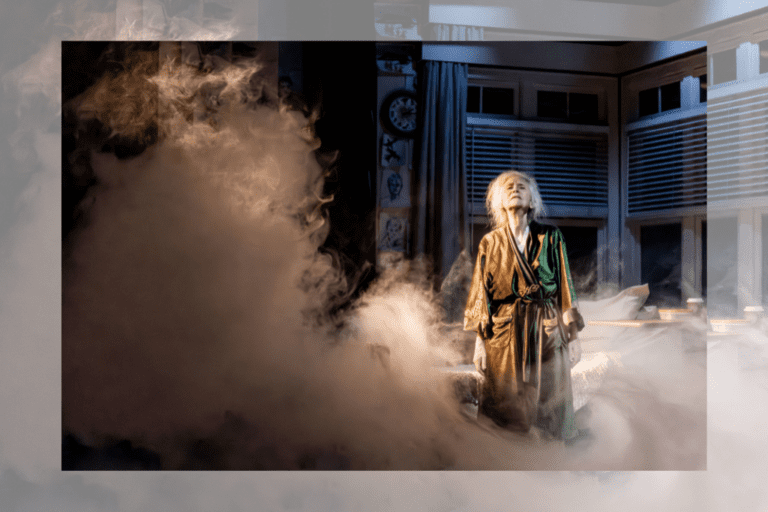 iPhoto caption: Clare Coulter in 'Queen Maeve.' Photo by Jae Yang.
REVIEW: Tarragon’s Queen Maeve packs one hell of an emotional wallop
The astonishing Clare Coulter manages to appear one moment as if she’d blow away in a faint breeze, another as though she’d easily cleave you in twain with a broadsword.
 iPhoto caption: Dan Mousseau and bahia watson in 'Summer and Smoke.' Photo by Dahlia Katz.
REVIEW: Tennessee Williams deep cut Summer and Smoke warms up Crow’s Theatre
I wondered if further following the directive to push upward instead of outward, balancing the corporeal dark with a little more spiritual lightness, might have made this ambitious and heartfelt production spark just a little bit hotter.
Comments