
REVIEW: Topdog/Underdog opens the Canadian Stage season with a snarl
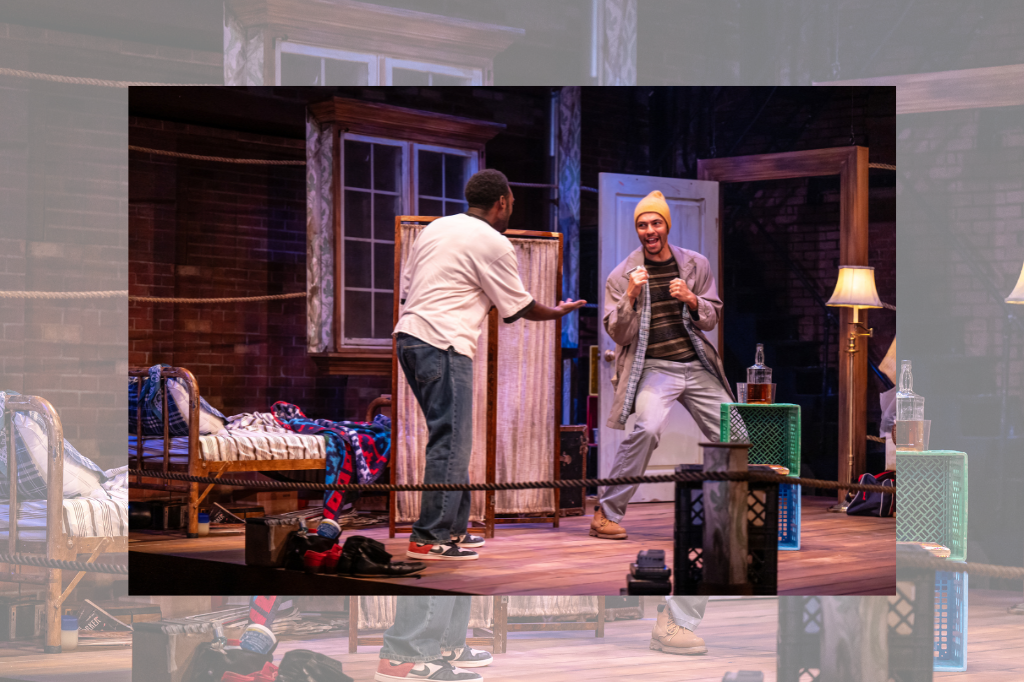 iPhoto caption: Photo by Dahlia Katz.
When the characters in a two-person play are named Lincoln and Booth, you can take a guess how things might end up.
Such is the case in Suzan-Lori Parks’ Pulitzer Prize-winning Topdog/Underdog, presented in a moody production at Canadian Stage that binds together past and present in an explosive exploration of family, failure, and love.
Lincoln and Booth are brothers, bonded by parents who abandoned them and complicated relationships with their own Blackness. Lincoln, played here by a well-cast Sébastien Heins, spends his days impersonating the president for whom he was named, top hat and all. Every morning, he greases his face with white paint, stepping into a historical suit with a combination of disgust and amusement. Every day, for hours on end, he sits in a replica of Abraham Lincoln’s theatre chair, letting museum patrons take turns “shooting” him. It’s an act that for me evoked images of Atlanta’s Teddy Perkins, a disturbing display of whiteface that immediately suggests not all is right in Lincoln’s personal life.
Booth, on the other hand, has struggles of his own – women, his sexuality, the annoyance of a precariously employed brother taking up space on his recliner. Mazin Elsadig, of Degrassi: The Next Generation fame, plays Booth with swagger and bite, a sharp foil to Heins’ more frenetic Lincoln.
The brothers and their myriad obstacles converge in the development of a card game scam, in which the dealer flips cards, and the player must follow a specific card as the deck shuffles across a table. Lincoln hopes to get away from this line of work – he’s on to better, more presidential uses of his time, he says – but in the end his brother, and the ease with which he games the system to snag an extra dollar, call to him.
Tawiah M’Carthy directs a dark, brooding Topdog/Underdog, in a three-hour production that often feels its length. Rachel Forbes’ set, a studio apartment tucked inside a boxing ring, is intriguing and off-kilter, placed such that Canadian Stage has had to re-jig the audience space of the Marilyn and Charles Baillie Theatre – audience members now sit in a corner formation that hugs the sides of the boxing ring, creating a sense of intimacy that, were it not for those bouncy, echoing exposed brick walls of the Canadian Stage building, would be quite effective. The set and the space in which it’s been placed create something of a vacuum for the energy onstage, almost leaving the performances from Heins and Elsadig to evaporate before they reach the audience.
Still, not all is lost – Parks’ script is a corkscrew of a play, twisting and twisting until the inevitable boom. M’Carthy has a firm handle on the play’s moments of anger and betrayal, and it’s in those moments that the chemistry between Heins and Elsadig gets to shine. Clothed expertly by Joyce Padua and lit well by Jareth Li, Heins and Elsadig keep the production from collapsing in on itself – just.
Parks’ play is one worth seeing, especially if you missed the Obsidian/Shaw Festival co-production in 2011. Despite being penned in 2002, the play has timely, audacious things to say about Black America and the history weighing it down. Topdog/Underdog is a fine season opener for Canadian Stage, if a little under-energized – it’s not impossible it’ll perk up over the course of its run.
Topdog/Underdog runs at Canadian Stage until October 15. Tickets are available here.
Intermission reviews are independent and unrelated to Intermission’s partnered content. Learn more about Intermission’s partnership model here.

Aisling Murphy
Aisling is Intermission's former senior editor and the theatre reporter for the Globe and Mail. She likes British playwright Sarah Kane, most songs by Taylor Swift, and her cats, Fig and June. She was a 2024 fellow at the National Critics Institute in Waterford, CT.
LEARN MORE iPhoto caption: Members of the company of 'Narnia.' Photo by Dahlia Katz.
REVIEW: Bad Hats’ Narnia is a joyful, heartwarming escape
The spirit of openness and the joy of discovery rule over this Narnia. Open the wardrobe and see.
 iPhoto caption: Members of the company of 'Robin Hood.' Photo by Dahlia Katz.
REVIEW: Canadian Stage’s Robin Hood panto is anti-capitalist fun for the whole family
Following Ross Petty’s legacy of scene-stealing, Damien Atkins as the evil Prince John is easily the greatest delight of the show.
 iPhoto caption: Lauren Gillis and Alaine Hutton in 'Public Consumption.' Photo by Eden Graham.
REVIEW: Lester Trips’ stylish Public Consumption captures the internet’s profound emptiness
Rather than directly representing online life, Public Consumption speculates — with virtuosity — about how the digital world affects our bodies. And the show's findings are by no means comfortable.
 iPhoto caption: Tony Ofori and Daren A. Herbert in 'Moonlight Schooner.' Photo by Dahlia Katz.
Kanika Ambrose’s Moonlight Schooner is animated and visually stunning, but its individual pieces don’t come together as neatly as I would've expected.
 iPhoto caption: Fiona Mongillo in 'Reproduktion.' Photo by Ann Baggley.
REVIEW: Here For Now’s well-acted Reproduktion attempts to tackle too much
Amy Rutherford’s world premiere script is ambitious and the material it covers is complex — but the narrative feels disjointed.
 iPhoto caption: Kristen Thomson in 'Fulfillment Centre.' Photo by Elana Emer.
REVIEW: Coal Mine’s Fulfillment Centre asks how we end up alone, together
The production understands the play’s themes, yet feels limited by a script that delivers a package it never fully opens.
 iPhoto caption: Photo by Aisling Murphy.
In the darkest months of Yukon winter, it’s all about the Sun Room
I’m here for a week in January as a guest of Nakai Theatre, a hub for theatrical experimentation and outside-the-box programming in Canada’s westernmost territory.

Armchairs, tattoos, and an online theatre magazine
When I started at Intermission, my world was limited to the confines of an armchair. Arts journalism was a high it felt dangerously fruitless to chase. The life stretched ahead of me was amorphous and frightening, a chasm filled with hand sanitizer and immigration concerns. It was worth crying over a spilled kombucha and scrubbing at the stain.
 iPhoto caption: Liz Appel headshot courtesy of Liz Appel.
Five questions with Wights playwright Liz Appel
Intermission spoke with Appel over email for a brief Q&A about Wights, now playing at Crow’s Theatre until February 9.

Call for applications: Publishing and editorial assistant
Intermission Magazine is seeking a dynamic and collaborative individual to join our team.
 iPhoto caption: What Writing Can Do: The 2025 Musical Theatre Critics Lab
Announcing What Writing Can Do: The 2025 Musical Theatre Critics Lab
What Writing Can Do is timed to coincide with the Grand and Theatre Aquarius’ co-production of Waitress, which will serve as a jumping-off point for discussions throughout the Lab.
 iPhoto caption: A Christmas Story production still by Dahlia Katz.
REVIEW: A Christmas Story feels fresh at Theatre Aquarius
If you want to catch A Christmas Story before it closes, good luck — the show is close to sold out, and with the talent on that stage, it’s not hard to see why.
Comments