
Q&A: Casey and Diana director Andrew Kushnir on bringing the acclaimed drama to Theatre Aquarius
 iPhoto caption: Photo by Dahlia Katz.
After premiering at the Stratford Festival in 2023, transferring to Soulpepper Theatre the following January, and winning best new Canadian play at the 2024 Toronto Theatre Critics’ Awards, Nick Green’s Casey and Diana is returning to Ontario.
Playing at Theatre Aquarius in a co-production with Royal Manitoba Theatre Centre (RMTC), Casey and Diana is a six-actor drama inspired by Princess Diana’s historic 1991 visit to Casey House, a Toronto hospice for people living with AIDS.
While this version of Casey and Diana isn’t identical to the production that played at Stratford and Soulpepper, and sports an all-new cast, it does share the same director: Andrew Kushnir.
Over email, I connected with Kushnir for a brief Q&A about Casey and Diana, and the changes he’s making to this co-production. His answers have been lightly edited for length and clarity.
How has it been revisiting this text, a year after the Soulpepper remount, and in our current social/political moment? Are new themes emerging for you?
I’ve been thinking a lot about grief and grieving during this process — and how Casey and Diana gives us a rich, dynamic, cathartic, and often joyful public ritual for our grief. It’s the opposite of a downer for me.
There’s lots to grieve right now in the world. But there are so few communal places to be with that grief. And I do think grieving in public normalizes a universal human condition: that we’ve all loved and lost something (time, a dream, a way of life) — or, more commonly, a dear someone. I don’t think the ritual solves the grief, but it makes us feel less alone in it.
While Joshua Quinlan is back as set and costume designer, you have a new composer/sound designer (Ashley Au) and lighting designer (Logan Raju Cracknell). How’s that changing things?
My partner is a designer, and he often talks about how design is autobiographical. In the way I like to work, new collaborators mean new forms of seeing (and hearing) the play.
We haven’t yet started tech rehearsals on Casey and Diana, but all our prep has been fixated on making the show bespoke to the Aquarius and RMTC theatres. I think the relationship between story and space is paramount; these designers are bringing their considerable gifts to that.
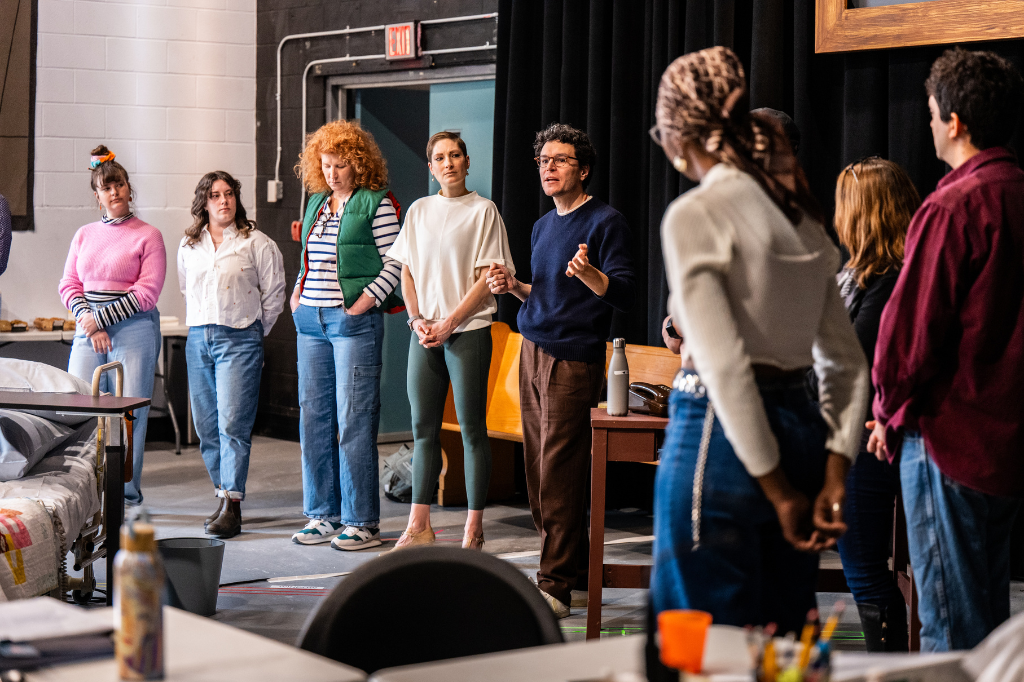
Speaking of space, the Aquarius mainstage theatre has about 700 seats — almost double the size of Soulpepper’s Marilyn and Charles Baillie Theatre. Does that lead to any changes? How do you keep things intimate?
Josh Quinlan and I have always wanted audience members to feel as though they’re in that room with Thomas and Diana at Casey House — no matter the theatre size. We’re not interested in the play being a voyeuristic experience, the stuff of strangers overhearing or spying on the deep intimacy of hospice care and men dying of AIDS.
In this design, we’ve created a series of stained glass “portals” and have gently raked the stage. The overall effect is pulling the audience toward those two beds and the men residing in them. I think we’ve created a powerful concentration of energy for the audience to step into.
What about the all-new cast, which includes Gregory Prest as Thomas and Catherine Wreford as Diana?
A mentor of mine told me that casting well — and casting “for love” (as in love of the piece, and what it’s trying to do in the world) — gets a production 90 per cent of the way there.
I’ve seen how this bi-provincial ensemble has become a fast family around this play. The humour of Nick’s script is such a huge part of the play’s lifeforce. And this is a room — including stage management — that gets the vibe. They also get the responsibility of this work: to honour history, community, and ghosts.
Is there anything else new about this co-production that people who’ve already seen the show might not expect?
When this show first premiered at Stratford, we were all freshly emerging from the worst of the pandemic.
I think the play, and its pandemic, made us think about proximity — what it means to make or withhold human contact. During COVID, I remember hearing this term “skin hunger” — starving for someone’s touch — and feeling how that was a possible entry point into the plight of those dying from both the physical and social dimensions of AIDS.
Now, for me, the play seems to be homing in on something else. I think we have compassion hunger. I think we’re looking at a world where we are unwilling or unable to suffer with others in a way that validates their humanity, and thereby our own. And I think people will be surprised to find how this play stirs and tends to that in such a compassionate way.
Casey and Diana runs at Theatre Aquarius from February 19 to March 8, and at Royal Manitoba Theatre Centre from March 19 to April 12.
 iPhoto caption: Louise Pitre in 'Kimberly Akimbo.' Photo by Emelia Hellman.
REVIEW: Mirvish’s well-cast Kimberly Akimbo never stops surprising
The simple and the unconventional meld radiantly throughout Jeanine Tesori and David Lindsay-Abaire's Tony Award-dominating 2021 musical.
 iPhoto caption: Athena So, Mike Nadajewski, Taylor Garwood, and Ben Page in rehearsal for 'All the Cows Are Dead.' Photo by Dahlia Katz.
What I discovered at rehearsals for TIFT’s world premiere musical All the Cows Are Dead
I’m sure most new musicals have interesting rehearsal processes — but it helped my excitement level that All the Cows Are Dead is a site-specific, existential two-hander from one of Ontario’s most risk-taking companies. There'll also be countless balloons.
 iPhoto caption: L to R, top to bottom: 'The 39 Steps' (photo by Raph Nogal), 'Benevolence' (photo by Jae Yang), 'The Born-Again Crow' (photo by Jeremy Mimnagh), 'Dimanche' (photo by Thomas Müller), 'Last Landscape' (photo by Fran Chudnoff), 'The Merchant of Venice' (photo by Kyle Purcell), 'Slave Play' (photo by Dahlia Katz), 'Waiting for Godot' (photo by Elana Emer), 'The Welkin' (photo by Dahlia Katz).
Twelve indelible moments of performance from 2025
With the lights fading on another year of fleeting thrills in dark rooms, we asked 12 Ontario performing arts writers to reflect on a moment that stayed with them. The results mainly stem from Toronto theatre productions, but there are a few surprises weaved in.
 iPhoto caption: Connor Mitton and members of the company of 'Sex Dalmatian’s Hot Holiday Spectacular.' Photo by Jeremy Mimnagh.
REVIEW: Sex Dalmatian’s Hot Holiday Spectacular is a peppermint-coated acid trip
Rock Bottom Movement’s surrealist mandate is on full display in this 15-dancer fantasia, which begins with an invitation to let go: “The only thing you need to know is not to know anything at all,” pronounces the Mayor of Sex Dalmatian, the evening’s narrator and the mayor of the titular canine’s mind.
 iPhoto caption: Tom Rooney in 'Rogers v. Rogers' at Crow's Theatre. Photo by Dahlia Katz.
REVIEW: Tom Rooney dazzles in world premiere of Michael Healey’s Rogers v. Rogers
Rooney and Healey skewer the Rogers family with a disarmingly relaxed virtuosity that the surrounding Crow's Theatre production sometimes supports, and sometimes lets down.
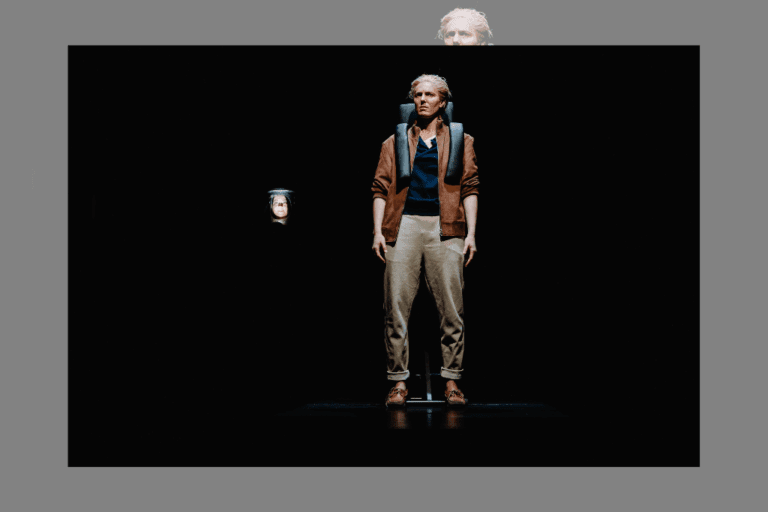 iPhoto caption: Lauren Gillis and Alaine Hutton in 'Public Consumption.' Photo by Eden Graham.
REVIEW: Lester Trips’ stylish Public Consumption captures the internet’s profound emptiness
Rather than directly representing online life, Public Consumption speculates — with virtuosity — about how the digital world affects our bodies. And the show's findings are by no means comfortable.
Comments