
REVIEW: The Born-Again Crow is an ardent ode to unproductivity
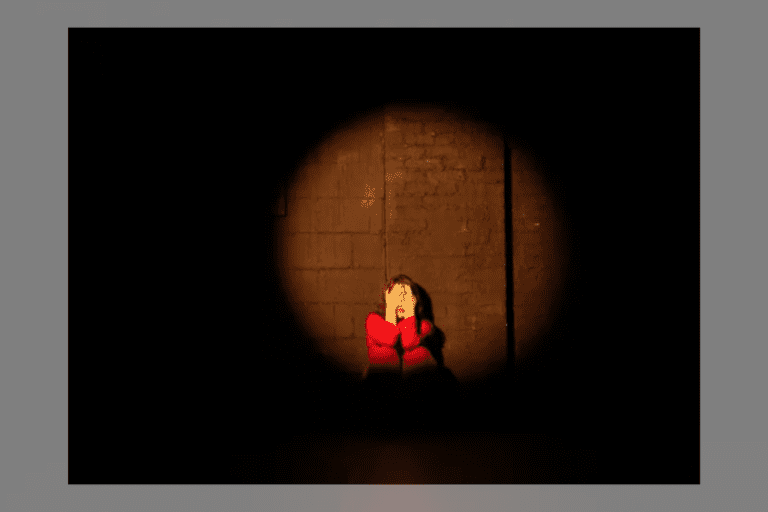
 iPhoto caption: Photo of Tara Sky by Jeremy Mimnagh. Set design by Shannon Lea Doyle, costume design by Asa Benally, lighting design by Hailey Verbonac.
Demolish a pyramid of soup cans. Ignite the magazine aisle. Smother a coworker in rice flour. Affix raw steak to an office door. Of these very fun ways to quit a job at Real Canadian Superstore, I can’t pick a favourite.
Neither could Beth (Tara Sky), the young Indigenous protagonist of Caleigh Crow’s Governor General’s Award-winning drama There is Violence and There is Righteous Violence and There is Death or, The Born-Again Crow. She performed those rebellious deeds after her manager refused to give her a one-dollar raise. Now, she’s unemployed, back at the suburban home of her retired mother Francine (Cheri Maracle).
In The Born-Again Crow’s vision of contemporary society, capitalism is a force so constraining that only violence has the power to alter the course of an average citizen’s life. Produced by Native Earth Performing Arts and Buddies in Bad Times Theatre in the latter’s Chamber space, director Jessica Carmichael’s 100-minute Toronto premiere staging trucks along with the passionate force of an early-2000s emo rock hit, imbuing Crow’s systemic critique with rousing, playful life.
The Born-Again Crow unfolds primarily in Francine’s backyard. She’s fitted the space with a pair of large bird feeders in the hope that Beth will spend time decompressing outside. Despite initial skepticism and the distraction of fuckboy-next-door Tanner (Dan Mousseau), Beth becomes wholly dedicated to the local birds. She attracts the patronage of several dozen crows, who begin to leave small gifts on the feeder: a rusty screw, a shard of glass, earrings.
This flock produces noise and dirt, enraging the neighbourhood homeowners’ association: “Property value is dropping, my car is covered in shit… Cease and desist!” demands Jim, their gruff leader (also Mousseau). The irresponsible social media reporting of gossipmonger Jane Lafontaine (Mousseau again) exacerbates this mistreatment. All the while, a nonchalant talking crow (Madison Walsh) appears. When Beth asks her if every crow can speak, the bird’s response is divinely mysterious: “I’m the only one that talks to you.”
Sky’s Beth plucks one string: angst. Until the play’s surreal, Matthew Rankin-esque climax, the character doesn’t experience her emotions so much as spell them out in chunky red marker. This heightened approach often harmonizes with the play’s off-kilter dialogue, as well as the performance of Maracle, whose neurotic Francine moves around the stage in frantic, uptight fashion, punctuating jokes with awkwardly loud exclamations of “Ha!”
Carmichael captures the emotional distance between the two characters by frequently placing them on opposite sides of Shannon Lea Doyle’s wide backyard set; conversely, Tanner and the crow tend to get disarmingly close to Beth. While the show really soars once it fully abandons verisimilitude, these earlier, character-focused scenes serve to ground the eventual mayhem. (The scene transitions are expressionistic throughout, and I sometimes found them distractingly dance-like, as when, for no apparent reason, Maracle makes a drawn-out display of transforming back into Francine after playing a silent bird.)
Joining a suite of recent women-led Toronto theatre productions deconstructing the concept of work — including Veronica Hortigüela and Annie Luján’s MONKS, Lester Trips’ Honey I’m Home, and Rosamund Small’s Performance Review — The Born-Again Crow begs to be read through the lens of productivity. By abandoning wage labour to feed birds, Beth is performing a quietly subversive act — and she’s vilified for it. The play moreover underlines the glorious unproductivity of nature, with Beth at one point proclaiming that “if you can’t be happy living as a lark, or an otter, or a porcupine, you’ve already lost what makes living worthwhile. You are born, you live, and you bear witness to the greatest miracle ever devised. That’s the gift.” Maybe we should all spend more time squawking and defecating on Audis.
Or making plays. While, in script form, The Born-Again Crow already serves as a worthy rallying cry for young working people, Carmichael’s ecstatic production seems to me to double as a statement about theatre’s own responsibility to get angry, make a mess, and — like Beth in the supermarket — feel really fucking real.
The Born-Again Crow runs at Buddies in Bad Times Theatre until March 29. Tickets are available here.
Intermission reviews are independent and unrelated to Intermission’s partnered content. Learn more about Intermission’s partnership model here.
Liam Donovan
Liam is Intermission’s senior editor. He lives in Toronto. His Substack newsletter is available at loamdonovan.substack.com.
LEARN MORE iPhoto caption: Steven Sutcliffe and company in 'Twelfth Night.' Photo by Dahlia Katz.
REVIEW: High Park Twelfth Night pays tribute to the crazy things we do for love
As the play’s events ping-pong between seriousness and frivolity, Caroline Toal’s Viola appears constantly aware of the dangerous contradictions in the air, remaining guarded against the chaos' pull — and yet never entirely abandoning the possibility of enchantment.
 iPhoto caption: Paul Gross in 'Waiting for Godot.' Photo by David Hou.
Why Paul Gross thinks Waiting for Godot is ‘one of the great achievements of human creativity’
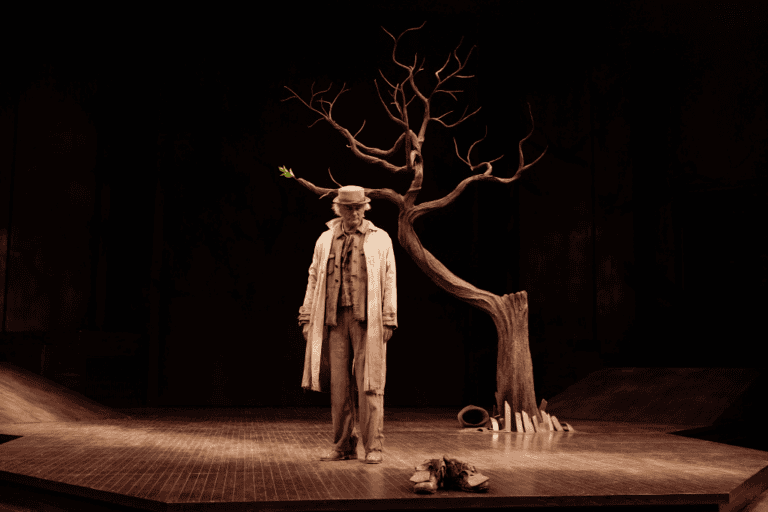
“The audience is with you. You bring them in. There isn't a big division between the stage and the audience,” says Gross, currently playing Vladimir in Waiting for Godot at the Stratford Festival. “They’re the final piece of the storytelling. We need them to complete the circle.”
 iPhoto caption: Karl Ang, Ivy Charles, Daniel Maslany, Mariya Khomutova, and Alon Nashman in 'The Division.' Photo by Dahlia Katz.
Productions at Crow’s and Theatre Passe Muraille win top honours at the 2026 Dora Awards
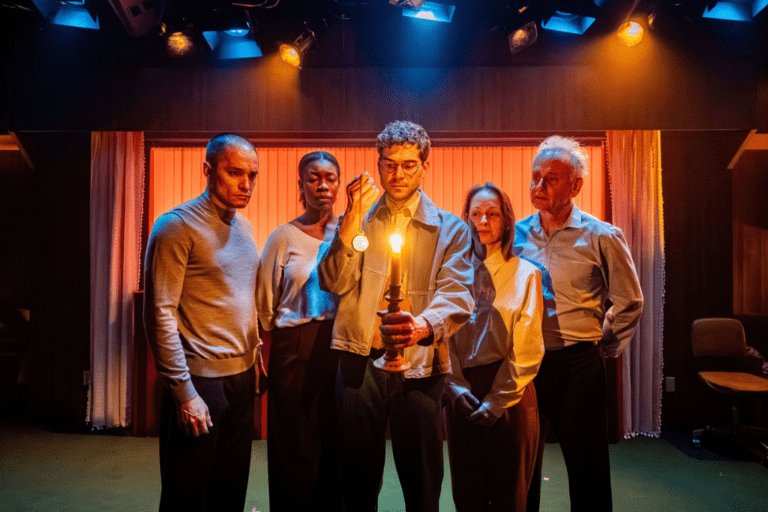
This evening at Meridian Hall, the Toronto Alliance for the Performing Arts (TAPA) announced the recipients of the 46th annual Dora Awards, celebrating local theatre, dance, and opera.
 iPhoto caption: 'Golden Rez Dog.' Photo by Philippe Latour.
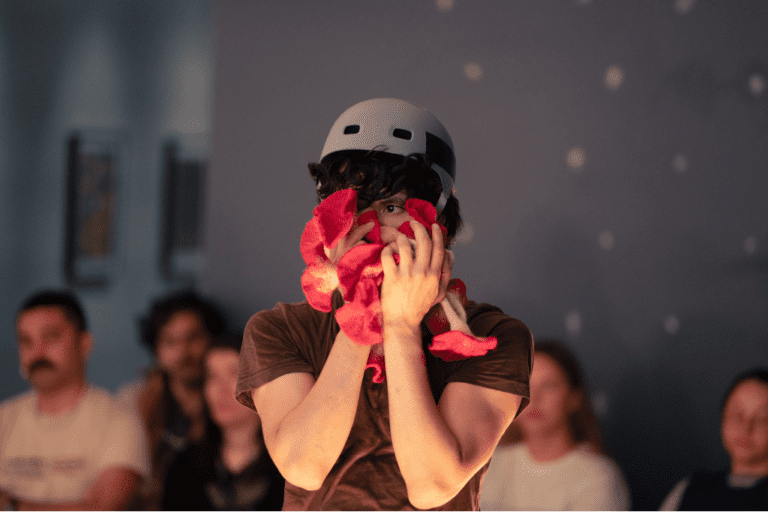
Creations from Denmark, Hong Kong, Iran, Mexico, and beyond feature in this year’s SummerWorks Performance Festival programming.
 iPhoto caption: Photo by Drew Berry.
REVIEW: An homage to Richard Foreman commands us to change our lives — and our theatre
Richard Foreman's plays usually drew on his personal journals and clocked in around 70 minutes; when he passed away last year at the age of 87, he left behind an invitation for directors to create royalty-free work from those journals. With the recently closed You Must Change Your Life at Toronto’s Alumnae Theatre, creator-director Ilana Khanin took up that offer to ludic, collage-like effect.
 iPhoto caption: Danny O’Mahony and Emily Kilkenny Roddy in 'Bellow.' Photo by Ste Murray.
REVIEW: This year’s Bealtaine Theatre Festival featured accordions, ketamine, and James Joyce
The festival serves up a curated program of contemporary theatre from Ireland — appreciated, in a city that punches below its weight in terms of international performing arts offerings from countries it doesn’t border.
Comments