
REVIEW: The Massey Report shaped Canadians’ perception of the arts. These theatre-makers are rewriting it.
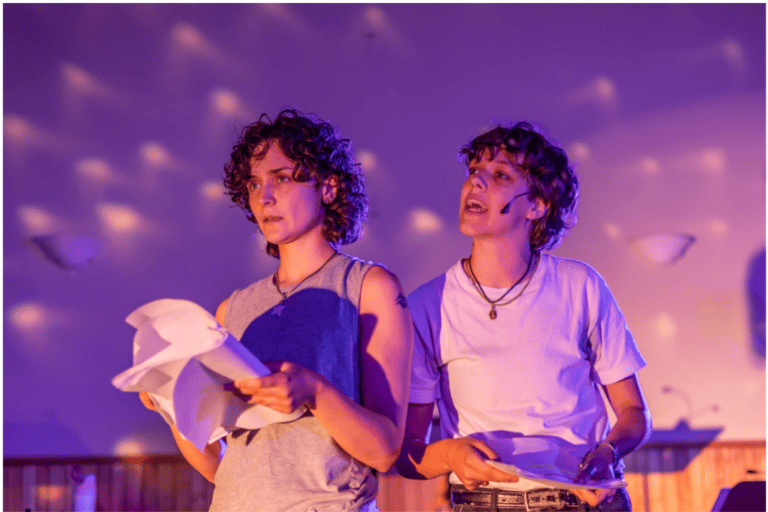
 iPhoto caption: 'Documents Perform 3.' Photo by T Photo Factory.
I dig boundary-pushing contemporary theatre and edit articles about the performing arts in Canada. So perhaps I’m an easy mark for an experimental performance about actors editing a document that laid the foundations for the last 70 years of Canadian arts and culture policy. Either way, I found Documents Perform 3 — presented on the first weekend of Aluna Theatre’s 11-day, trans-American RUTAS Festival — a welcome invitation to zoom out and reflect on the ways in which colonial principles might still inform the country’s approach to supporting artists.
At the Factory Theatre Mainspace, creators Natalie Álvarez, Katiana Gonçales Rangel, and Richard Maxwell fill a downstage projection screen with a livestream of a Google Doc holding eight brief excerpts from the Massey Report. Born in 1951 out of a royal commission’s two-year survey of Canadians, the document argued for government support of universities and the arts, eventually leading — among other things — to the creation of the still-essential Canada Council for the Arts.
The Massey Report was rooted in Euro- and Anglocentric values that continue to shape Canadian assumptions about the arts’ role in society. Documents Perform 3 rewrites it through a more expansive, future-conscious lens. Joining online from across the Americas, more than a dozen artists, artistic producers, cultural leaders, and policymakers add live suggestions to the document, together transforming stuffy bureaucratic language into a rowdy patchwork of compassionate imagining. (The project is co-presented by — deep breath! — the Arts Impact Partnership, the New York City Players’ Incoming Theatre Division, Hemispheric Encounters, and Aluna Theatre.)
Documents Perform 3 is the third entry in a multi-year series of performances rewriting different sections of government documents from Canada and beyond. The creators turn a viewing experience that I half-expected to be dry and scattered (again, they’re editing a 1951 royal report) into something surprisingly focused and fast-paced. The “hacktors,” as Aluna’s website has it, tackle each section in small, rotating groups. Flocks of cursors type bolded additions that, in performance, were sometimes a little hard to distinguish from regular text.
We don’t see or hear the performers, but an unidentified voiceover narrator kicks off each section by doing a roll call and setting a visible timer of three or four minutes. Over a similar duration, the audience has to process both the original text and the rapidly evolving revisions. There’s always something new to read, and never quite enough time. It’s an engaging scramble to try and take in all the action (if you can call it that), but thankfully there isn’t much pressure to read each revised section in its entirety — because Chekhov’s printer-and-two-microphone-stands communicate that a pair of anonymous actors will eventually fill the gap on stage and read the final document aloud.
Canada’s cultural future is a subject that could produce several symposiums’ worth of broad reflections and open-ended questions. Documents Perform takes the more stirring route of inking a manifesto.
Where the Massey Report hedges to an almost caricatural degree — “the Federal Government has some measure of responsibility in” the field of the arts, concludes one drab sentence — the revised version punctuates the idea: The government must “always reflect the will of the people across diverse ideologies, diverse geographies, and diverse practices.”
Where the Massey Report pretends to have no opinion on the types of works artists should create but slyly reminds us that “the appetite grows by eating” and thus “the best must be made available to those who wish it,” the hacktors prescribe a wider diet: “The full and rich diversity of social and cultural life.”
Where the Massey Report at one point labels artists “human assets” as if it’s negotiating a trade agreement, Documents Perform reminds us: “Culture is not a resource to be extracted.”
The hacktors add these energizing proclamations with such efficient confidence that I wondered what kind of preparation they’d gone through: Are they executing an agreed-upon game plan, or encountering each other’s contributions for the first time? This question seems particularly pertinent because the revised report underlines that arguments should help drive the sector’s policy frameworks. “Cultural value is created and debated by artists, communities, and publics,” insists one contributor. The quick pace doesn’t allow space for hacktors to dialogue in the Google Doc about what to include in the report — but perhaps they’d already debated it? I was left curious about the project’s larger structures and rules of engagement. (Through a pre-show QR code, the creators tried to enlist the audience to complicate the editing with their own comments, but the crowd barely participated.)
Whatever the conversations that led to the new report, it’s only a draft. At the end of the performance, Álvarez wrote out a text describing it as an “evolving cultural charter” that will be collectively rewritten, contested, and expanded over the coming years — though there’s a degree of ambiguity around exactly who that collective is, and if the editing process will extend beyond future presentations of Documents Perform.
Given this ideal of direct participation, it’s easy to see why Aluna artistic director Beatriz Pizano programs the Documents Perform series; in her curatorial statement, she wrote that for each edition of RUTAS, the company asks itself, “What are the conversations that we want to bring forth at this moment in time that will contribute to manifesting a better world?”
This year’s conversations officially conclude this weekend with the Spanish-language premiere of a play by Nlaka’pamux playwright Tara Beagan, two international offerings for young audiences, and an all-night comic-strip creation marathon. Neat programming for editors and beyond.
The 2026 RUTAS Festival runs until October 4. More information is available here.
Intermission reviews are independent and unrelated to Intermission’s partnered content. Learn more about Intermission’s partnership model here.
Liam Donovan
Liam is Intermission’s senior editor. He lives in Toronto. His Substack newsletter is available at loamdonovan.substack.com.
LEARN MORE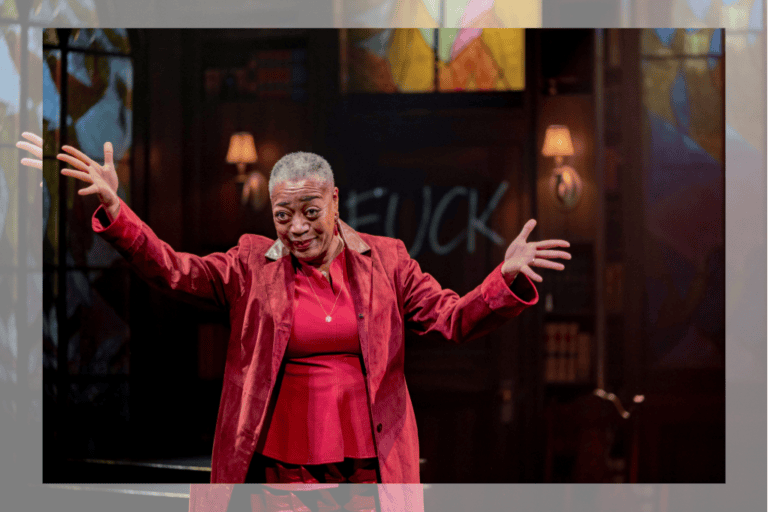 iPhoto caption: Karen Robinson in 'Prophetess.' Photo by Jae Yang.
REVIEW: In Tarragon’s outstanding Prophetess, language is both mighty and inadequate
Margaret’s facility with text helps her maneuver through an institution like York University, where words hold significant power. But the brilliant middle-aged scholar finds herself surprisingly unequipped to process the true sense of more elemental forces: love, grief, spiders.
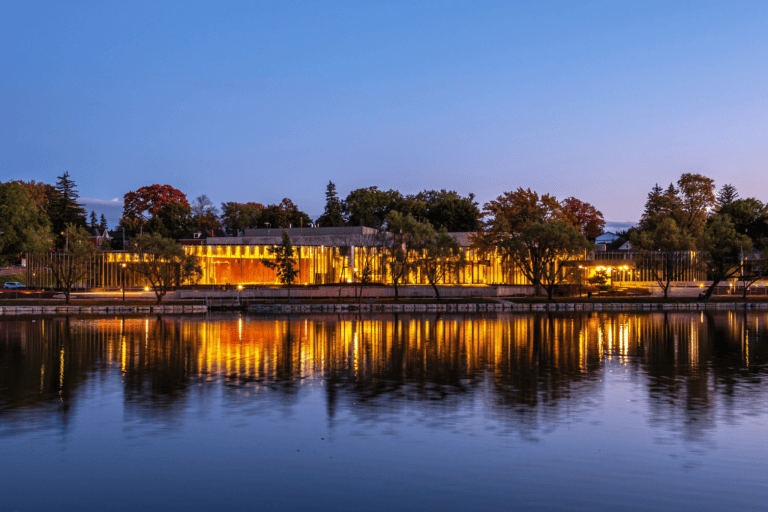 iPhoto caption: Stratford's Tom Patterson Theatre. Photo by Ann Baggley.
2027 highlights include a new Canadian Jacob Two-Two musical and two of the Bard’s thornier plays: The Merchant of Venice and The Taming of the Shrew.
 iPhoto caption: Devon Michael Brown as Rusty Charlie with members of the 'Guys and Dolls' company.
“It's so exhausting, but it's really rewarding when you get to dance so full-out,” says Devon Michael Brown. “You get to use your technique and your training to the fullest extent.”
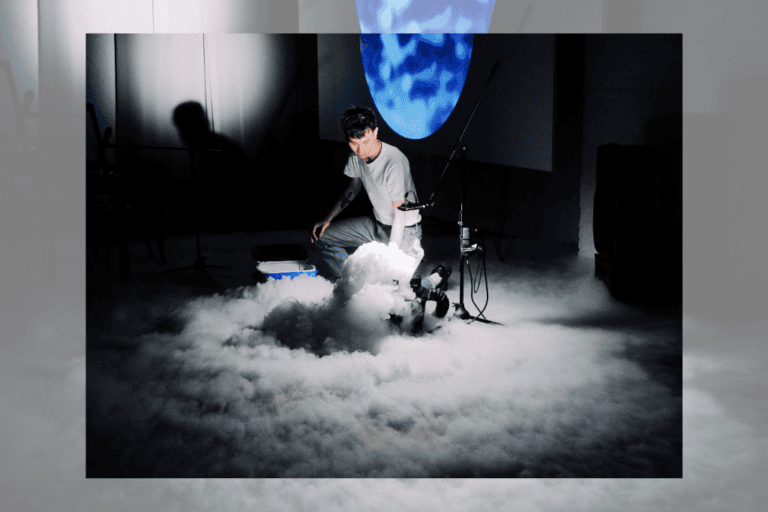 iPhoto caption: Ping-Hsiang Wang in 'Retina Maneuver.' Photo by Hang Su.
REVIEW: At this year’s SummerWorks Performance Festival, physical storytelling is central
From a dancer becoming a canine to a shy theatre director practicing his swordsmanship, the shows I’ve seen so far use performers’ bodies to dramatize defiance.
 iPhoto caption: Anna Morreale and Luca McPhee perform in 'From Stardust' at the 2025 MADGEN Theatre Festival. Photo by Dave Klassen.
MADGEN Theatre Festival returns to the Danforth
Theatre of the Beat selected four producers under the age of 30 to receive paid mentorship from Toronto theatre-makers. From August 20 to 22, each member of the cohort mounts a new one-act Canadian play.
 iPhoto caption: Steven Sutcliffe and company in 'Twelfth Night.' Photo by Dahlia Katz.
REVIEW: High Park Twelfth Night pays tribute to the crazy things we do for love
As the play’s events ping-pong between seriousness and frivolity, Caroline Toal’s Viola appears constantly aware of the dangerous contradictions in the air, remaining guarded against the chaos' pull — and yet never entirely abandoning the possibility of enchantment.
Comments