
REVIEW: A Poem for Rabia at Tarragon fits a large story into a small space
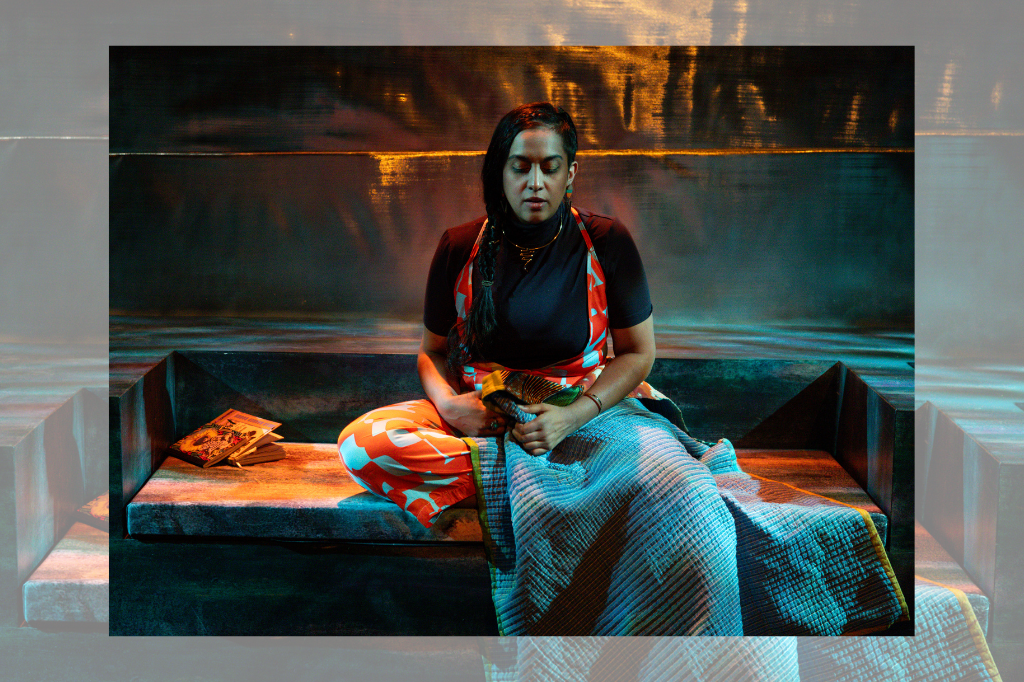 iPhoto caption: Photo by Cylla von Tiedemann.
If I had a nickel for every 2023 Tarragon show that interweaves a 21st-century setting with an older one, stars the playwright as a queer Canadian trying to make sense of the world, and features a pool of real water at the front of the stage, I’d have 10 cents.
The first was Makram Ayache’s The Hooves Belonged to the Deer in April. The second is Nikki Shaffeeullah’s A Poem for Rabia, produced by Tarragon in association with Nightwood Theatre and Undercurrent Creations.
While the former made up for fuzzy performances with explosive aesthetic highs, the latter works somewhat oppositely. On a scene-to-scene level, co-directors Clare Preuss and Donna-Michelle St. Bernard render Shaffeeullah’s ambitious text with impressive clarity, ensuring the actors are supported in their traversal of the play’s manifold shifts. The dramatic foundation of A Poem for Rabia is well in place; it’s the visual concept that’s in need of greater love — and, perhaps, a larger canvas than the intimate Tarragon Extraspace can offer.
Shaffeeullah plays Zahra, an activist living in Canada in the year 2053. Though the country recently abolished prisons, she feels disconnected from her ancestors, and worries her contemporary lifestyle is turning her into a “fairweather descendant.”
The play brings to life two such ancestors, interweaving their stories with Zahra’s. One is Betty (Michelle Mohammed), a secretary starting work at the Governor of British Guiana’s office in 1953. Another century back lives the titular Rabia (Adele Noronha), an Indian domestic worker being sent to the Caribbean on an indentured labour ship helmed by colonizers.
All three live through times of immense political change. But Shaffeeullah doesn’t coat their lives in drama. Instead, A Poem for Rabia focuses on the smaller joys and disappointments of everyday life — the nervous excitement that accompanies a new job, the embarrassment-tinged thrills of awkward conversation, and the delight of exploring new foods (along with the comfort of indulging in old ones). Despite the vast temporal gulf separating the women, Shaffeeullah’s attention to detail connects them: their emotional and spiritual journeys intersect even as their literal circumstances diverge.
The show’s double casting contributes to this sense of overlap. Virgilia Griffith, Jay Northcott, and Anand Rajaram each play characters in two of the timelines, blurring the differences between the worlds. The grounded performances of the central trio of women keep things from becoming unclear, however — Mohammed, in particular, anchors her setting with fire and dynamism.
It’s becoming somewhat common for Toronto playwrights to star in their own shows, but Shaffeeullah gives herself a fairly laidback role — Zahra’s emotional range isn’t huge, and she speaks less than one might expect. Shaffeeullah’s casting also helps underline her personal connection to the material (her playwright’s note hints at parallels between her family history and Zahra’s).
Sonja Rainey’s sea blue set doesn’t evoke a specific time or place. Instead, it’s an abstract jungle gym of sorts; a couple of inclined slopes and a blocky upstage platform serve as perches for the actors, allowing Preuss and St. Bernard to create unique stage images.
The semi-circular pool of water is less effective, however: it occupies downstage centre, and a barrier cuts it off from the rest of the playing space; since it’s only really used in one late scene (Chekhov’s pond, yes), this placement feels unearned — though the payoff of the pond scene is sweet, I’m not sure it’s worth losing prime stage space elsewhere. And when scenes take place on the ground behind the pool, the barrier cuts off the actors’ legs, leeching their energy.
Any show that interweaves settings puts a great deal of responsibility on the lighting designer; especially if there aren’t many set changes, they tend to be tasked with dividing and defining the space. Echo Zhou 周芷會 takes up this challenge admirably, offering expressionistic flourishes in addition to clearly signposting the play’s shifts. But a large, foil-like wall at the back of the stage at times muddies Zhou’s work — it’s a reflective surface, so it smudges the light, making it difficult to isolate characters in spotlights without light flashing forward.
A Poem for Rabia feels a little trapped in the Extraspace — at two-and-a-half hours, Shaffeeullah’s play is big, and could use more space to breathe. (It would even be fascinating to see what a film or novel adaptation would do with the sweeping story.)
But the show’s passionate core comes through nonetheless. Though the character Rabia does write a poem, it’s moving that the play’s title speaks of a poem “for” Rabia, not “by” her; A Poem for Rabia is ultimately a circular gesture, a loving handing back of what’s been passed down.
A Poem for Rabia runs at Tarragon Theatre until November 12. Tickets are available here.
Intermission reviews are independent and unrelated to Intermission’s partnered content. Learn more about Intermission’s partnership model here.
Liam Donovan
Liam is Intermission’s senior editor. He lives in Toronto. His Substack newsletter is available at loamdonovan.substack.com.
LEARN MORE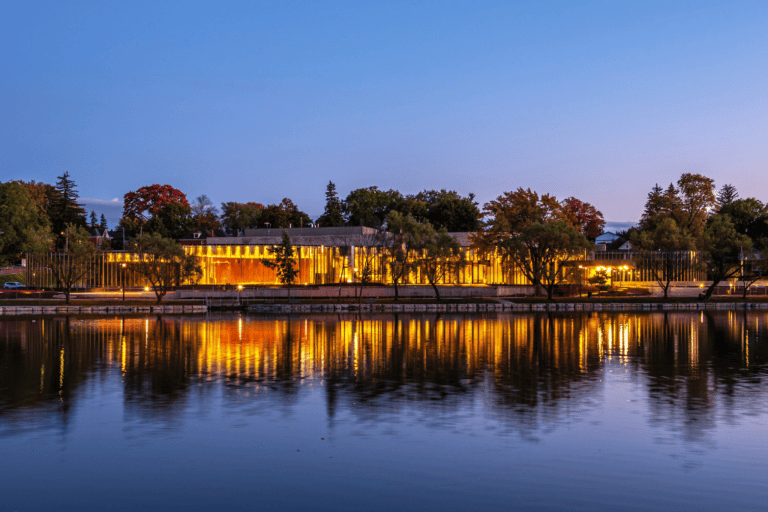 iPhoto caption: Stratford's Tom Patterson Theatre. Photo by Ann Baggley.
2027 highlights include a new Canadian Jacob Two-Two musical and two of the Bard’s thornier plays: The Merchant of Venice and The Taming of the Shrew.
 iPhoto caption: Devon Michael Brown as Rusty Charlie with members of the 'Guys and Dolls' company.
“It's so exhausting, but it's really rewarding when you get to dance so full-out,” says Devon Michael Brown. “You get to use your technique and your training to the fullest extent.”
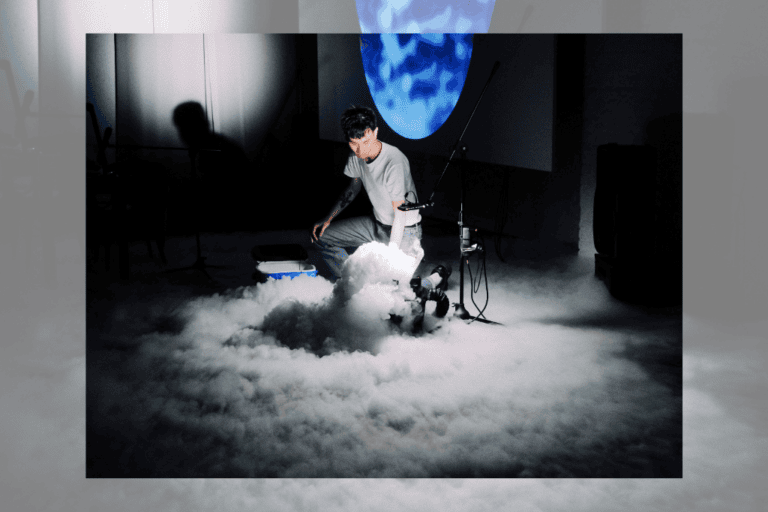 iPhoto caption: Ping-Hsiang Wang in 'Retina Maneuver.' Photo by Hang Su.
REVIEW: At this year’s SummerWorks Performance Festival, physical storytelling is central
From a dancer becoming a canine to a shy theatre director practicing his swordsmanship, the shows I’ve seen so far use performers’ bodies to dramatize defiance.
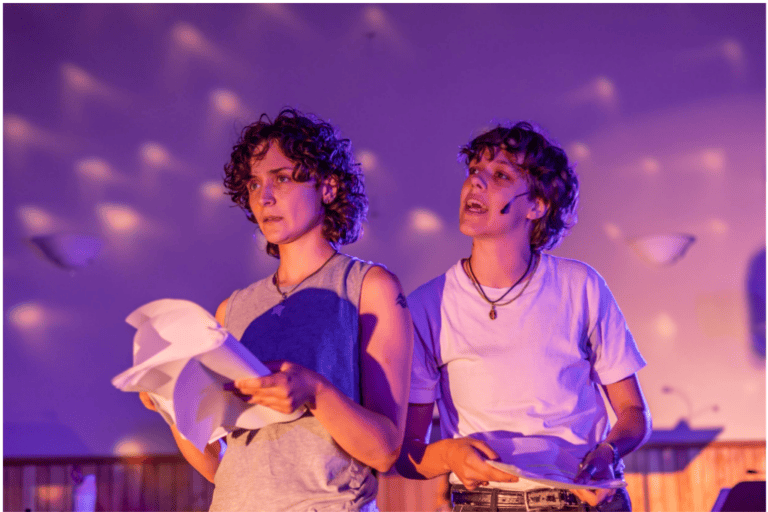 iPhoto caption: Anna Morreale and Luca McPhee perform in 'From Stardust' at the 2025 MADGEN Theatre Festival. Photo by Dave Klassen.
MADGEN Theatre Festival returns to the Danforth
Theatre of the Beat selected four producers under the age of 30 to receive paid mentorship from Toronto theatre-makers. From August 20 to 22, each member of the cohort mounts a new one-act Canadian play.
 iPhoto caption: Steven Sutcliffe and company in 'Twelfth Night.' Photo by Dahlia Katz.
REVIEW: High Park Twelfth Night pays tribute to the crazy things we do for love
As the play’s events ping-pong between seriousness and frivolity, Caroline Toal’s Viola appears constantly aware of the dangerous contradictions in the air, remaining guarded against the chaos' pull — and yet never entirely abandoning the possibility of enchantment.
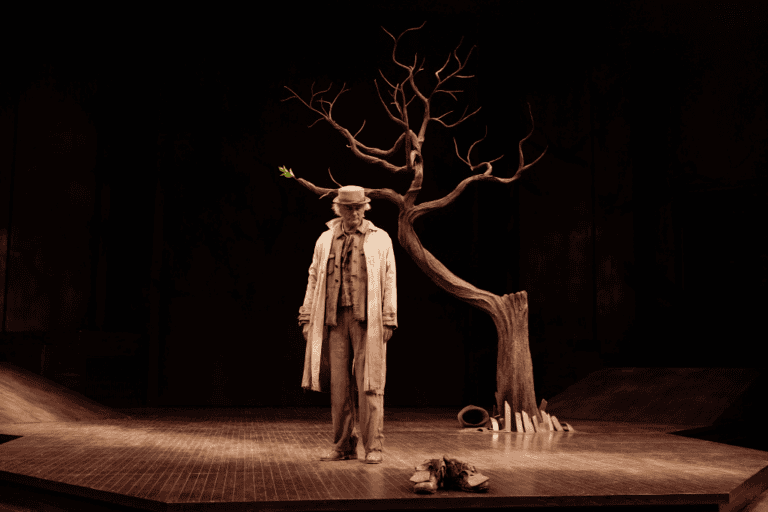 iPhoto caption: Paul Gross in 'Waiting for Godot.' Photo by David Hou.
Why Paul Gross thinks Waiting for Godot is ‘one of the great achievements of human creativity’
“The audience is with you. You bring them in. There isn't a big division between the stage and the audience,” says Gross, currently playing Vladimir in Waiting for Godot at the Stratford Festival. “They’re the final piece of the storytelling. We need them to complete the circle.”
Comments