
How director Jillian Keiley uses perspective to guide the audience’s eye in Dial M for Murder at Theatre Calgary
 iPhoto caption: Tyrell Crews and Stafford Perry in 'Dial M For Murder.' Photo by Trudie Lee.
A latchkey, a handbag, and a letter: the plot of Frederick Knott’s classic thriller Dial M for Murder hinges on small objects. For his hit film adaptation of this 1952 play about a man who murders his wife to nab her inheritance, Alfred Hitchcock highlighted essential details via close-ups and unexpected cinematographic angles. But in a live production, how should the audience know where to look?
“I’m in a [750]-seat theatre. I can’t see a key. I lose my keys every day in my house!” reflected Jillian Keiley, director of Jeffrey Hatcher’s 2022 Dial M adaptation, in a co-production between Theatre Calgary (where it opens first) and Vancouver’s Arts Club Theatre Company (where it starts performances in February 2026).
Over Zoom, Keiley explained that she guides the audience’s eye through one central concept: perspective. This prominently manifests in Anton deGroot’s 1950s apartment set, which rests on a turntable that revolves with near-imperceptible slowness. As the show progresses, “the audience should feel like [they’re] actually changing perspective,” said Keiley, artistic director of Ottawa’s National Arts Centre English Theatre from 2012 to 2022.
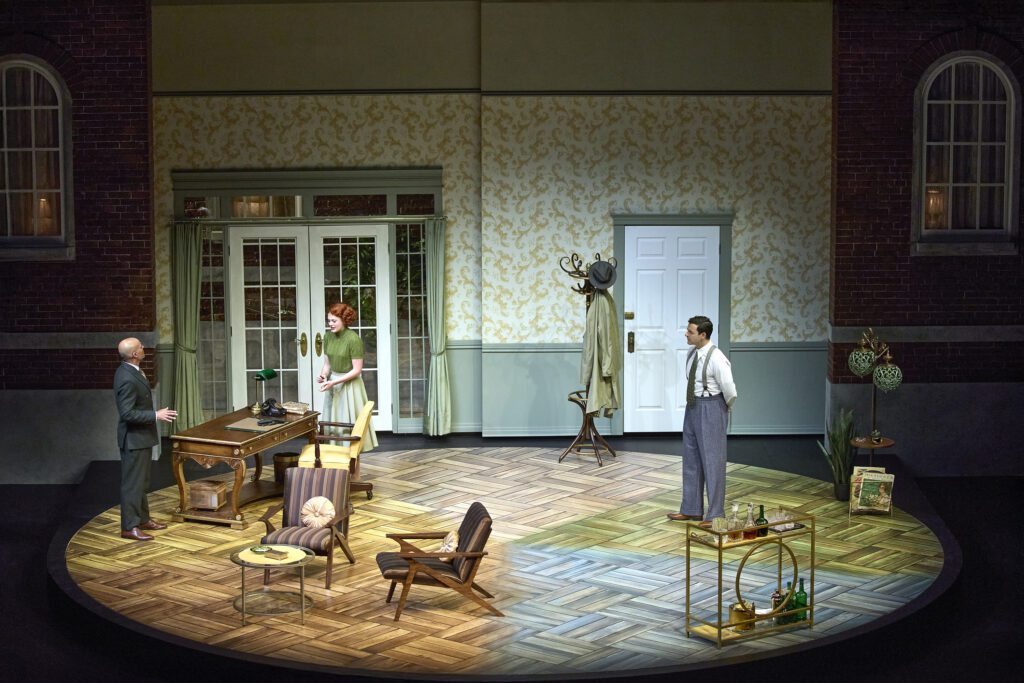
Keiley and costume designer Jolane Houle complement this rotating scenic design with a colour palette that evolves as time passes between the script’s five acts (here presented with one intermission). The hope is that if in one section, many of the actors are wearing brown, the audience will start subconsciously paying attention to narratively important mahogany props or set pieces.
“We’re just helping them see what they need to see and when,” said Keiley. “[Thanks to colour], things that were in the background suddenly go to the foreground. So if there’s a [green] lamp back here and it’s the green section, you never noticed the lamp before, but suddenly [it] becomes important.”
Keiley drew parts of these staging techniques from the Gestalt principles — laws of design and psychology that categorize how people recognize patterns and parse complex images. The turntable plays with the principle of “proximity,” while colour grouping is a facet of “similarity.”
She introduced Gestalt to the actors on the first day of rehearsals, and now a couple of the principles make themselves felt in the actors’ performances. “There’s one that is called ‘common fate,’” said Keiley. “[It’s] that everything is going in one direction, and then one person is going in the other direction. And that can be that everybody’s talking, talking, talking, and one person’s silent… [or that] everybody’s looking in one direction, and one person’s looking [the other] way.
“And there’s another one, which is ‘continuity’ — it’s really cool,” she continued, speaking of a concept unrelated to cinematic continuity editing. “One of the actors uses it a lot, and it’s really great. So they’ll be walking while they’re saying something, and then when they drop the clue, they’ll walk backward, [and then keep walking forward].”
Keiley emphasized that because Dial M is a thriller and not a murder mystery, the plot should be legible (though not obvious). One goal of the production is to make “the audience feel smart.” And calibrating this effect requires smarts on the part of the production team. For example, to keep the lighting of the set’s doors and windows consistent as the stage rotates, designer Itai Erdal must gradually dim certain lights and intensify others.
“Lighting-wise, there’s a lot of math, constant math,” Keiley said. “I have an assistant director, [Anna Cummer], who’s quite brilliant [and] really good at math, thank God. In the rehearsal room, I’m actually on a rolling chair, and she’s like, ‘come this way, go that way’ — she’s directing me where to be and when.
“It’s very hard to rehearse,” Keiley continued. “The actors are good as gold, and they’re very talented, but this is a leap of faith for them… Because for them, in the room, the proscenium is changing all the time: The proscenium is me.”
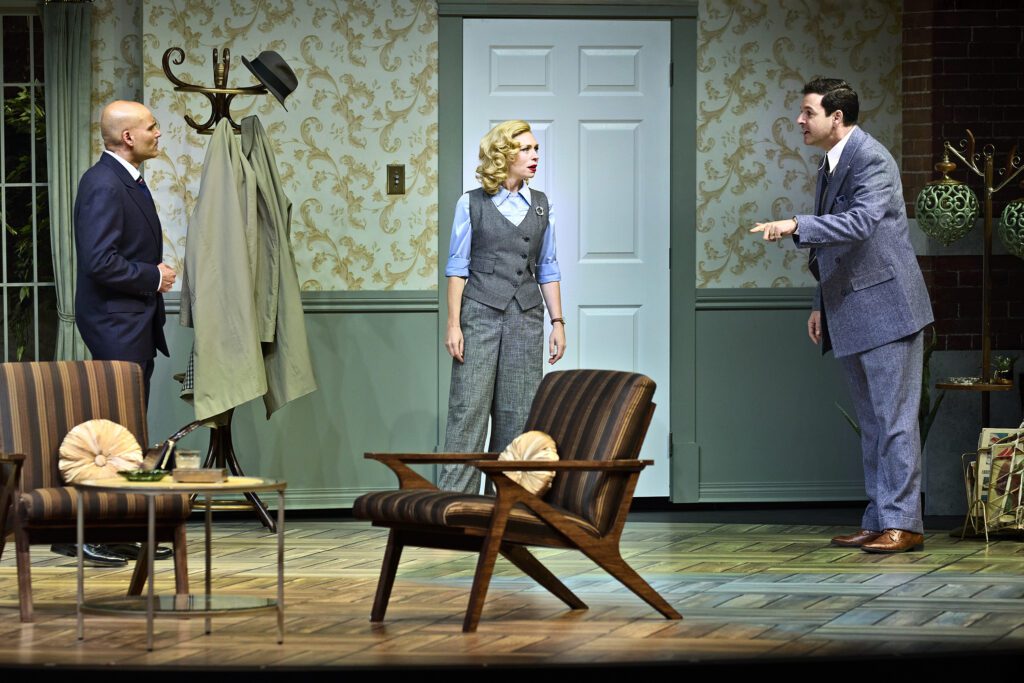
Considering the high level of difficulty, I found myself wondering: Why bother with a stage adaptation when Hitchcock already tells the story with such precision? Keiley’s response was that this sense of overcoming the impossible is a large part of what makes the project — and theatre in general — special.
“There’s a magic in theatre, and a spiritual part of theatre, that’s really important. It’s the gathering, but it’s also: ‘How did you make me believe that? How did you do that?’” she said. “That’s the mystery I play with in all my shows. And it’s a tightrope every time, especially when you’re doing something new like this… The math says it’ll work, but I actually don’t know. I have no idea… I’m thanking [Theatre Calgary artistic director] Stafford Arima, who brought me in to do the show, because you can get a lot of people to do a show like this, and just do the set [in the stage directions]. But he knew I’d do something different with it, and he was interested.
“I don’t ever read a script and think ‘OK, there’s a couch in the middle.’ I don’t see it that way. I can’t help it,” she continued. “I just want to shake it… like, to get the model, and shake the box. But it requires a ton of trust from my designers. And sometimes I fail. A lot, actually… When it works, it’s really exciting. But,” she repeated, “it’s a tightrope.”
Dial M for Murder runs until October 26 at Theatre Calgary. Tickets are available here.
Theatre Calgary is an Intermission partner. Learn more about Intermission’s partnership model here.
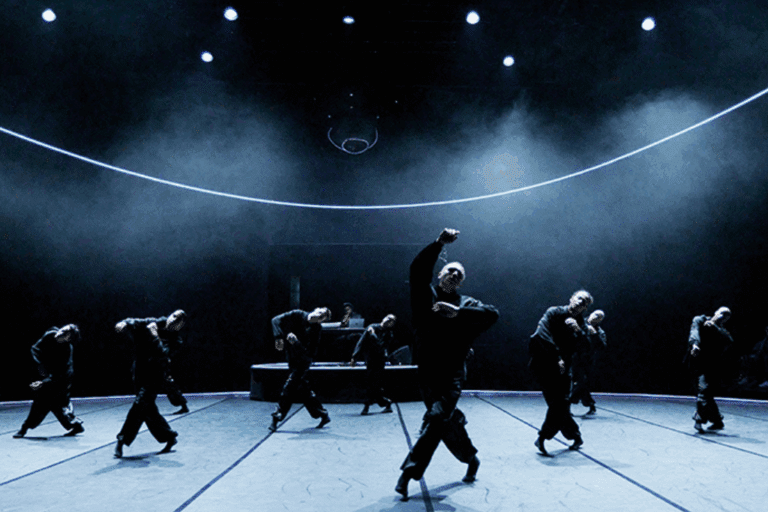 iPhoto caption: Photo by Fabian Hammerl.
In A a | a B : B E N D, choreographer Aszure Barton aims to rebuild dance from the inside out
“It’s so easy to over-intellectualize dance in general, but B E N D is about hearing and moving to cool-ass music together,” says Barton ahead of the show's run at the Bluma Appel Theatre.
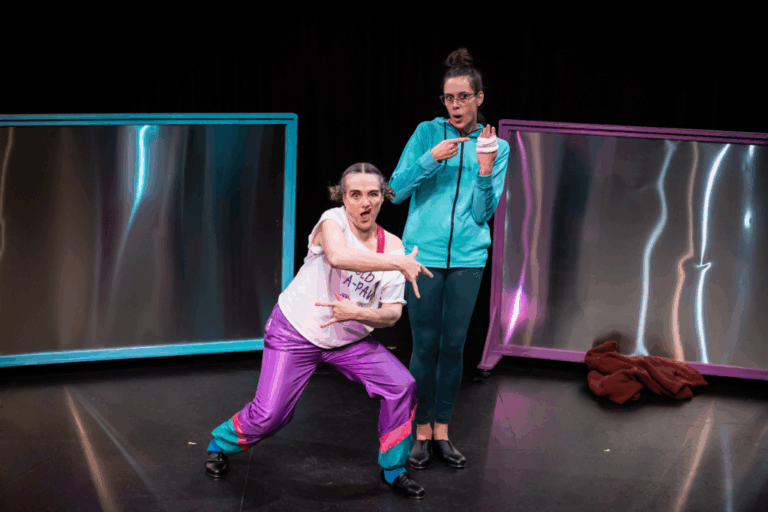 iPhoto caption: Elinor Holt and Ellen Close in 'How Patty and Joanne Won High Gold at the Grand Christmas Cup Winter Dance Competition.' Photo by Benjamin Laird.
“We’re living in a world right now where failure is not an option,” says actor Elinor Holt. “And a lot of times people would rather not try anything at all, rather than try something and risk failing at it.”
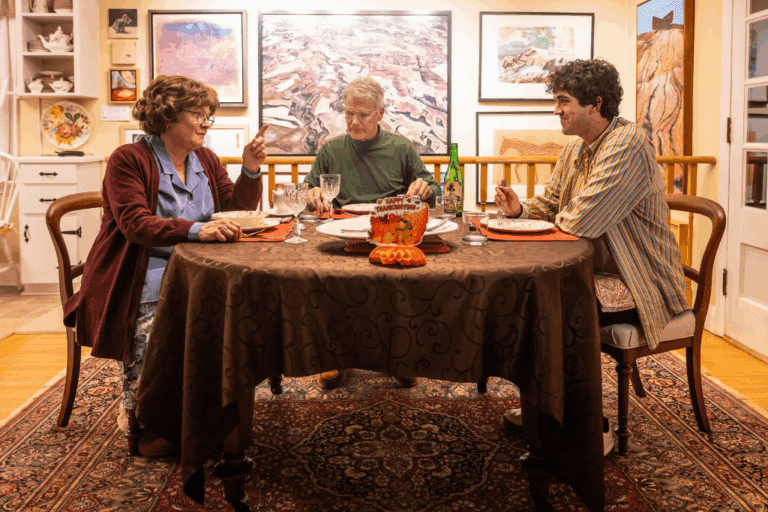 iPhoto caption: Jane Spidell as Bettye, Kevin Bundy as Jim, and Noah Beemer as Steve in 'Twelve Dinners.' Photo by Dahlia Katz.
With TIFT’s Twelve Dinners, actor Steve Ross makes the leap to playwright-director
"I love sitting with the actors before rehearsals and discussing, especially when they ask questions,” says Ross. “I love the blocking and staging. I love directing my own work, but find it challenging."
 iPhoto caption: Manus Halligan in Dan Colley's adaptation of 'A Very Old Man with Enormous Wings'. Photo by Ste Murray.
A contemporary Gabriel García Márquez adaptation touches down in Toronto
A Very Old Man with Enormous Wings has toured internationally since 2022, with a shifting cast of performers. Halligan and Beaman, the original actors and co-adaptors, will reprise their roles for the Toronto premiere.
 iPhoto caption: 'Narnia' in rehearsal. Photo by Dahlia Katz.
"What emerged for us was this idea of life cycles,” reflects Narnia adaptor-director Fiona Sauder. “‘What happens when you get stuck in one season [of life], and what happens when that season comes to an end? [What things] have to die and fall away in order for new things to grow?’”
 iPhoto caption: Jordan Pettle, Janelle Cooper, and Monique Mojica in CHILD-ish. Photo by Jae Yang.
Tarragon’s upcoming show gives audiences a verbatim taste of children’s wisdom, wit, and weirdness
The first inklings of CHILD-ish came to Drake in 2017. “I got to an age where I started having a lot more kids in my life,” he said. That “got me curious about what adults can learn from kids: playing with and flipping that power dynamic of who’s the learner and who’s the teacher.”
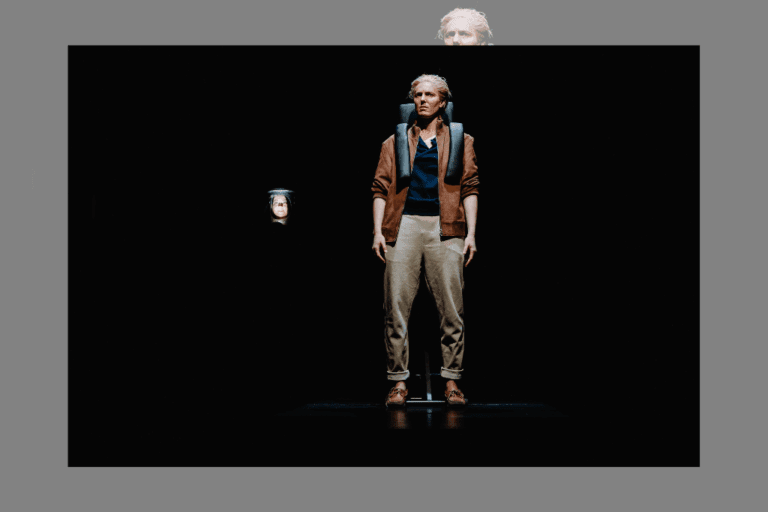 iPhoto caption: Lauren Gillis and Alaine Hutton in 'Public Consumption.' Photo by Eden Graham.
REVIEW: Lester Trips’ stylish Public Consumption captures the internet’s profound emptiness
Rather than directly representing online life, Public Consumption speculates — with virtuosity — about how the digital world affects our bodies. And the show's findings are by no means comfortable.
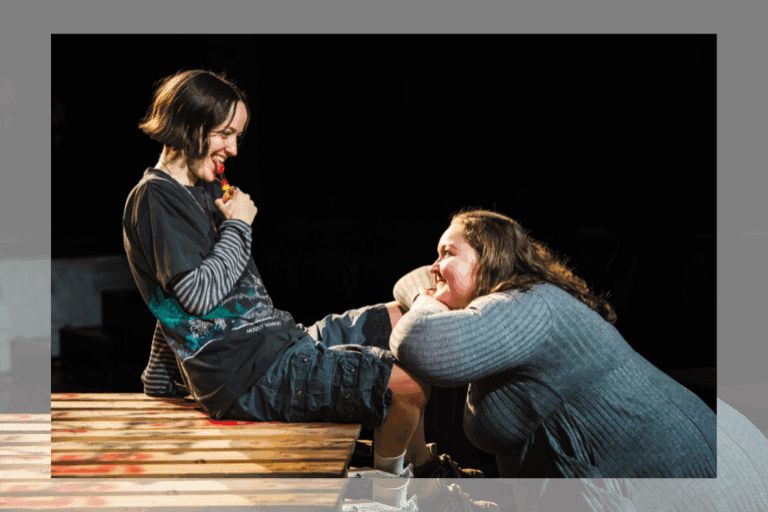 iPhoto caption: Photo by Elana Emer.
REVIEW: Icarus Theatre’s DNA paints a disturbing mural of teenage rebellion
While director Erik Richards’ tendency toward snappy, thriller-esque pacing doesn’t suit all of DNA’s more intimate moments, it adds electricity to the drama’s group scenes, bringing playwright Dennis Kelly’s reflections on groupthink and collective grief into clear view.
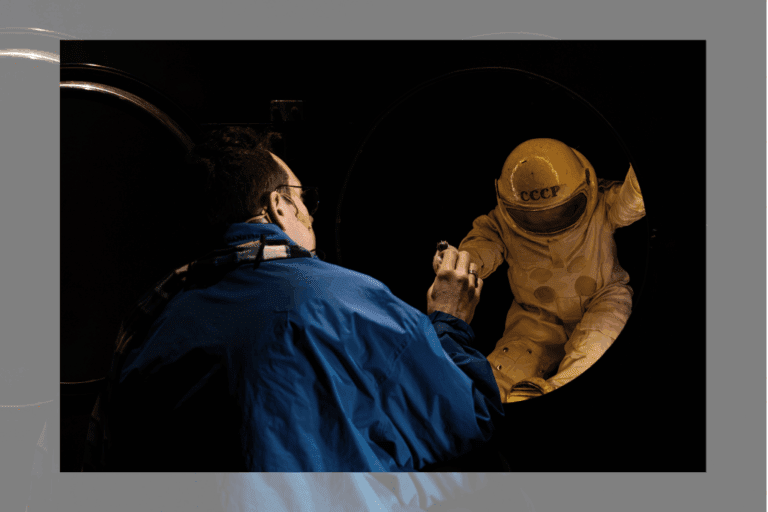 iPhoto caption: Olivier Normand in 'The Far Side of the Moon.' Photo by Li Wang.
REVIEW: Lepage’s ethereal The Far Side of the Moon is insomniac theatre
The Far Side of the Moon begins and ends with a large mirror on stage, and the show extracts enigmatic power from the tantalizing question of whether its protagonist is losing himself in his reflection, or moving toward self-discovery.
 iPhoto caption: 'Kokuho' still courtesy of TIFF.
REVIEW: During this year’s TIFF, two films depicted theatre as a vessel for transcendence
Of the several performing arts-adjacent selections I took in, most affecting were two dramas: Lee Sang-il’s Kokuho and Chloé Zhao’s Hamnet. In both period pieces, theatre creation serves as an emotional outlet for an artist navigating devastating loss.
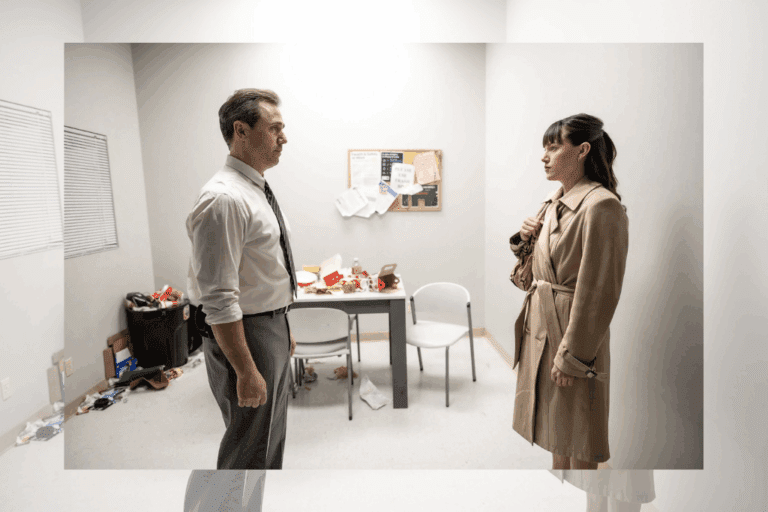 iPhoto caption: Cyrus Lane and Kirstyn Russelle in Barrie run of 'Blackbird.' Photo by Dahlia Katz.
REVIEW: Talk is Free Theatre’s Blackbird offers a close-up look at two detailed performances
Emerging director Dean Deffett has concocted a tight, straightforward production, primarily of interest as an intimate character study.
 iPhoto caption: Sleman Aldib and an audience member in 'The Opposite.' Still from a trailer by Spectrum Associates.
REVIEW: Kitchener’s biennial IMPACT Festival crackled with urgency
Most of the six works I viewed tackled urgent topics, from the convoluted Canadian immigration system to the Palestinian experience of displacement: explorations that line up with artistic director Pam Patel’s curatorial statement, which discusses how IMPACT ‘25 “unpacks what it means to survive, to resist, and to seek refuge” through a global, Indigenous-focused lens.
Comments