
In this Irish touring production of Beckett’s Endgame, nothing is funnier than unhappiness
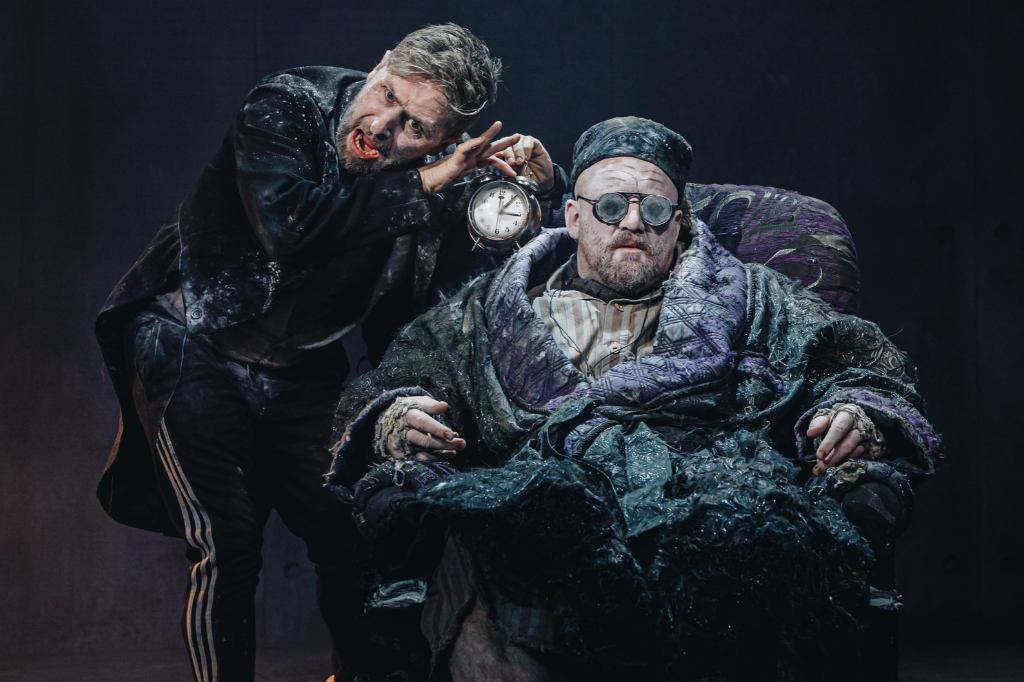 iPhoto caption: Aaron Monaghan and Rory Nolan in Druid Theatre's 'Endgame.' Photo by Green Yang.
Lately there’s been no shortage of fear about the end times. Everywhere, the end is near. We hear. The end of what remains unclear. But for one theatre it’s the beginning times — and they’re beginning their time with a play about the end, at the end. After all is done, one must go somewhere. Why not here?
This is my best impression of Irish absurdist playwright Samuel Beckett being given the task of opening this feature about one of his personal favourite plays (or, rather, the one he disliked the least), Endgame, which is one of the first major productions at Toronto’s new Irish arts centre, the Corleck.
After 30 years in the making — including a $20-million revamp of the 9,600-square-foot former Canada Malting Company building — the Corleck has been settling in with events including the Bealtaine Theatre Festival earlier this spring. Situated in Ireland Park, which commemorates Canada’s Irish refugees, the Corleck’s future programming will devote one-third of the year to Irish programming, while the rest will welcome all cultures.The Canada Ireland Foundation invited Tony Award-winning director Garry Hynes and her Galway-based theatre company Druid to officially inaugurate the stage.
Starting with Beckett, a pinnacle of Irish theatre, is a firm indication of its roots and the questions we might see it tackle in coming years. Beckett’s unsparing vision of human existence has always tended to resonate in times of political upheaval, but in recent years — as reality has begun to lack all durability — his works’ ability to create worlds so bleak that they’re forced to find humour in the futile rituals of survival feels more relevant to the current moment than ever.
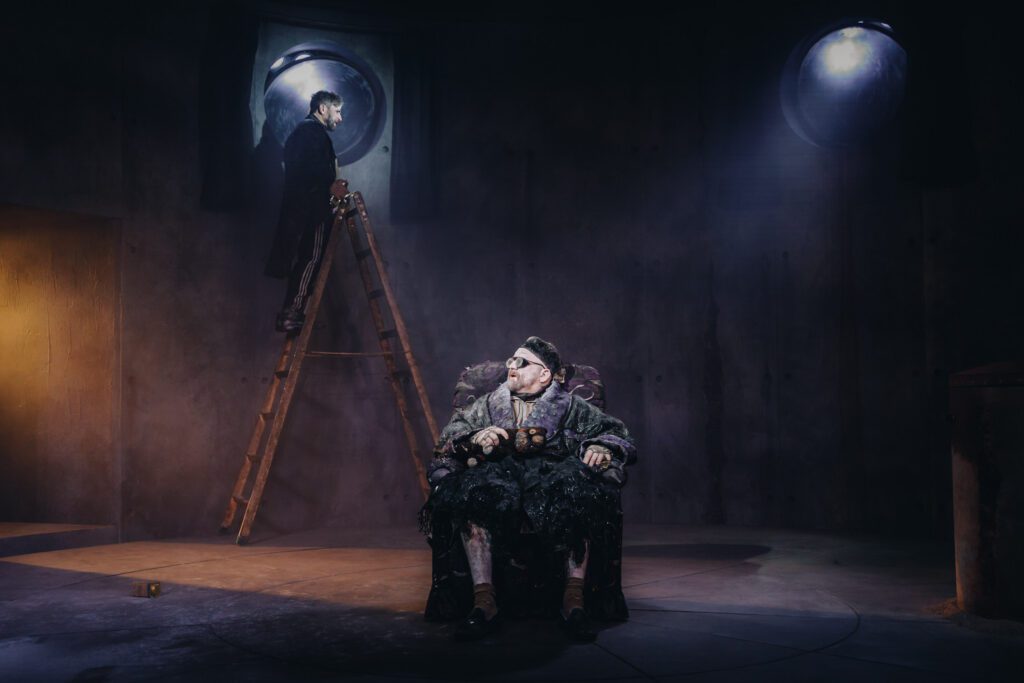
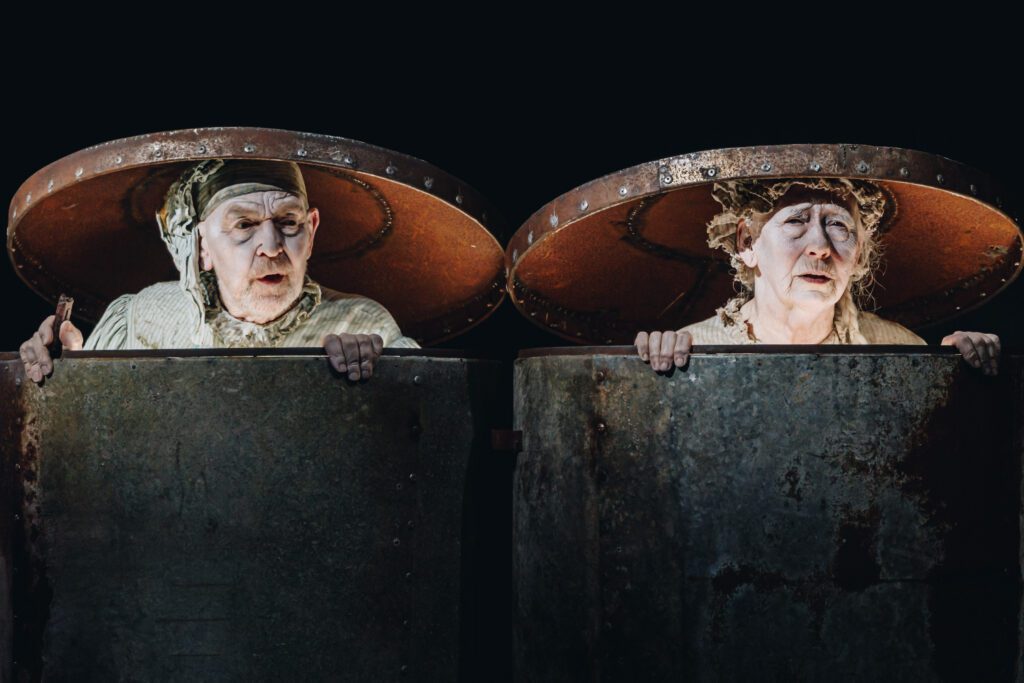
Druid opens Endgame, a tragicomic one-act play and thematic cousin to Waiting for Godot, in what might be a brutalist, post-apocalyptic bunker replete with towering grey walls and high, opaque windows. It’s inspired by the last dismal moves of a chess game, and the movements of the characters are loosely mapped onto the game pieces. We meet Hamm (Rory Nolan), a blind tyrant with limited mobility like the king piece, and Clov (Aaron Monaghan), Hamm’s despondent servant who moves erratically like the knight piece and begrudgingly sees to Hamm’s every whiny demand. Soon, Hamm’s parents Nagg (Bosco Hogan) and Nell (Marie Mullen), two de-facto pawns, appear at the back of the stage inside cylindrical trash cans — lids on their heads, Oscar the Grouch style.
From there, it doesn’t spoil anything to say that over 90 minutes the characters undertake the exhausting business of waiting for an end that won’t arrive, filling the time they have left with petty cruelty, repetitive arguments, and lyrical riddles. We wonder if Clov will leave as he threatens and seems free to, and whether Nagg and Nell will find some final consolation in the memories they share as their physical forms age and literally turn to garbage.
Depending on the direction, Endgame can veer more toward desolation or humour, but Hynes seems to actively push it in neither direction, instead allowing the audience to inform the tone. “Theatre is about the response of the audience in the present moment. So unfortunately [how it’s read by viewers are] calculations I can’t and don’t make,” she told me over email correspondence. That said, reviewers of the show’s debut in Ireland and its subsequent visit to New York have agreed that Hynes treats the text less as austere philosophy and more of an opportunity for its actors to find recognizable human depth — in quotidian frustration, pleas for affection, and resentment — beneath its comic absurdism.
Over the years set styles for Endgame have also veered in many different directions. For example, in the Old Vic’s production in 2020 — which ironically ended early with the onset of COVID-19 lockdowns — was set in shockingly bright domestic daylight and colourful clothes with Nagg and Nell in modern wheelie bins. Druid’s rendition is under the vision of set designer Francis O’Connor and lighting designer James F. Ingalls, who have created a desaturated, stony dystopia for the characters and the room, which is somehow both lofty and claustrophobic. A halo of light beams down from the ceiling promise transcendence, if only the characters could get there. But they can’t, or will not, and it acts as a sky hook that never grabs.
Hope is certainly a question to ponder in Endgame. How much hope can a play obsessed with stuckness and stasis really offer? Asking this of Hynes, she replied only with a quote from Beckett’s novel The Unnameable: “I can’t go on. I’ll go on.” Instantly it reminded me of a pedantic schoolteacher who, when a student asks, “Can I go to the bathroom?” replies, “I don’t know, can you?” But like Beckett does so well, Hynes suggests that language and grammar allow for paradoxes that don’t cancel each other out, but rather describe the cyclical human experience of feeling two opposite ways at one time — of holding hope and defeat in the same breath.
“Beckett will continue [to] resonate as long as the human condition continues,” Hynes said.
Ultimately Endgame suggests that “the end” isn’t one final moment of closure but an unending loop. For Beckett, perhaps asking if this is the end is the end, while at the same time the action that keeps it from ending. In an age of perpetual crisis, there’s something powerfully sad but hilarious about this human choice to trudge on, and trudge on miserably — what else would we do? Stop?
Endgame runs at the Corleck until November 28. The run is sold out, but you can join the waitlist here.
Canada Ireland Foundation is an Intermission partner. Learn more about Intermission’s partnership model here.

Lindsey King
Lindsey King is a Toronto-based freelance writer and editor with bylines in Toronto Life, Maclean's, Canadian Business, Intermission, and The Creative Independent.
LEARN MORE iPhoto caption: Tessa Virtue performs at Fall for Dance North. Photo by Bruce Zinger.
REVIEW: At Fall for Dance North’s festival opening, it all came back to Tessa Virtue
This year’s Fall for Dance North opening programme gave audiences a multi-course feast that’s delish all the way through. Well, almost.
 iPhoto caption: From left: Vivien Endicott-Douglas as Han, Rylan Wilkie as George Abbot (top left), Sara Topham as Cath (top right), Angel Lo as Anna and Liz Der as Roni in 'The King James Bible Play.' Stratford Festival 2026. Photo by David Hou.
REVIEW: The King James Bible Play both finds and fumbles profundity in translation
Corbeil-Coleman’s best-known plays, such as Guarded Girls and Scratch, centre contemporary young women circling grief, inheritance, and intergenerational trauma. It might seem like a surprise, then, that The King James Bible Play opens with five men centuries ago — but it turns out that the intergenerational trauma in this case stretches back about 417 years.
 iPhoto caption: Members of the company of 'Play Dead.' Photo by Alexander Galliez.
Play Dead trades death-defying circus tricks for bigger emotional risks
“The idea of consequences in [Play Dead] can make someone think the show is a little dreary, but we think of it more as a surreal celebration of all the little things that make up life,” says performer and People Watching co-artistic director Jérémi Lévesque.
 iPhoto caption: Melissa James and Patrick Heusinger in 'Paranormal Activity.' Photo by Johan Persson.
REVIEW: Mirvish’s Paranormal Activity summons real screams — but crashes into a cheap shock ending
It’s a spooky, cleverly staged hoot, but audiences might be distracted by one glaring narrative spectre that could use an exorcism.
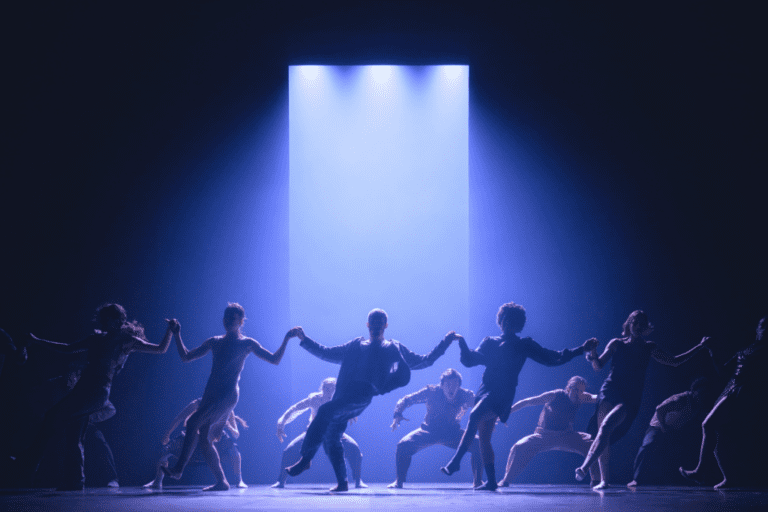 iPhoto caption: Members of the company of 'Theatre of Dreams.' Photo by Tom Visser.
It’s tough to tie Shechter’s style to any one dance lineage, but modern floorwork; commonplace gestures rendered sharp and frenzied; and loose, hip-circling movements often reserved for low-lit clubs evoke the woozy surreality of half-revealed consciousness.
 iPhoto caption: Amy Keating, Zorana Sadiq, Katherine Cullen, and Jean Yoon in 'Dance Nation.' Photo by Elana Emer.
REVIEW: Coal Mine Theatre’s Dance Nation vaults into the feral, ecstatic mess of girlhood
Played by a cast whose ages range widely, the characters exist in two tenses at once: present-day adolescence and retrospective memory, living these tender years shadowed by the adults they’ll become.
Comments