
For the creators of Why Not Theatre’s Mahabharata, nothing is more contemporary than an ancient epic
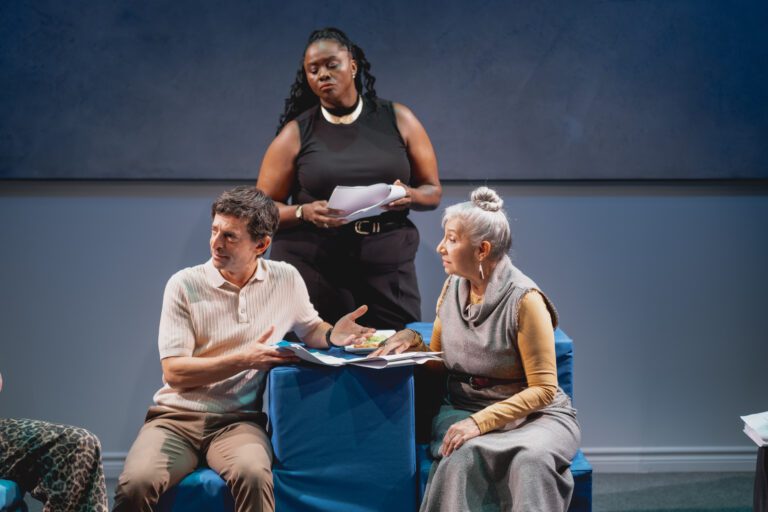
 iPhoto caption: Miriam Fernandes as the Storyteller, with Anaka Maharaj-Sandhu as Arjuna and Neil D'Souza as Krishna in Why Not Theatre’s Mahabharata (Shaw Festival, 2023). Photo by David Cooper. Set design by Lorenzo Savoini, costume design by Gillian Gallow, lighting design by Kevin Lamotte, projection design by Hana S. Kim.
It took a creative team of almost 60 people to bring Why Not Theatre’s two-part, five-and-a-half-hour adaptation of the Mahabharata to life, but there’s one co-conspirator you won’t find listed in the program: time.
“I’ve been [telling] the company to embrace time as a collaborator,” said the production’s director Ravi Jain in an interview. Jain co-leads Why Not Theatre with Miriam Fernandes; together, the pair adapted Mahabharata for the stage. Written in Sanskrit and almost 4000 years old, the titular source material is the longest major epic poem ever penned and foundational to many South Asian cultures.
Since its premiere at the Shaw Festival in 2023, Why Not’s adaptation has toured to the Barbican in England and the Perth Festival in Australia. This April, Canadian Stage will present Mahabharata at Toronto’s Bluma Appel Theatre. Depending on the day, audiences can choose to experience each part on its own, or as one long experience, with a separately ticketed community meal in between. Hosted by two storytellers, the meal is a chance to savour some authentic Indian food — along with the themes and meanings of the main event’s ancient story.
It’s that very antiquity that poses an almost philosophical challenge to the show’s performers. “There’s the time that we’re in now, and there’s the ancient time of the story that’s actually tied to [something] more cosmological,” said Jain. For the company, there’s an “imagination that’s required to hold that space, [and] a humility.”

Since its compilation, the Mahabharata has been reinterpreted in countless forms, including English director Peter Brook’s nine-hour 1985 staging, as well as an iconic comic book series by publisher Amar Chitra Katha. It took eight years for Why Not’s adaptation to assume its current shape.
Fernandes joined the project in 2018, when she became co-leader of Why Not. Beyond co-writing the adaptation, Fernandes is also the show’s associate director and appears onstage in the role of the Storyteller, who guides the audience through Mahabharata’s concentric narratives.
“I’ve never had this experience as a performer… where it really feels like the experience of meeting the audience and telling the story keeps changing,” Fernandes reflected in the same interview. She noted how evolving global events have made different aspects of the show’s story sing — and sear.
Mahabharata “centralizes around a family,” she explained. “Two groups of cousins are warring over the throne to this kingdom, and who’s the rightful king, and who should own this land. They eventually end up going to war — a massive [conflict] that kills a billion people.”
During the 2023 Barbican run, “the day that we closed the show was October 7, which is when the whole world in the Middle East exploded again,” Fernandes said. “The show is really about cycles of revenge and genocide. We human beings keep getting into these cycles of hate and revenge and greed and ambition. We somehow never learn the lessons from this ancient wisdom.”
Jain agreed. “There’s a whole thread in the storytelling around the planet and ecocide,” he said. During the tour to Perth, “that was [an element] that the Australians really picked up on, because [of] their relationship to forest fires.” He also acknowledged the perspectives of “the South Asian community that’s seeing the story. There have been so many layers that [it’s] been really exciting to see unfold.”
Contributing additional layers are the international cast of performers — a total of 17 actors (including understudies) and six band members — hailing from across the South Asian diaspora. Jain described how each artist has brought their own unique skill set to the piece.
“We have Kathakali dancing and Odissi dancing in the show because there are performers with those particular trainings,” he said. “We have North and South Indian classical music because of the band composition. Most people were born somewhere [other than India but] have a relationship to [the country], like Miriam and [me]… There are some who know [the original Mahabharata] very well, but the majority didn’t until now. So that came with a lot of curiosity, a lot of responsibility, and a lot of fear that we all had to pass through, in order to find an authentic way for us to tell it.”
Why Not’s innovative telling juxtaposes the ancient art forms mentioned above with other forms both old and new — from Baroque opera to live video feeds.
The piece “starts away from you, and over time, it becomes very personal and very recognizable,” Jain said. “To go from more ancient forms to film acting and live camera feeds is a way of connecting the audience to that same journey: from being distanced to [realizing the story] is actually closer to you than you think.”
For Fernandes, “the forms of the story also help us deal with the problem of time.” She described how Mahabharata begins like “street theatre, people jumping in and out of a circle.” This simplicity of form means that “for the first half hour of the show, we [can] go back and forth in history a lot. Then… we start to sink in and meet characters and live with them for a while… Scenes start to emerge, technology starts to emerge, props start to emerge to help us land in this scene.”

The problem of time is also central to how Jain and Fernandes think about Why Not’s international artistic mission.
“Always, we’re in some kind of intercultural, international conversation,” said Jain. “We’re playing with cultures, playing with languages, playing with forms of storytelling. Our differences are the things we have in common.” In prioritizing touring, he continued, the company is “sending these messages in a bottle so that people find them years from now, in order to speak to people that don’t yet exist, in a time that doesn’t exist.”
That’s the future — but Jain made a point of savouring the company’s present success. Mahabharata “is a really rare project in Canadian theatre… in terms of its collaborations, in terms of its size and scale, [and] in terms of the people making it,” he said.
“It’s a big moment, and we’re really proud of that.”
Part One of Mahabharata opens at the Bluma Appel Theatre on April 8, and runs until April 26. Part Two opens April 11 and runs until April 27. Tickets are available here.

Nathaniel Hanula-James
Nathaniel Hanula-James is a multidisciplinary theatre artist who has worked across Canada as a dramaturg, playwright, performer, and administrator.
LEARN MORE iPhoto caption: Photo by Fabian Hammerl.
In A a | a B : B E N D, choreographer Aszure Barton aims to rebuild dance from the inside out
“It’s so easy to over-intellectualize dance in general, but B E N D is about hearing and moving to cool-ass music together,” says Barton ahead of the show's run at the Bluma Appel Theatre.
 iPhoto caption: Elinor Holt and Ellen Close in 'How Patty and Joanne Won High Gold at the Grand Christmas Cup Winter Dance Competition.' Photo by Benjamin Laird.
“We’re living in a world right now where failure is not an option,” says actor Elinor Holt. “And a lot of times people would rather not try anything at all, rather than try something and risk failing at it.”
 iPhoto caption: Jane Spidell as Bettye, Kevin Bundy as Jim, and Noah Beemer as Steve in 'Twelve Dinners.' Photo by Dahlia Katz.
With TIFT’s Twelve Dinners, actor Steve Ross makes the leap to playwright-director
"I love sitting with the actors before rehearsals and discussing, especially when they ask questions,” says Ross. “I love the blocking and staging. I love directing my own work, but find it challenging."
 iPhoto caption: Manus Halligan in Dan Colley's adaptation of 'A Very Old Man with Enormous Wings'. Photo by Ste Murray.
A contemporary Gabriel García Márquez adaptation touches down in Toronto
A Very Old Man with Enormous Wings has toured internationally since 2022, with a shifting cast of performers. Halligan and Beaman, the original actors and co-adaptors, will reprise their roles for the Toronto premiere.
 iPhoto caption: 'Narnia' in rehearsal. Photo by Dahlia Katz.
"What emerged for us was this idea of life cycles,” reflects Narnia adaptor-director Fiona Sauder. “‘What happens when you get stuck in one season [of life], and what happens when that season comes to an end? [What things] have to die and fall away in order for new things to grow?’”
 iPhoto caption: Jordan Pettle, Janelle Cooper, and Monique Mojica in CHILD-ish. Photo by Jae Yang.
Tarragon’s upcoming show gives audiences a verbatim taste of children’s wisdom, wit, and weirdness
The first inklings of CHILD-ish came to Drake in 2017. “I got to an age where I started having a lot more kids in my life,” he said. That “got me curious about what adults can learn from kids: playing with and flipping that power dynamic of who’s the learner and who’s the teacher.”
iPhoto caption: Manus Halligan in Dan Colley's adaptation of 'A Very Old Man with Enormous Wings'. Photo by Ste Murray.
A contemporary Gabriel García Márquez adaptation touches down in Toronto
A Very Old Man with Enormous Wings has toured internationally since 2022, with a shifting cast of performers. Halligan and Beaman, the original actors and co-adaptors, will reprise their roles for the Toronto premiere.
iPhoto caption: 'Narnia' in rehearsal. Photo by Dahlia Katz.
"What emerged for us was this idea of life cycles,” reflects Narnia adaptor-director Fiona Sauder. “‘What happens when you get stuck in one season [of life], and what happens when that season comes to an end? [What things] have to die and fall away in order for new things to grow?’”
 iPhoto caption: Headshot of Njo Kong Kie. Photo by Tam Chi Chun.
For composer Njo Kong Kie 楊光奇, the word ‘artist’ is a complicated label
At the ping pong table, eating pastries that Njo had thoughtfully laid out, I listened as this artist reflected on the back and forth of a career that’s bounced between multiple genres and disciplines.
iPhoto caption: Jordan Pettle, Janelle Cooper, and Monique Mojica in CHILD-ish. Photo by Jae Yang.
Tarragon’s upcoming show gives audiences a verbatim taste of children’s wisdom, wit, and weirdness
The first inklings of CHILD-ish came to Drake in 2017. “I got to an age where I started having a lot more kids in my life,” he said. That “got me curious about what adults can learn from kids: playing with and flipping that power dynamic of who’s the learner and who’s the teacher.”

How three arts professionals navigate the daunting world of fundraising and development
With these questions in mind, I invited a trio of experts to share advice, geared toward anyone just starting to navigate the world of grants, foundations, and donors. Anne Rawn, Cherise Solomon, and Josh Marchesini each bring a different perspective to fundraising and development.
 iPhoto caption: Photo courtesy of Playwrights Canada Press.
In CoyWolf, playwright Colin Wolf ponders the meaning of resistance
“There’s a venn diagram [in which] wolf displacement across Canada matches Indigenous displacement,” he explains ahead of the play's publication with Playwrights Canada Press. “If you look at a map over the years of wolf territory, it's very similar to Indigenous territory in the way that it's been pushed over and up.”
Comments