
At Soulpepper, Bad Hats’ Narnia completes a trilogy of musicals championing a child’s-eye view of life
 iPhoto caption: 'Narnia' in rehearsal. Photo by Dahlia Katz.
The holiday season may be a time to celebrate family, but it’s up to us to decide what kind. For some, “family” might mean blood relations. For others, it might refer to bonds forged in the classroom, the rehearsal hall — or even on the other side of a wardrobe.
Narnia, a musical adaptation of C.S. Lewis’s classic book series, pays attention to that last sort of family. Created by Bad Hats Theatre, it’s adapted, directed, and choreographed by the company’s artistic director Fiona Sauder, with music and lyrics by associate artist Landon Doak. Originally commissioned by Winnipeg’s Manitoba Theatre for Young People, Narnia first debuted in 2023. The Toronto premiere, a co-production with Soulpepper and Crow’s Theatre, runs through the holiday season at the Young Centre for the Performing Arts, alongside other Distillery District events like the Winter Village.
Although the musical incorporates elements from multiple books in the Chronicles of Narnia, it draws most of its narrative from The Lion, The Witch, and the Wardrobe. In Lewis’ novel, set in England during the Second World War, the Pevensie siblings flee their London home to live in the country house of a kindly professor. There, they crawl through the titular enchanted wardrobe into the fantastical land of Narnia, at present trapped under the icy spell of Jadis, the White Witch.
During a Zoom interview, Sauder, Doak, and Bad Hats’ artistic and managing producer Matt Pilipiak unpacked the artistic choices they made while reimagining this classic story for contemporary audience members of all ages. Unlike the Pevensies in Lewis’ novel, the children who arrive at the professor’s home are not siblings. Rather, each one is an orphan who bears their own experience of loss. The decision refocuses Narnia’s narrative to emphasize different kinds of bonds and community-building, beyond those based on DNA.
The three interviewees’ own identities informed this shift. “We’re all queer artists,” said Pilipiak, who’s also Narnia’s associate director and dramaturg. “One of the pillars of the queer community is found family. So many queer people don’t get to, or choose not to, stay with their families for a plethora of reasons. [The musical] really speaks to the idea of what it means to choose and find a new family: [One] which has all of the same dynamic struggles, ups and downs, fights, reconciliations, sacrifices, loyalty, love, and forgiveness” as a biological one.
“I’m somebody who believes that all families are found or chosen,” added Doak, who hopes the show will remind queer audience members that “you are worthy of family, [even if they are] not the people who brought you into this world.”

Pilipiak acknowledged that this message will be especially relevant during the holidays, which can be “a beautiful and complicated time for families” of any kind.
Narnia is the final instalment in a trilogy of three musicals by Bad Hats, each reimagining a classic tale. The first, Peter Pan, was originally produced in 2016 at Old Flame Brewery — owned by Doaks’ family — in Port Perry, before Bad Hats’ official founding as a company; it then ran at Soulpepper in 2017. The second, Alice in Wonderland, had its live premiere at Soulpepper in 2022, and completed a summer tour across Ontario earlier this year. “It wasn’t our intention when we began that there would be three [musicals] that would relate so directly to one another,” said Sauder. “But as we built them, [a] throughline started to emerge.”
Sauder explained that each musical examines childhood from a different perspective. Peter Pan centres the realization that “we all have to grow up, and how we grapple with that,” while Alice is “about the next stage of life in which you’re peeking into adolescence, and the [world’s] infinite rules and structures… that you either do or don’t fit.”
In adapting Narnia, “what emerged for us was this idea of life cycles,” Sauder reflected. “‘What happens when you get stuck in one season [of life], and what happens when that season comes to an end? [What things] have to die and fall away in order for new things to grow?’”
For Sauder, the core of this family-friendly production is the proposition that “the things you knew when you were a kid will get you through” even the most grown-up chapters of life.
Bad Hats’ musicals wrap these wide-reaching themes in the company’s trademark aesthetic, which includes bare-bones theatrical magic, high-octane physicality, and a barnstorming ensemble of actor-musicians. “It satisfies me to watch things that are virtuosic,” said Sauder. “As a director, I love working with actors who have multi-faceted skill sets and who can bring all of that to the table.” If there’s a kernel of found family in Narnia’s ensemble, they added, it’s that “any show which asks so much of the actors becomes like a team sport.”
Readers who haven’t had a chance to see Peter Pan or Alice can experience this spirit of collaboration through the shows’ cast recordings, which are both available to stream. Narnia’s will be recorded later this month.
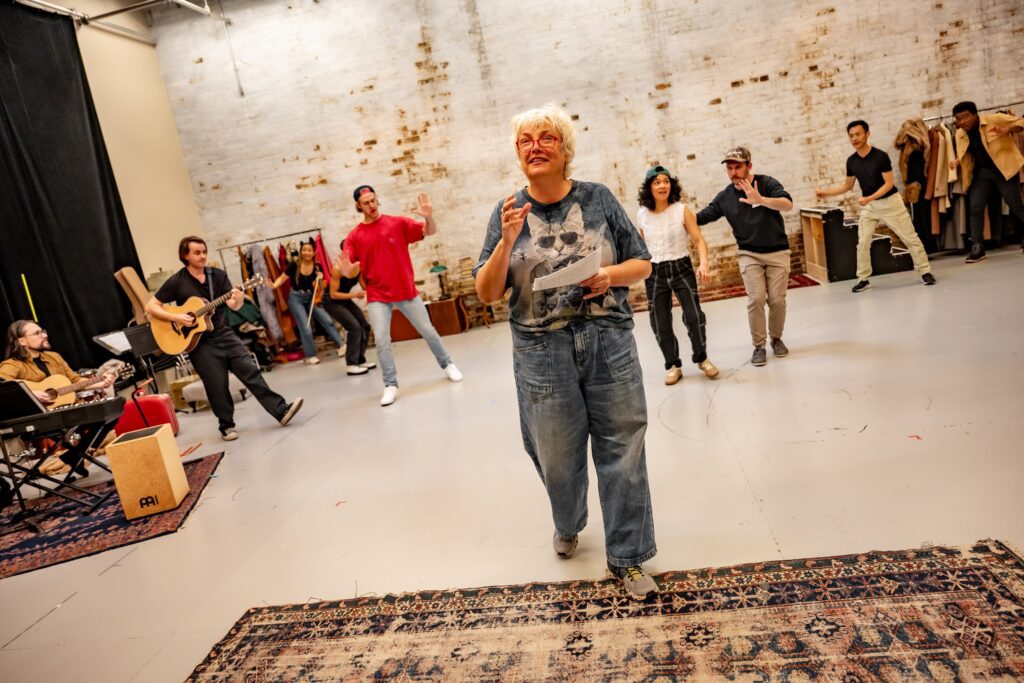
It’s possible to see Doak, Sauder, and Pilipiak as a family of sorts: one forged by ambitious projects, late-night rehearsals, and collective meal prep. The artists first met at George Brown Theatre School. “[Landon] asked if I wanted to write an adaptation of Peter Pan to do at [their family’s] brewery one holiday season,” said Sauder.
The pair assembled a cast of other George Brown artists, including Pilipiak. During rehearsals, the team “pretty much lived in my parents’ basement” in Port Perry, said Doak. The artists slept on air mattresses, cooked for each other, and rehearsed at the brewery after-hours from 11 p.m. to 2 a.m. “It felt, I imagine, like what a 1970s arts commune felt like,” Doak said. “I don’t know that I would enjoy living that way so much now! But in our early 20s, we were living our best lives, you know?”
Almost 10 years later, Sauder joked that the team is “returning to the proverbial Doak family basement of creativity all the time.”
Sauder also reflected on the found family of teachers and artists who offered guidance and care through Bad Hats’ earliest years. Narnia’s take on Lewis’ professor, played by Astrid Van Wieren in this production, is a tribute to real life mentors in families of every kind. “The play, for me, is a love letter to those people who taught me [and who] gave me permission to be exactly who I am,” Sauder said.
Penning a holiday tale for all ages and every kind of family has been a way “to use the powers they gave us for good,” they continued.
“[Narnia] feels like an act of honouring all of the seeds that these people planted for us.”
Narnia runs at Soulpepper Theatre until December 28. Tickets are available here.
Soulpepper Theatre is an Intermission partner. Learn more about Intermission’s partnership model here.
Nathaniel Hanula-James
Nathaniel Hanula-James is a multidisciplinary theatre artist who has worked across Canada as a dramaturg, playwright, performer, and administrator.
LEARN MORE iPhoto caption: Brendan Healy in rehearsal for 'A Doll's House.' Photo by Dahlia Katz.
Canadian Stage’s A Doll’s House marks the second entry in a trilogy of productions about marriage
“At 50, thinking about marriage and love, and [their] place in my life, I wanted to do an artistic deep-dive into the idea of partnership,” says director Brendan Healy.

Rhubarb! Festival director Ludmylla Reis wants artists to embrace ‘the detour’
"We do something formative at some point in the arts, and then we just continue doing that in different fonts until we’re no longer on this earth," says Reis. "The important thing is to know what that is, because you don’t want to be controlled by it. You want to be in control."
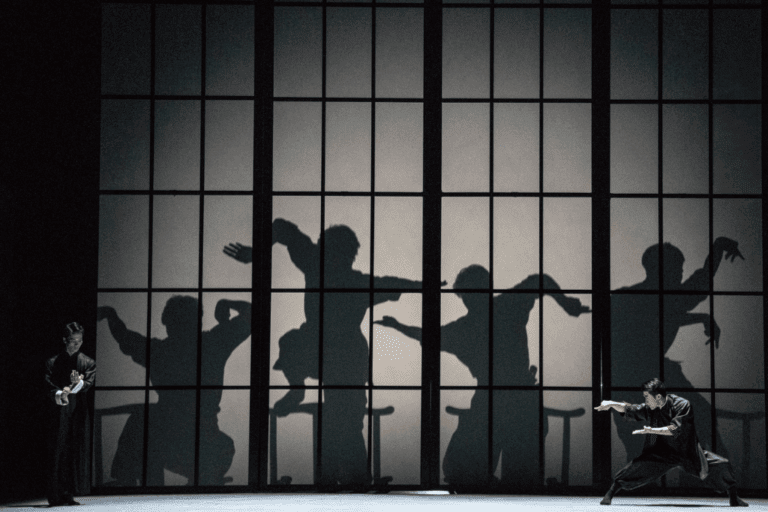 iPhoto caption: Wing Chun Dance Drama, courtesy of Shenzhen Opera and Dance Theatre.
Wing Chun Dance Drama is a martial arts movie come to life
“In China — especially in the history of Chinese cinema — Ip Man is a household name,” said Han, in translated written responses to questions over email. Ip had a lasting influence on wing chun, a style of kung fu that originated in southern China over 300 years ago. In his 60s, he trained Bruce Lee, who would go on to become a famous performer in Hong Kong and American martial arts films.
 iPhoto caption: Michael Rubinoff and Mary Francis Moore. Photo by Dahlia Katz.
Theatre Aquarius’ National Summit for New Musicals showcases original works from across Canada
“I want us, as a community, to be confident in our own work,” says Theatre Aquarius artistic director Mary Francis Moore. “I want us to get to a place where we don’t need the validation of outside communities to tell us that we’re good. I want us to be in a place where we have the resources to take chances, so our projects don’t have to leave the country to find success.”
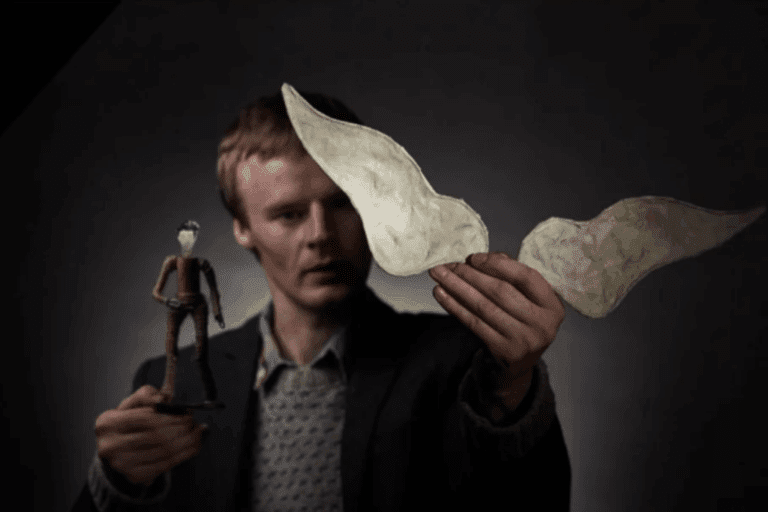 iPhoto caption: Manus Halligan in Dan Colley's adaptation of 'A Very Old Man with Enormous Wings'. Photo by Ste Murray.
A contemporary Gabriel García Márquez adaptation touches down in Toronto
A Very Old Man with Enormous Wings has toured internationally since 2022, with a shifting cast of performers. Halligan and Beaman, the original actors and co-adaptors, will reprise their roles for the Toronto premiere.
 iPhoto caption: Headshot of Njo Kong Kie. Photo by Tam Chi Chun.
For composer Njo Kong Kie 楊光奇, the word ‘artist’ is a complicated label
At the ping pong table, eating pastries that Njo had thoughtfully laid out, I listened as this artist reflected on the back and forth of a career that’s bounced between multiple genres and disciplines.
Comments