
REVIEW: Stratford Festival’s Death of a Salesman is stark and melancholy
 iPhoto caption: Raymond Strachan and Tom McCamus in 'Death of a Salesman.' Photo by David Hou.
The Stratford Festival’s 2026 production of Arthur Miller’s Death of a Salesman arrives not with a gentle flute, but a jazz trumpet.
Played by a figure (Michael Louis Johnson) who provides pre-show commentary and warns us to turn off our anachronistic cell phones, the trumpet delivers a brash rendition of Irving Berlin’s “Blue Skies.” It’s a motif that will recur often over the course of three hours, providing an aural reminder of the bustling cityscape that has sprung up to dwarf the Loman household, the urbanization and anonymization that become too much for its patriarch, travelling salesman Willy (Tom McCamus), to handle.
It replaces the famous flute refrain called for in the stage directions that represents Willy’s idealized past and the instruments his father used to make, as though even Miller’s stage fantasy itself is ironically being forced to make way for something more urgent and modern.
While Salesman purists may sniff at flouting the flute, there’s a lot to admire in director Dean Gabourie’s stark, melancholy version with a hint of brass. The relatively straightforward production is aesthetically austere, but strong central performances of the family at its core keep it heartbreakingly human.
Framing the stage of the Avon Theatre on three sides, Scott Penner’s set of large, encroaching buildings resembles a panopticon jail observing the household; one out-of-reach window displays a trophy to symbolize the family’s deferred dreams. Louise Guinand’s lighting is moody and dim, its darkness and gloom deliberately contrasting the aural fantasy of blue skies.
In Salesman, Willy drifts into damaging daydreams, shifting like an unwieldy car to ignore the realities of his family’s failures as Miller deftly exposes the hypocrisies in his characters’ thought processes. McCamus makes Willy coherent even in incoherence as Willy tries to protect his loved ones from ruin, playing with the dizzying inconsistencies and finding vibrations in the quantum state of being simultaneously sure and unsure of reality.
In one flashback, Willy extols the virtues of his Chevy and refrigerator, praising their parent companies and their large advertisements, only to bitterly complain about the machines moments later when the bills come due. He vacillates between praising his eldest son Biff (Joe Perry) and damning him with the same language. McCamus starts the scene full of pride, boasting about his sales, only to deflate into a small, bitter ball alongside the rapidly shrinking numbers he reports.
McCamus draws a clear parallel between Willy’s feelings of not being heard in the business world and his constant dismissive shutdowns of his wife Linda’s attempts to communicate, behaving like a mistreated animal that turns around and attacks its littermate. However, as Linda, Lucy Peacock is no shrinking violet; Willy may be the flashy role, but Peacock holds the play together. Linda is afraid, but Peacock’s prevailing emotional state is crackling anger in the face of helplessness. Linda rages at her sons for abandoning their father, Peacock implacable in the face of their protestations as she shoves them toward the door.
The behaviour of Willy’s sons is also a clear reaction to their upbringing. In seeking his father’s approval, Happy (Josh Johnston) recreates his father’s delusions, Johnston leaning into the glib people-pleasing personality with a vacuous smile. While trying to be anything but his father, Biff loses himself but tastes the same failure; Perry’s notable performance crackles with the frustration of a man who peaked in high school.
The last family member shows up only in Willy’s flashbacks, as the set splits to reveal his older brother Ben (David W. Keeley), an imposingly tall and successful figure whose echoing voice reverberates through the theatre as he trails Willy like an overbearing ghost. Keeley’s height forces McCamus to constantly look up to him both metaphorically and literally, Ben’s crisp white suit a beacon in the relative darkness.
The cohesive family unit of the Lomans’ neighbours, Charley (Matthew Kabwe, radiating warmth) and his son Bernard (a quietly dignified Raymond Strachan), lends poignancy as a counterpoint. Charley’s increasingly pointed offers of financial help and Bernard’s humble surety about his career success underscore the show’s message that actions speak louder than words, magnifying Willy’s indignity and the tragedy he self-inflicts to recover from the wound.
The power of the family scenes overshadows another pivotal moment, where Willy confronts the next generation of business, in the shape of his former boss’ unfeeling son (Sean Arbuckle) who Willy’s seen grow from infant to company manager. This scene feels particularly small on the expansive stage and could sizzle more in order to further emphasize Willy’s various abortive bargaining tactics.
In his essay “Tragedy and the Common Man,” Miller defines tragedy as “the consequence of a man’s total compulsion to evaluate himself justly.”
Willy may see nothing but blue skies, but on the trumpet, we hear a herald of doom.
Death of a Salesman runs at Stratford’s Avon Theatre until October 24. More information is available here.
Intermission reviews are independent and unrelated to Intermission’s partnered content. Learn more about Intermission’s partnership model here.

Ilana Lucas
Ilana Lucas is a professor of English in Centennial College’s School of Advancement. She is the President of the Canadian Theatre Critics Association. She holds a BA in English and Theatre from Princeton University, an MFA in Dramaturgy and Script Development from Columbia University, and serves as Princeton’s Alumni Schools Committee Chair for Western Ontario. She has written for Brit+Co, Mooney on Theatre, and BroadwayWorld Toronto. Her most recent play, Let’s Talk, won the 2019 Toronto Fringe Festival’s 24-Hour Playwriting Contest. She has a deep and abiding love of musical theatre, and considers her year working for the estate of Tony winners Phyllis Newman and Adolph Green one of her most treasured memories.
LEARN MORE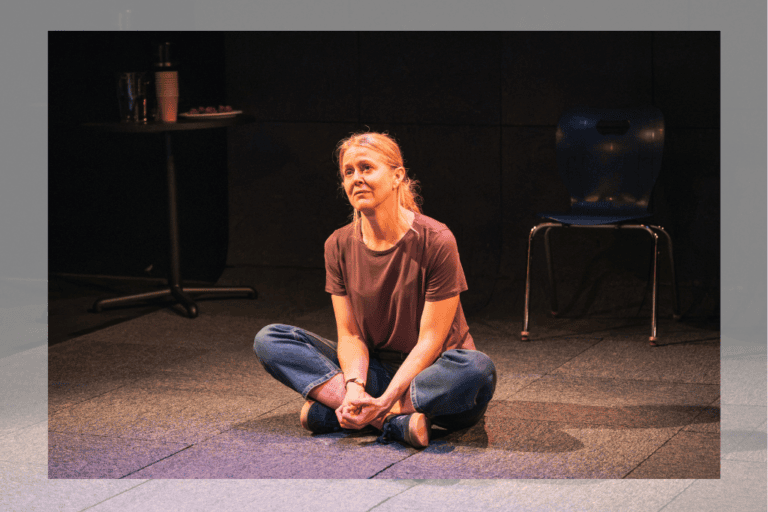 iPhoto caption: Amy Rutherford in 'Pre-Existing Condition.' Photo by Elana Emer.
In an attempt to create an issue-based work with a central everywoman, the play sends the message that we shouldn’t allow domestic violence to define a person while simultaneously staging that definition.
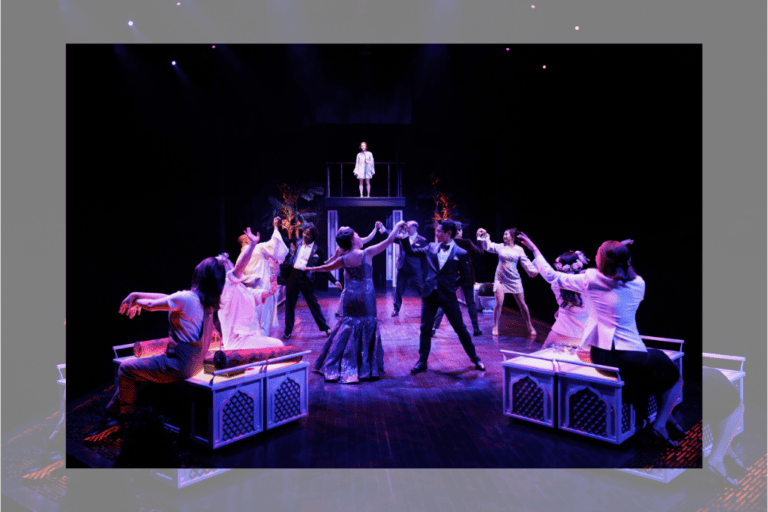 iPhoto caption: Members of the company in 'The Tao of the World.' Stratford Festival 2026. Photo by David Hou.
Set in an opulent world of Singaporean elites, writer-director Jovanni Sy 施崇梵’s world premiere work at the Tom Patterson Theatre is a bubbly, Crazy Rich Asians-style romcom that sweetens the palate before releasing a poignant pop of acidic social commentary, arguing that the concept of restoration is laughable to those who suffered most in the interim and returned to a status quo little better than the disruption.
 iPhoto caption: André Sills and Krystin Pellerin in 'Othello.' Photo by David Hou.
REVIEW: In The Tempest and Othello, the Stratford Festival gets vengeful — and it rocks
The two strong productions, seen as a double bill, make a compelling case against choosing vengeance, with director Haysam Kadri’s Othello an especially riveting and taut interpretation.
 iPhoto caption: Sara Farb and Qasim Khan in 'Funny Girl.' Photo by David Cooper.
REVIEW: Sara Farb shines in Funny Girl at the Shaw Festival
One theme of Funny Girl is acceptance of the self despite its flaws and inconsistencies. The musical, likewise, is full of flaws and inconsistencies, but compelling all the same. Luckily, Sara Farb as Fanny Brice in all her boastful vulnerability gives us that central figure who delights — an umbrella to ward off the rain.
 iPhoto caption: Members of the company of 'Fiddler on the Roof.' Photo by Dahlia Katz.
REVIEW: Exquisite Yiddish Fiddler on the Roof bursts with both elation and pain
The word “Torah” in Hebrew dominates centre stage, constantly illuminated and glowing like an eternal flame. The backdrop’s sanctification, desecration, and resurrection signifies the resilience and endurance of the people before it.
 iPhoto caption: Daniel Maslany and Karl Ang in 'The Division.' Photo by Dahlia Katz.
REVIEW: Andrew Kushnir’s The Division confronts the impossibility of fully knowing the past
Playing at Crow’s Theatre, The Division is a thorny, intimate work of theatre that examines inherited guilt, the relentlessness of eye-for-an-eye justice, and the seductive promise of being able to clearly define and banish evil forever, if only you could choose and label the correct side.
Comments