
REVIEW: Coal Mine’s Pre-Existing Condition is an engaging but contradictory look at the after-effects of domestic violence
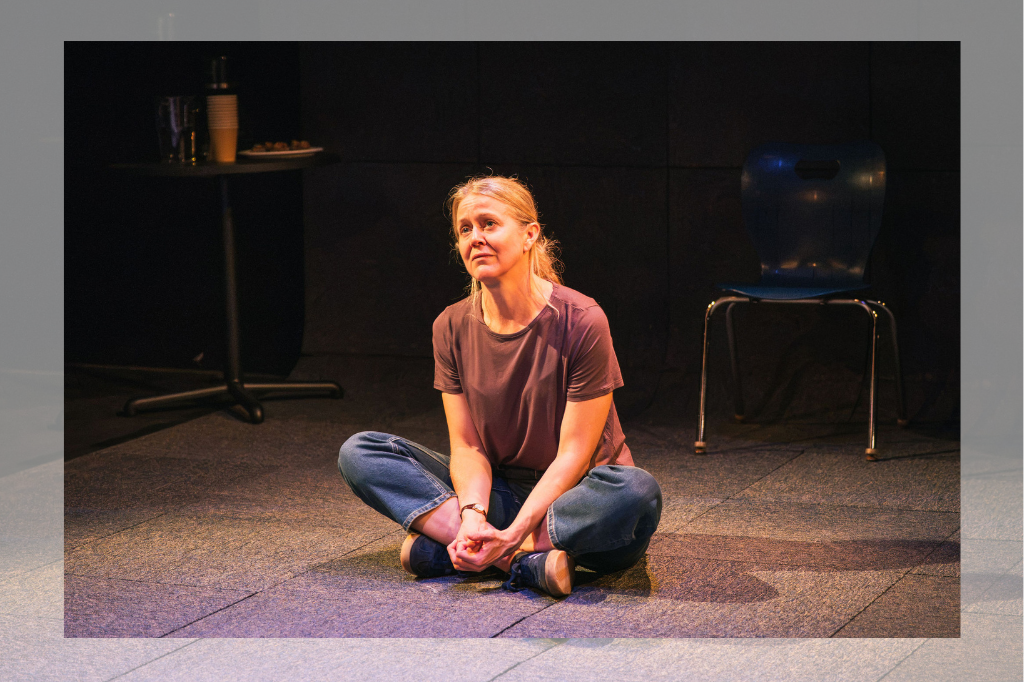 iPhoto caption: Amy Rutherford in 'Pre-Existing Condition.' Photo by Elana Emer.
“I don’t want the big task of my life to be dealing with this,” the main character of Marin Ireland’s unflinching Pre-Existing Condition, playing at Coal Mine Theatre, tells her therapist. “A” (Amy Rutherford) exists uncertainly in the aftermath of intimate partner violence, with a story sad enough to kill the vibe at parties but not adequately tragic to secure legal justice, and too messy to provide the perfect victim narrative everyone seems to require.
As she winds her way through an uncertain future, A finds closure elusive, in part because she can’t even define what she wants it to be. Her ex-boyfriend’s violent actions against her, a serious breach of trust, seem to have permanently altered her state of being, clinging to her self-image and pervading her life like the pre-existing condition of the play’s title. (Ireland’s metaphor also has roots in reality. The U.S.-set play reminds us that prior to the Affordable Care Act, health insurance companies in eight states and the District of Columbia could cite a history of domestic violence in denying victims coverage.)
A 75-minute series of vignettes about trying to reclaim a sense of control, Ireland’s work is brutally resonant when it examines the messy, far-reaching impact of abuse so intimate it even causes dissociation from the communities victims trust most to understand. In the hands of director Linda Kash, Ireland’s fast-paced scenes pulse with fear, anger, and pain, blending into a kaleidoscopic tide of alienation that’s evocatively wrapped in set designer Michelle Tracey’s gray carpeted walls and floor.
At the same time, to show the limitation of A’s world, the play deliberately limits itself; the big task of A’s life may not, at some point, be “dealing with this,” but that’s certainly the task of the play. In an attempt to create an issue-based work with a central everywoman — reducing A to a present-tense, frayed-nerve reactant to her circumstances — it sends the message that we shouldn’t allow domestic violence to define a person while simultaneously staging that definition.
That doesn’t prevent the play from being meaningful or memorable, particularly as an entry-level primer or teaching tool about how American systems treat victims. Beginning with the sound of raw gasping (designed by Heidi Wai Yee Chan), for some the show may feel similarly breathless and shocking; for others, the material may seem nothing new.
In Rutherford’s thoughtful performance, A feels alive and compelling despite the lack of specificity outside the edges of the issue. Rutherford maintains a sort of animated stillness, her character detached and shaken, yet capable of appreciating the ludicrousness of her position with wry humour as she attends group therapy, attempts to date again, or has inane phone conversations with the mother (Philip Riccio) she can’t tell what happened. (Why the production gender-swaps the role of A’s mother in particular is left a mystery in a work that otherwise has a clear point of view about the contribution of gender to the unequal treatment of female domestic violence victims.)
To add to the feeling of overwhelm and dissociation, Ireland deliberately blurs the lines between her characters, particularly the men in A’s life (all also played by Riccio, as D), leading to short stretches where we have to readjust our bearings. Is the man asking for forgiveness A’s abuser, or a family member? Is the incorrigible flirt her first date, or her best friend? Even when the character’s identity becomes clear, the relationship lines sometimes stay blurry; Riccio plays A’s close buddy as vacillating between sweet bestie-ism (a scene where she asks him to listen to and perform her dreaded voicemails is one of the play’s strongest) and creepy reminders of his sexual attraction to her.
As if visually trying to counteract those close lines, Riccio’s characters take up space, sprawling and spreading in contrast to A’s tight body language. In one pitch-perfect visual, his group therapy patient practically slithers off his chair pelvis first as A and Lindsay Leese’s B make eye contact, sharing The Look women exchange behind obnoxious men’s backs. Leese also plays A’s therapist and group therapy moderator, sometimes providing steely support and sometimes giving jargon-filled introductions so earnest they feel like purposeful parody. The unsettling mixture of mocking therapeutic intervention and showing its real benefits feels tonally odd, but also realistic to A’s conflict.
Two of the most memorable scenes occur between Rutherford and Diana Bentley’s C, whose characters provide A with the most encouragement and angst. As a mutual friend who’s sided with A’s abuser and who tries to get A to see things from his perspective, she’s eviscerating; as a would-be mentee, she briefly lets A see beyond A’s constructed walls.
And yet, when A discusses imposter syndrome with this eager woman, we never even find out what job causes this feeling of imposterhood; the conversation turns oblique, as though we’re being kept at arm’s length, too.
The choice to border the otherwise moving play with constraints like these is its own sort of pre-existing condition.
Pre-Existing Condition runs at Coal Mine Theatre until September 27. More information is available here.
Intermission reviews are independent and unrelated to Intermission’s partnered content. Learn more about Intermission’s partnership model here.

Ilana Lucas
Ilana Lucas is a professor of English in Centennial College’s School of Advancement. She is the President of the Canadian Theatre Critics Association. She holds a BA in English and Theatre from Princeton University, an MFA in Dramaturgy and Script Development from Columbia University, and serves as Princeton’s Alumni Schools Committee Chair for Western Ontario. She has written for Brit+Co, Mooney on Theatre, and BroadwayWorld Toronto. Her most recent play, Let’s Talk, won the 2019 Toronto Fringe Festival’s 24-Hour Playwriting Contest. She has a deep and abiding love of musical theatre, and considers her year working for the estate of Tony winners Phyllis Newman and Adolph Green one of her most treasured memories.
LEARN MORE iPhoto caption: Members of the company in 'The Tao of the World.' Stratford Festival 2026. Photo by David Hou.
Set in an opulent world of Singaporean elites, writer-director Jovanni Sy 施崇梵’s world premiere work at the Tom Patterson Theatre is a bubbly, Crazy Rich Asians-style romcom that sweetens the palate before releasing a poignant pop of acidic social commentary, arguing that the concept of restoration is laughable to those who suffered most in the interim and returned to a status quo little better than the disruption.
 iPhoto caption: André Sills and Krystin Pellerin in 'Othello.' Photo by David Hou.
REVIEW: In The Tempest and Othello, the Stratford Festival gets vengeful — and it rocks
The two strong productions, seen as a double bill, make a compelling case against choosing vengeance, with director Haysam Kadri’s Othello an especially riveting and taut interpretation.
 iPhoto caption: Sara Farb and Qasim Khan in 'Funny Girl.' Photo by David Cooper.
REVIEW: Sara Farb shines in Funny Girl at the Shaw Festival
One theme of Funny Girl is acceptance of the self despite its flaws and inconsistencies. The musical, likewise, is full of flaws and inconsistencies, but compelling all the same. Luckily, Sara Farb as Fanny Brice in all her boastful vulnerability gives us that central figure who delights — an umbrella to ward off the rain.
 iPhoto caption: Raymond Strachan and Tom McCamus in 'Death of a Salesman.' Photo by David Hou.
REVIEW: Stratford Festival’s Death of a Salesman is stark and melancholy
The relatively straightforward production is aesthetically austere, but strong central performances of the family at its core keep it human.
 iPhoto caption: Members of the company of 'Fiddler on the Roof.' Photo by Dahlia Katz.
REVIEW: Exquisite Yiddish Fiddler on the Roof bursts with both elation and pain
The word “Torah” in Hebrew dominates centre stage, constantly illuminated and glowing like an eternal flame. The backdrop’s sanctification, desecration, and resurrection signifies the resilience and endurance of the people before it.
 iPhoto caption: Daniel Maslany and Karl Ang in 'The Division.' Photo by Dahlia Katz.
REVIEW: Andrew Kushnir’s The Division confronts the impossibility of fully knowing the past
Playing at Crow’s Theatre, The Division is a thorny, intimate work of theatre that examines inherited guilt, the relentlessness of eye-for-an-eye justice, and the seductive promise of being able to clearly define and banish evil forever, if only you could choose and label the correct side.
Comments