
REVIEW: A sparkling young cast buoys Soulpepper’s slick Spring Awakening
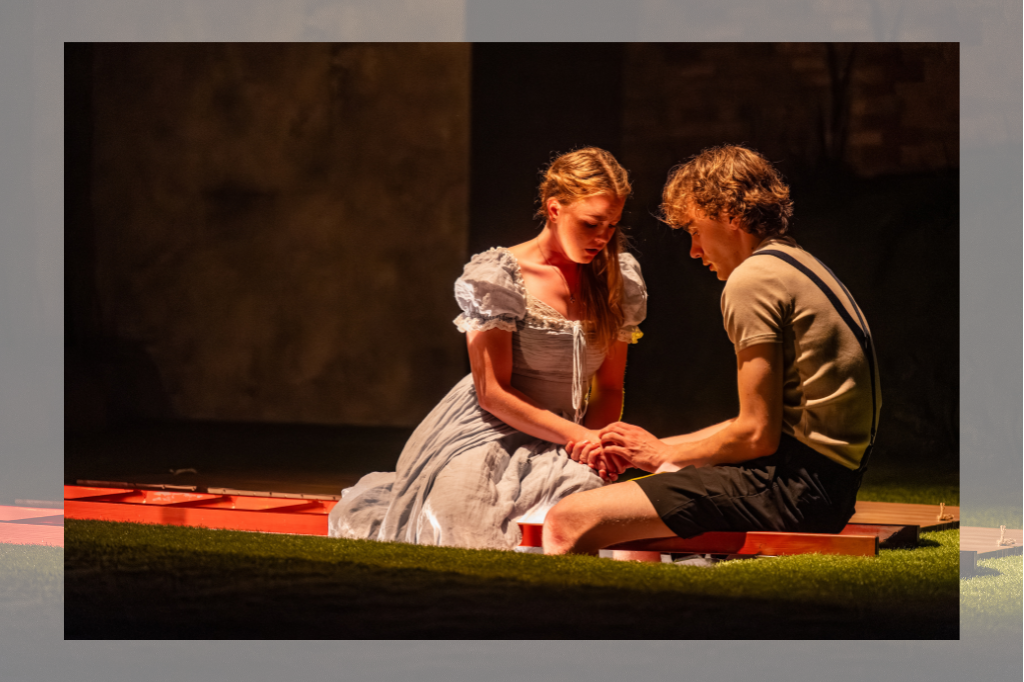 iPhoto caption: Olivia Neary-Hatton and Jake Bunyan in 'Spring Awakening.' Photo by Dahlia Katz.
If knowledge is the best defence, the adults in Frank Wedekind’s 1906 play Spring Awakening hand their children suits of armour perforated with thousands of holes. In their nameless, provincial German village, educational achievement is everything, but none of the lessons hold relevance to the adolescents rapidly coming of age without the tools to understand their changing bodies and feelings.
Soulpepper Theatre’s new artistic director Paolo Santalucia gives the controversial turn-of-the-century play a slick adaptation that feels both of its time and place and modern, still unfortunately relevant during our era’s most recent conservative backlash. Buoyed by its sparkling young cast, Santalucia’s production ably displays how the thrill of discovery and horror of suppression meet when developing adult anatomy pushes up against childhood’s lack of agency.
Spring Awakening predominantly follows the trials of three youths, each searching for meaning instead of expectations. Wendla Bergmann (Olivia Neary-Hatton) chafes against her comfortable and protected existence; despite her unwillingness to graduate to the frumpy gowns of adulthood, she’s desperate to know how her older married sister keeps having babies. Moritz Stiefel (Jake Cohen) teeters on the precipice of becoming the family embarrassment, competing for the last slot in a class his grades may not afford him. And while Melchior (Jake Bunyan) easily finds academic success, he may be too smart for his own good; his disillusionment with authority and religion marks him as a potential danger to the community.
Shannon Lea Doyle’s set design, featuring movable stark grey panels adorned at most with a window or cross, symbolizes the puritanical lifestyle so idealized by the community’s adults and so damaging to its youth. (In one powerful moment, the cross, plucked from the wall, adorns a fresh grave.) Behind the panels, nature blooms, a small terraced hill and tree showing the passage of the seasons as the children find refuge in the woods. These plants will grow, even if hands try to push them back into the earth.
Santalucia’s adaptation condenses the school staff into two roles but expands the institution’s presence, foregrounding added scenes of Diego Matamoros’ Professor Knochenbrüch, a cruel taskmaster, running the students through Latin conjugation and calisthenics with equal fervour. (A slight reverb effect on his dialogue by sound designer Thomas Ryder Payne makes him seem both otherworldly and a little like one of the trombone-voiced adults from Peanuts.)
The added school content foregrounds the male students more heavily in an already lopsided show, making a powerful early scene between Wendla and two female friends (Jasmine Case and Raylene Harewood), where they speak about parental abuse, seem like an outlier. As well, in comparison to the more grounded interactions between the youth, the authority figures appear almost cartoonish at times, particularly in a scene where Knochenbrüch and Daren A. Herbert’s Headmaster Hart-Brand berate Melchior in a one-note shouting match.
More moving are the relationships between the children and the parents (numbers also reduced from the original) who love them, but seem incapable of acting in their best interests. Liisa Repo-Martel as Frau Bergmann seems more childlike than her 14-year-old daughter, fussily playing dress-up with Wendla and shrinking from any questions about reproduction like she’s touched a hot stove. Raquel Duffy plays Melchior’s mother Fanny with a detached and distracted maternal warmth; it’s easy to see why Moritz is so drawn to her, but also how a minute lack of understanding between them could cause one to see an action as a kindness, and the other a betrayal.
While the subject matter of Spring Awakening is dark, that tone isn’t unrelenting; as children find humour in the dark and absurd, so does the surprisingly funny show. Cohen is a wonder as Moritz, blending the pathos of his existential anguish with the physical comedy of his growing desires in a juxtaposition that heightens both emotions. Watching the longing embarrassment flit across his face as his staunchly bohemian friend Ilse (a magnetic Anaka Maharaj-Sandhu) details some of her more lascivious experiences feels painfully familiar.
Cohen also has plenty of chemistry with Bunyan’s charismatic and broody Melchior, who sparks with Neary-Hatton’s fresh-faced Wendla in sexually charged scenes. These scenes read as two young people desperately trying to feel something unprotected and real, whether it’s the sting of a switch against Wendla’s thigh or the scratch of hay against their backs, even if they hurt each other in the process. Their clashes quickly escalate into something more disturbing than titillating or tender, but Bunyan’s intense portrayal of Melchior’s subsequent remorse mitigates that burn into sorrow for two kids who tested their boundaries far past the breaking point.
The third act of Spring Awakening flirts with early Expressionism in its depiction of the fine border between being and nothingness, with Santalucia’s staging bringing in notes of Our Town that serve as a potent reminder of the preciousness and transience of life. Here, Santalucia’s decision to assign Ilse a crucial role cleverly reinforces the play’s presentation of the choice between a bright self-directed future and the comforting stasis of death.
And what of that future?
In a late, tender scene that seems breathtakingly contemporary but belongs to the original play, two schoolboys (Justin Eddy and Noah Beemer) find love and solace in each other; under the delicate, dappled sunlight (designed by Kevin Lamotte), it feels like an offer of healing in a broken world.
When our armour is full of holes, all we can do is dress the wounds underneath.
Spring Awakening runs at Soulpepper Theatre until October 18. More information is available here.
Intermission reviews are independent and unrelated to Intermission’s partnered content. Learn more about Intermission’s partnership model here.

Ilana Lucas
Ilana Lucas is a professor of English in Centennial College’s School of Advancement. She is the President of the Canadian Theatre Critics Association. She holds a BA in English and Theatre from Princeton University, an MFA in Dramaturgy and Script Development from Columbia University, and serves as Princeton’s Alumni Schools Committee Chair for Western Ontario. She has written for Brit+Co, Mooney on Theatre, and BroadwayWorld Toronto. Her most recent play, Let’s Talk, won the 2019 Toronto Fringe Festival’s 24-Hour Playwriting Contest. She has a deep and abiding love of musical theatre, and considers her year working for the estate of Tony winners Phyllis Newman and Adolph Green one of her most treasured memories.
LEARN MORE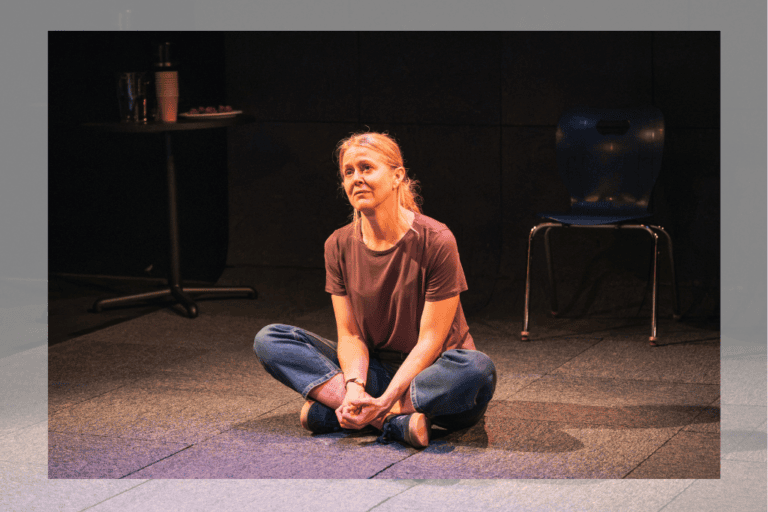 iPhoto caption: Amy Rutherford in 'Pre-Existing Condition.' Photo by Elana Emer.
In an attempt to create an issue-based work with a central everywoman, the play sends the message that we shouldn’t allow domestic violence to define a person while simultaneously staging that definition.
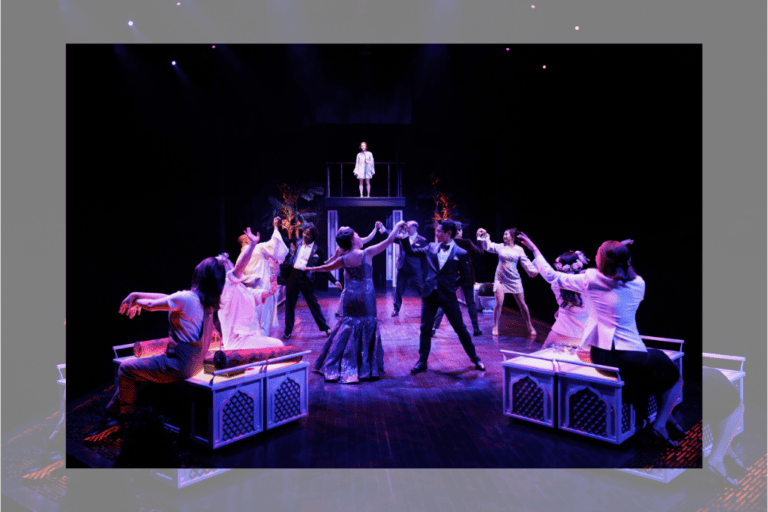 iPhoto caption: Members of the company in 'The Tao of the World.' Stratford Festival 2026. Photo by David Hou.
Set in an opulent world of Singaporean elites, writer-director Jovanni Sy 施崇梵’s world premiere work at the Tom Patterson Theatre is a bubbly, Crazy Rich Asians-style romcom that sweetens the palate before releasing a poignant pop of acidic social commentary, arguing that the concept of restoration is laughable to those who suffered most in the interim and returned to a status quo little better than the disruption.
 iPhoto caption: André Sills and Krystin Pellerin in 'Othello.' Photo by David Hou.
REVIEW: In The Tempest and Othello, the Stratford Festival gets vengeful — and it rocks
The two strong productions, seen as a double bill, make a compelling case against choosing vengeance, with director Haysam Kadri’s Othello an especially riveting and taut interpretation.
 iPhoto caption: Sara Farb and Qasim Khan in 'Funny Girl.' Photo by David Cooper.
REVIEW: Sara Farb shines in Funny Girl at the Shaw Festival
One theme of Funny Girl is acceptance of the self despite its flaws and inconsistencies. The musical, likewise, is full of flaws and inconsistencies, but compelling all the same. Luckily, Sara Farb as Fanny Brice in all her boastful vulnerability gives us that central figure who delights — an umbrella to ward off the rain.
 iPhoto caption: Raymond Strachan and Tom McCamus in 'Death of a Salesman.' Photo by David Hou.
REVIEW: Stratford Festival’s Death of a Salesman is stark and melancholy
The relatively straightforward production is aesthetically austere, but strong central performances of the family at its core keep it human.
 iPhoto caption: Members of the company of 'Fiddler on the Roof.' Photo by Dahlia Katz.
REVIEW: Exquisite Yiddish Fiddler on the Roof bursts with both elation and pain
The word “Torah” in Hebrew dominates centre stage, constantly illuminated and glowing like an eternal flame. The backdrop’s sanctification, desecration, and resurrection signifies the resilience and endurance of the people before it.
Comments