
What’s it like to play Hamlet? Ahead of Fat Ham’s Canadian premiere, Qasim Khan and Peter Fernandes trade tales
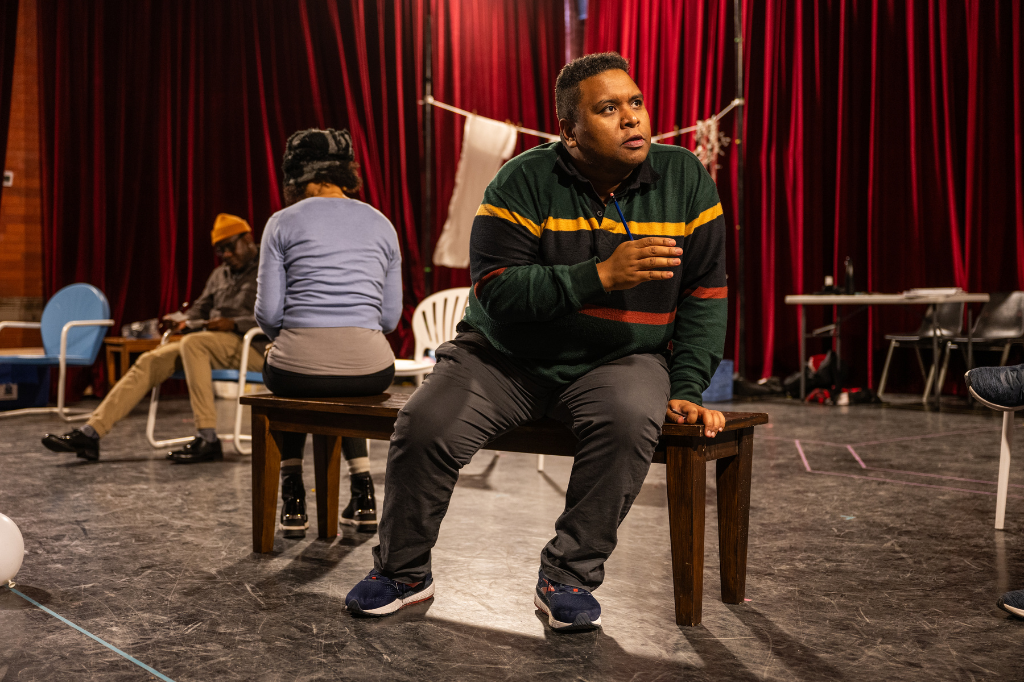
 iPhoto caption: Photo of Peter Fernandes by Lorne Bridgman; photos of Qasim Khan and the Berkeley Street Theatre by Dahlia Katz.
Spend a few months attending shows in a busy English-speaking theatre city, and it’d be tough not to stumble upon a take on Hamlet. Toronto has been particularly productive over the last year, churning out a starry ballet adaptation at the Elgin Theatre, an immersive riff at the Toronto Fringe Festival, a (remounted) solo version at Soulpepper Theatre, and Stoppard with hobbits at the CAA Theatre.
Canadian Stage is doing its part by following up a grief-centred summer High Park Hamlet with the Canadian premiere of James Ijames’ Fat Ham. A contemporary adaptation set at a cookout in the American south, the play won the 2022 Pulitzer Prize for Drama before running on Broadway the following year.
The directors of both productions enlisted performers on hot streaks to play Hamlet. When Qasim Khan played the Dane at High Park, he was coming off back-to-back roles in The Inheritance at Canadian Stage and Hedda Gabler at Coal Mine Theatre. And Peter Fernandes, who plays Fat Ham protagonist Juicy — described by the script’s dramatis personae as “a kind of Hamlet” (as well as “thicc,” “Black,” “beautiful,” “lonely,” and “smart”) — recently appeared in The Bidding War and The Master Plan at Crow’s Theatre, Pollyanna at Theatre Aquarius, One Man, Two Guvnors at the Shaw Festival, and more.
But in a joint interview at Fat Ham’s venue, the Berkeley Street Theatre, both actors emphasized that they hadn’t previously expected to play the infamous soliloquizer.
“I always considered myself way more of a Horatio,” said Fernandes. “I just never thought someone would see me as Hamlet, even though I’m sure part of me would [have loved] to play that part.”
“Even though I thought it would be a cool part to play, like a special kind of experience, I didn’t think it would happen,” agreed Khan, who himself played Horatio at High Park in 2016. But then, after discussing it with Mike Nadajewski, who understudied Hamlet at the Stratford Festival in 2015, Khan began to realize that “Hamlet’s the kind of thing that anyone can play, because there’s so much to relate to.”
When Khan eventually took up the mantle (in a two-hour production that deviated from the original text in decisive ways), he found the character surprisingly actor-friendly. “There’s so much happening to Hamlet in that play,” said Khan. “As central as he is to the story… he’s in response to a world that’s happening around him. So there’s actually less to be intimidated by, because part of the exercise, I found, was to show up open to what was gonna happen from the other characters.”

This friction between people’s expectations around Hamlet and what actually ends up happening onstage came up in our conversation a lot. Fernandes thinks of such dissonance as a big part of Fat Ham’s engine.
“Ijames was butting up against… a lot of what people thought Hamlet was, and he took away things from that, and created a world around it that reflect[s] how Hamlet affected him,” he said. “Those questions of being indecisive are expanded to [Juicy’s] relationship with his sexuality, his relationship with his body, and how both those things exist in that context. And yes, it’s very funny, but, even leading up to me saying it’s funny, those are all very real, visceral experiences that I think a lot of people take away from Hamlet… To be funny is not to be stripped away from the inner turmoil of oneself.”
This balance between comedy and tragedy isn’t just a Fat Ham thing — the High Park Hamlet was pretty funny, too. “The fun of it came from the ensemble, because it was a pretty joyful group of people to be around,” said Khan. “But the other part was that the situations are ridiculous… When someone dies in a family, it pushes the rest of the family to go to such extremes, and in some cases, it goes to really dark places… but then you also see people’s ugliness, and that’s funny.”
“Hamlet’s mom is marrying his uncle, and then he gets visited by a ghost,” said Fernandes. “If you’re saying this in any other context, of course there’s comedy there!”
Next to the irreversibility of death, “human nature, humanity, is laughable,” added Khan. “Sort of like if we look around the world right now… The stuff going on in the States right now is so serious and so scary, but it’s also laughable.”
Fat Ham wouldn’t be a worthwhile adaptation unless it broke from the original in interesting ways. Of Ijames’ many thematic interventions, Fernandes highlights the question of whether violence can ever stop repeating itself.
“It’s great that you brought up the States,” said Fernandes. “I feel like a lot of us are looking at… the cyclical trauma that’s happening — the cyclical nature of history, and that’s on a macro level. And I think we’re experiencing this [personally] as well. So then, how do I break free of that trauma?… How do I make sure that I don’t impart onto the next generation the harm that has been inflicted on me or the people before me?
“These stories are familiar, but part of what Ijames is exploring in a different way is breaking those cycles, and how to do that.”
And this engagement with cross-generational inheritance mirrors the play’s relationship to Shakespeare. “I think the act of taking Hamlet and adapting it in this way is a version of breaking free from those cycles,” said Fernandes. “The text will always be there. It’ll be there. We’re just bringing ourselves to it… In fact, I’m confident that some people who saw your Hamlet will go back to [another version of the play], right?
“For some people in the audience, it was their very first time seeing Hamlet,” responded Khan. “So they got a very clear sense of the story, and, you’re right: they’ll go back.”
“They’ll go back! And then, if that’s their first experience, they’ll be open to experiences like Fat Ham, where it’s not so revered,” said Fernandes. “It’s OK that there’s an adaptation; we can add to the canon. How beautiful to see how somebody else was moved by the piece that moved you.”
Fat Ham runs from February 15 to March 9 at Canadian Stage’s Berkeley Street Theatre. Tickets are available here.
Liam Donovan
Liam is Intermission’s senior editor. He lives in Toronto. His Substack newsletter is available at loamdonovan.substack.com.
LEARN MORE iPhoto caption: 'Golden Rez Dog.' Photo by Philippe Latour.
Creations from Denmark, Hong Kong, Iran, Mexico, and beyond feature in this year’s SummerWorks Performance Festival programming.
 iPhoto caption: Photo by Drew Berry.
REVIEW: An homage to Richard Foreman commands us to change our lives — and our theatre
Richard Foreman's plays usually drew on his personal journals and clocked in around 70 minutes; when he passed away last year at the age of 87, he left behind an invitation for directors to create royalty-free work from those journals. With the recently closed You Must Change Your Life at Toronto’s Alumnae Theatre, creator-director Ilana Khanin took up that offer to ludic, collage-like effect.
 iPhoto caption: Danny O’Mahony and Emily Kilkenny Roddy in 'Bellow.' Photo by Ste Murray.
REVIEW: This year’s Bealtaine Theatre Festival featured accordions, ketamine, and James Joyce
The festival serves up a curated program of contemporary theatre from Ireland — appreciated, in a city that punches below its weight in terms of international performing arts offerings from countries it doesn’t border.
 iPhoto caption: A promo shot for the 2026 Toronto Fringe Festival. Photo by Robbie Harper.
Toronto Fringe reveals 2026 programming
Summer is on the horizon, and that means the Toronto Fringe Festival is too. The annual event’s 38th edition spans 13 days and features 123 shows in 27 venues across the city.
 iPhoto caption: Members of the company of 'Tiger Bride.' Set and costume design by Shannon Lea Doyle, lighting design by Frank Donato. Photo by Dahlia Katz.
Soulpepper’s Tiger Bride offers a ‘wildly transformative’ audience experience, says Hailey Gillis
“It starts out in a hyper-fairy-tale world, and then we slowly, by the end of it, move into a rock-n’-roll basement concert,” says creator-performer Hailey Gillis. “We're just left with guitars and sweaty bodies and loudspeakers."
 iPhoto caption: Lunchbox Theatre's new home. Photo by Hugh Short.
Calgary’s Lunchbox Theatre announces 2026-27 season — and a new home
After nearly two decades at the base of the Calgary Tower, North America’s longest-running lunchtime theatre will now reside in an arts and culture hub called cSPACE Marda Loop.
Comments